Moving to UK checklist: your first week and month
What should you do in your first week in the UK?
Prioritise accessible immigration records, accommodation, employment checks, money access and the right local healthcare registration route. Use the first week and month as suggested planning stages, not legal deadlines. Check the nation-specific rules: England’s right to rent and GP guidance do not describe every UK process.
Plan your arrival with practical steps for paperwork, healthcare, housing and money, plus links to official services.
In this guide
- What should you do in your first week in the UK?
- Before starting: make a simple task and document record
- Check eVisa access and the correct share-code purpose
- Find your National Insurance number or apply if eligible
- Arrange access to money and ask banks about their requirements
- Organise accommodation, local charges and a usable contact number
- Register with a GP and understand the NHS number distinction
- Plan local transport and keep bank-holiday dates separate
- During your first month, check employment and tax paperwork
- Use the full checklist without creating unnecessary dependencies
- Common questions
- Official sources
- Related guides

What should you do in your first week in the UK?
Use your first week to make your status record accessible, organise somewhere to live, prepare employment paperwork, arrange access to money and find the right healthcare registration route. The order below is a suggested plan, not a set of legal deadlines. Move tasks earlier if a job, tenancy or health need requires it.
This moving to UK checklist is for England, Scotland, Wales and Northern Ireland, with national differences flagged. Right to rent checks apply in England only. The detailed GP registration rules quoted here are for England; check your nation’s health service for the local process.
SettleUK is an independent guide, not a government site. We link to official services and our detailed guides. We do not register accounts, approve immigration permission or submit applications for you. Keep personal identity documents in your own secure records.
Before starting: make a simple task and document record
Create a private checklist with columns for the task, official service, documents requested, next action and current status. Mark a task complete when the relevant service confirms it, rather than when you have only opened an account or started filling in a form.
Keep passport and immigration details accessible to you without putting them in a public or widely shared checklist. For a household, separate each person’s tasks. A partner’s registration, account access or identity evidence should not be assumed to cover everyone else.
| Suggested stage | Main task | Useful outcome |
|---|---|---|
| Arrival priorities | Accommodation, phone access and usable funds | Know what still needs arranging |
| Early paperwork | Immigration record and employment checks | Use the correct official route |
| During the first week | Bank enquiries, healthcare and local charges | Know each service’s next action |
| During the first month | Follow up applications and check pay records | Resolve incomplete or incorrect details |
Our settling-in hub gathers the individual guides. Use this page to organise their order, then open the relevant detailed guide when you need a document list or troubleshooting route. Avoid treating the table as a list of eligibility rules.
Check eVisa access and the correct share-code purpose
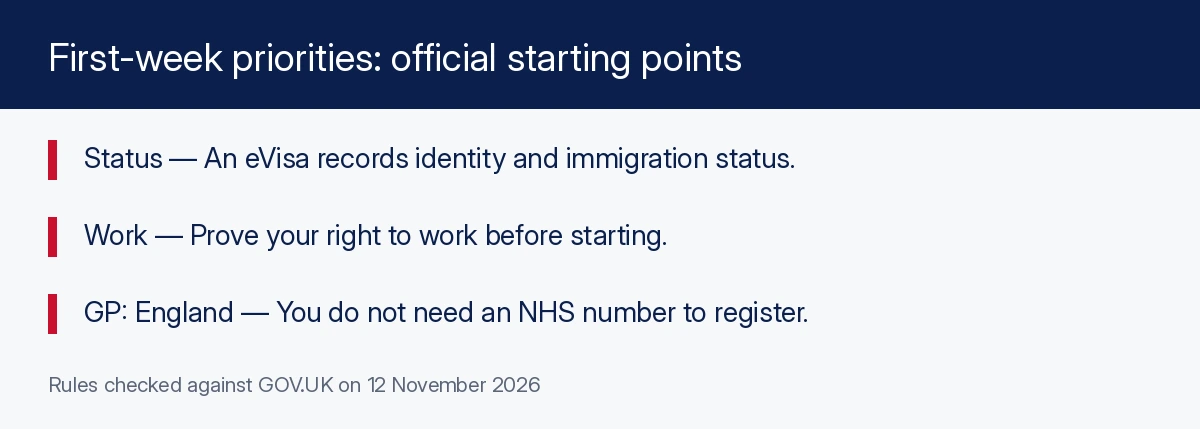
If you have an eVisa, make sure you can reach the digital record through your UKVI account. GOV.UK describes the eVisa as a record of identity, immigration status and conditions, including whether you can work or study. Read what your own record says.
Use our eVisa and UKVI account guide alongside GOV.UK’s eVisa guidance. That is the official starting point for account access, sharing and the linked update or error routes. A SettleUK page is not a replacement login portal.
Before starting work, you must prove your right to work to the employer. GOV.UK says the method depends on nationality and permission. Our right to work share-code guide explains the digital route and the employer’s separate checking step.
For a home in England, check the right to rent guide. GOV.UK says this proof is not required in Scotland, Wales or Northern Ireland. Keep work and rent requests separate instead of assuming a single exchange of documents completes both.
As a practical next action, list any upcoming job or tenancy start date beside the relevant evidence task. That helps you focus on a check needed for a specific event, rather than trying to complete every arrival form at once.
Find your National Insurance number or apply if eligible
Check whether you already have a National Insurance number before applying. GOV.UK says a BRP or eVisa holder might already have one, and the number stays the same for life. Our National Insurance number guide separates finding an existing number from a first application.
The application route is for people living in the UK who have the right to work and are working, looking for work or have an offer. You can only apply once you are in the UK. Use the official eligibility page to check your circumstances.
You can start work before receiving the number if you can prove your right to work. This matters when your job begins soon after arrival: tell the employer which task is pending rather than treating a missing number as a reason to skip the immigration check.
If you have applied, keep the confirmation and reference together and follow any identity instructions. In your checklist, distinguish “application submitted” from “identity completed” and “number received”. That makes a follow-up conversation clearer than marking the whole task complete at the first screen.
Arrange access to money and ask banks about their requirements
GOV.UK’s new-job checklist includes bank details among the information to give an employer for pay. If you need to arrange an account, use our opening a UK bank account guide and ask the bank directly what it accepts in your situation.
As planning advice, make a shortlist based on the way you expect to use the account. Ask about access, charges, identification, address evidence and the next application step. This checklist does not promise that a particular document, visa or accommodation arrangement will be accepted by every bank.
Keep a practical route to essential spending while an application is unresolved. Decide how you will pay for food, local journeys and accommodation using arrangements available to you. Do not build your first-week budget around an assumed account approval or a guessed opening time.
When giving payroll details, check them carefully against the actual account information. Keep the bank application and employer onboarding as separate tasks so that you can see which organisation needs the next response. Ask the bank or employer directly if a requirement is unclear.
For a household, decide who will handle each enquiry and where confirmations will be stored. This is an organisation suggestion, not a statement about account eligibility. Never treat a general arrival checklist as a bank’s final decision about your application.
Organise accommodation, local charges and a usable contact number
Keep the property address, landlord or agent contact and the arrangements you have agreed in one accessible place. If the property is in England, complete the relevant right to rent evidence step. Do not assume that completing an immigration check resolves every other part of renting.
Council Tax guidance covers England, Scotland and Wales. Use our council tax guide and check the service for your address. GOV.UK explains that the bill depends on the property’s band, the council’s charge and any discount or exemption. For Northern Ireland, check the separate local property-charge arrangements.
The GOV.UK Council Tax payment finder explicitly says it is available in England and Wales only. Do not treat that postcode service as a UK-wide payment route. For Scotland or Northern Ireland, check the relevant official local process instead of applying an England-and-Wales link automatically.
For phone or SIM arrangements, compare options against your own needs: usable contact access, coverage where you live, price, contract terms and how you will keep access to important account messages. Check these details before choosing a provider or plan.
Write down any temporary contact arrangements you are using and which services may need an update later. If a form asks for an address or telephone number you cannot provide, ask that service about its alternatives rather than inventing details to finish the form.
Register with a GP and understand the NHS number distinction
For England, NHS registration guidance says everyone can register with a GP surgery for free. Most surgeries allow online registration, and paper registration is another route. Check whether the surgery is accepting patients and whether it covers your area.
The NHS says you do not need ID, proof of address, proof of immigration status or an NHS number to register in England. Extra details may sometimes be requested for other reasons, such as locating records or confirming who is registering a child. Read the actual request rather than assuming a blanket document rule.
Our GP registration guide explains the practical process, while the NHS number guide deals with that separate identifier. Not knowing an NHS number should not be treated as a reason to postpone an England registration.
If you live in Scotland, Wales or Northern Ireland, check the registration instructions from the health service serving that nation. The England-specific document statements above should not be presented as a checked account of every devolved registration procedure.
As a personal preparation step, make a private note of regular medicines, existing care needs and any questions for the surgery. Registering is an administrative task; it does not by itself answer questions about a particular treatment, prescription or healthcare charge.
Plan local transport and keep bank-holiday dates separate
For transport, start with the journeys you actually need: home to work, accommodation to a viewing, or home to a healthcare appointment. Check the relevant operator or official transport service for routes, ticket conditions and current information before committing to a pass.
As planning advice, compare an initial journey cost with a longer-term ticket only once you know your likely travel pattern. This guide does not quote fares, promise discounts or assume that one city’s payment method works across the UK. Confirm details for the route you will use.
Use the 2027 bank holidays guide when planning appointments or travel. This checklist does not reproduce holiday dates or infer service closures. Check the specific service’s opening arrangements when choosing an appointment, rather than assuming a holiday means every service follows the same timetable.
Keep a note of the location and travel plan for any booked appointment. If a task needs original documents, add a reminder to bring the documents that service has actually requested. Avoid carrying your entire personal document folder simply because one appointment needs identification.
During your first month, check employment and tax paperwork
GOV.UK says a new employee should give the employer a P45, or complete the starter checklist if they do not have one. The employer uses the information to work out pay and tax. Use the official new-job steps rather than trying to substitute an unrelated document.
Check your first payslip. GOV.UK says employers must provide one on or before payday, and you are responsible for checking that the tax is correct. Our tax code guide explains where to start if the code looks wrong.
A P60 is different from a starter form. It shows tax paid on salary during the tax year. Read our P60 guide when organising employment records; do not wait for a P60 as if it were a document every newcomer receives immediately after arrival.
For pay questions, use the 2026 minimum wage guide with GOV.UK’s current rates. The official page says the rate depends on age and whether you are an apprentice. Check the rate for your age and apprenticeship circumstances.
At the end of the month, review unresolved applications and corrections, confirm which organisation holds the next action, and keep any references ready. Follow the official service’s help conditions. A suggested monthly review does not replace an actual deadline or a request for evidence.
Use the full checklist without creating unnecessary dependencies
Keep three practical labels: ready to do, waiting for someone else, and confirmed complete. A bank enquiry, an immigration-record correction and a GP registration may be at different stages. The purpose of the checklist is to show the next action without pretending every task must finish in one sequence.
If one task is delayed, check whether the next task really requires it. England GP registration does not require an NHS number, and starting work can be possible before receiving an NI number if right to work is proved. Those verified distinctions prevent avoidable waiting.
Save this first-week UK checklist for your own planning and return to the detailed guides as needed. Confirm phone, bank and transport requirements with the provider you plan to use.
Where your circumstances differ from a straightforward example, use the linked official guidance and explain the exact problem to the relevant service. This page cannot determine immigration permission, bank eligibility, healthcare charging or a local bill. Keep confirmed rules separate from questions still awaiting an answer.
Common questions
Is this a list of legal first-week deadlines?
No. The week and month labels are suggested planning stages. Actual deadlines, eligibility and evidence requests come from the relevant official service, employer or provider.
Can I start work before my NI number arrives?
Yes, if you can prove your right to work in the UK. GOV.UK separates that employment check from receiving a National Insurance number.
Do I need an NHS number to register with a GP?
In England, no. NHS guidance says you do not need an NHS number, ID, proof of address or proof of immigration status to register. Check local official instructions in the other UK nations.
Do right to rent checks apply in Scotland?
No. GOV.UK says proof of right to rent is not required in Scotland, Wales or Northern Ireland. The scheme covered by our guide applies in England.
Should I wait for a P60 before starting a job?
A P60 is a tax-year record, not the new-job starter document. GOV.UK’s new-job guidance says to give the employer a P45 or use the starter checklist if you do not have one.
Can I use this checklist to choose a bank or mobile contract?
Use its questions to organise enquiries, then check the provider’s current terms and requirements. It does not promise approval, a document list accepted by every bank, or a particular phone plan.
Does the Council Tax payment link cover all four nations?
No. The GOV.UK payment finder used here says it is available in England and Wales only. Check the appropriate official local process for Scotland or Northern Ireland.
Official sources
- What an eVisa is — GOV.UK · Checked 2026-11-12
- Prove your right to work — GOV.UK · Checked 2026-11-12
- Apply for a National Insurance number — GOV.UK · Checked 2026-11-12
- Prove your right to rent in England — GOV.UK · Checked 2026-11-12
- Start a new job: step by step — GOV.UK · Checked 2026-11-12
- Register with a GP surgery in England — NHS · Checked 2026-11-12
- How Council Tax works — GOV.UK · Checked 2026-11-12
- Your P60 — GOV.UK · Checked 2026-11-12
- National Minimum Wage and National Living Wage rates — GOV.UK · Checked 2026-11-12
- Pay Council Tax: England and Wales service — GOV.UK · Checked 2026-11-12
SettleUK is an independent guide. It is not a government website and is not affiliated with GOV.UK, DWP, HMRC or the NHS.