NHS number: how to find yours and when you need it
What is an NHS number and how do I find mine?
An NHS number is a unique 10-digit identifier used in England and Wales to match you to health records. In England, find it in the NHS App, NHS website account, NHS letters or through your GP. You do not need to know it to use NHS services. Scotland and Northern Ireland use separate local identifiers.
Find an existing number without delaying registration, and use the right route for England, Wales, Scotland or Northern Ireland.
In this guide
- What is an NHS number and how do I find mine?
- Recognise the number without guessing
- Look in the NHS App or NHS website account
- Check letters, prescriptions and test results
- Ask your GP surgery and check identity details
- New to the NHS: registration comes first
- Moving home, Wales and missing medical cards
- Scotland: ask about your CHI number
- Northern Ireland: Health and Care number
- If you cannot find a number or details look wrong
- Common questions
- Official sources
- Related guides

What is an NHS number and how do I find mine?
An NHS number is a unique 10-digit number used to identify you and match your details to your health records. In England, look in the NHS App or your NHS website account. You can also check NHS letters or prescriptions, or ask your GP surgery. You do not need to know the number to use NHS services.
This guide explains the NHS number used in England and Wales, with separate signposts for Scotland's Community Health Index (CHI) and Northern Ireland's Health and Care number. Do not assume that the same online account or identifier applies in every part of the UK.
SettleUK is an independent guide, not a government site. Use the official links to access your own details, and ask your healthcare provider if something does not match. This page cannot look up, issue or correct a number for you.
Finding a number and establishing entitlement to treatment are different tasks. The NHS expressly says having a number does not automatically entitle you to free use of every NHS service. Check any charges with the provider.
Recognise the number without guessing
The NHS explanation describes a 10-digit number unique to you. Healthcare staff use it to identify you correctly and match information with your health records. Look for the label “NHS number” on your own correspondence.
A hospital letter can contain several references. Rather than selecting a number because it looks familiar, check its label. If you cannot tell which reference the form wants, ask the service that issued the letter or is requesting the information.
Copy the number carefully from a reliable NHS record. Do not use an example number from a website, a relative's number or a reference that you have guessed. If a document is hard to read, look for another NHS letter or contact your surgery.
- Check that the correspondence is addressed to the correct person.
- Find the specific NHS number label rather than relying on position on the page.
- Compare the digits when copying into a form.
- Ask the practice if your documents appear inconsistent.
These are practical checking steps rather than extra registration requirements. In England, a missing number does not prevent you from applying to join a GP surgery.
Look in the NHS App or NHS website account
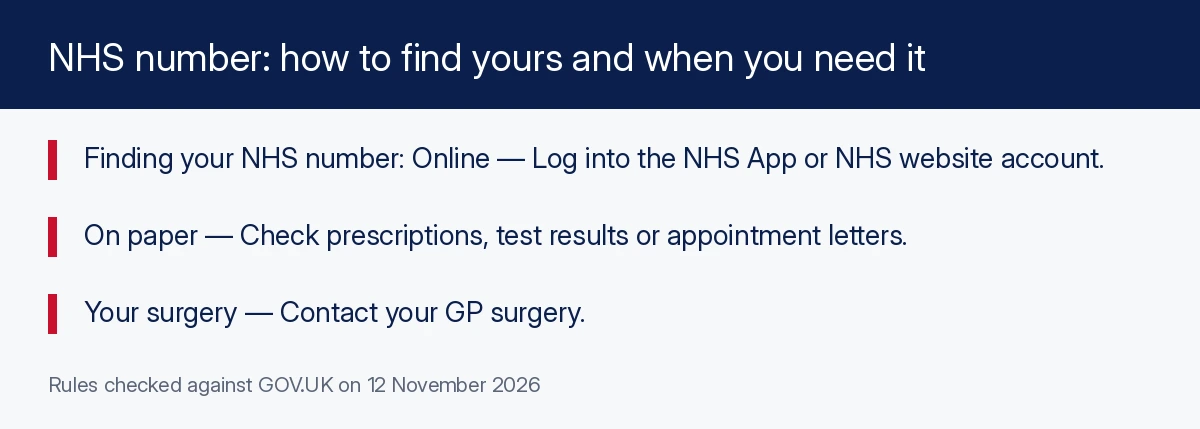
For England, the current NHS guidance on finding your number says you can find your number by logging into the NHS App or your account on the NHS website. Start from the NHS website if you need the official sign-in route.
The NHS also lists some GP online services as places where the number may be available. Availability depends on the service you use. If it is not obvious in your account, use your NHS correspondence or ask the surgery rather than assuming the number does not exist.
You need to register for the NHS App if you have not used it before. The GP registration guidance says you must already be registered with a GP surgery to use the App. Do not postpone your first GP registration because you cannot yet access it.
- Open the official NHS App or follow the account link from NHS.uk.
- Use the sign-in instructions for your own account.
- Look for your NHS number in the information available to you.
- If you cannot access the account, switch to letters or contact the surgery.
Follow the current NHS instructions to sign in. If you are new to the NHS, register with a GP first; an online account is a separate step.
Check letters, prescriptions and test results
You do not need an app to find an NHS number. The NHS lists prescriptions, test results, hospital referral letters and appointment letters as places to look. Search your own healthcare paperwork before beginning a new account-registration process just to retrieve the number.
| Where to look | What to check |
|---|---|
| Prescription | The patient's details and NHS number label |
| Test result | That the result belongs to the person whose number is needed |
| Hospital referral letter | The NHS number rather than another reference |
| Appointment letter | The name and personal details alongside the number |
Check digital copies as well as paper letters if you have them. A document saved from a previous appointment may be easier to access than an online account you have not used recently. Treat it as personal health information when storing or sharing it.
If you are helping a family member, keep each person's records separate. Read the name and date of birth before copying a number onto their form. Ask the practice how to help where the patient cannot manage the request themselves.
A missing letter is not a reason to invent a replacement number. The GP surgery is another official route for finding an existing number.
Ask your GP surgery and check identity details
The NHS says you can call your GP surgery and ask for your NHS number. You may need to prove your identity over the phone or visit with proof of identity. Ask the surgery what it requires before making a journey.
This identity check concerns releasing information from an existing record. It is separate from the NHS guidance that ID is not needed to register with a GP in England. A request for proof during a number enquiry does not change the registration rule.
- Contact the surgery using its published contact details.
- Explain that you are trying to find your NHS number.
- Follow the practice's instructions for confirming your identity.
- Check your name, date of birth and address if the record cannot be located.
Prepare previous details if your name or address has changed, and explain the change rather than assuming the practice has every update. The England registration page says to tell your surgery directly about changes to your address or other personal details.
If you have never registered with a GP, explain that instead of repeatedly asking a practice to search an unknown record. Read the next section about obtaining a number through registration, or use our GP registration guide.
New to the NHS: registration comes first
You should have an NHS number if you registered for NHS care in England, Wales or the Isle of Man. The NHS says a number is assigned soon after birth or the first time you get NHS care or treatment.
If you have never had NHS care or treatment, you can register with a GP surgery to get a number. The NHS says one will be assigned during registration if you do not already have one, and your registration letter will show it.
Do not interpret a blank NHS number field as a reason to abandon an application. Explain that you do not know the number or have never been assigned one, then follow the form or practice's instructions.
In England, the NHS also says you do not need ID, proof of address or proof of immigration status to register. Those are England-specific registration instructions. Elsewhere, ask the relevant national service or practice about its own process.
Write down questions about registration and number allocation separately. This helps reception understand whether you need to join the practice, locate an existing record, or simply retrieve information from it.
Moving home, Wales and missing medical cards
The NHS says your number is normally valid for life. Its guidance identifies exceptions where a new number may be assigned, such as adoption or gender reassignment. Moving home alone is not listed as a reason to apply for a new number.
If you are moving, give the new practice accurate information about your previous GP and existing NHS number if known. In England, you do not need to notify the old practice when changing surgery; it is informed after the new registration.
The NHS number guidance includes people registered for NHS care in Wales. However, the England NHS App and online registration instructions in this guide should not be treated as a promise that every digital route works for a Welsh practice.
Ask your Welsh GP about finding your number or accessing your record if you cannot use the route described. NHS letters and the practice remain useful starting points for identifying the patient information that a form requests.
In England, medical cards showing your NHS number are no longer sent out. The NHS says that if you lost an old card, you do not need a replacement. Find the number through another official route instead.
Before requesting any replacement paperwork, ask what the receiving service actually needs. It may be asking for the number rather than a historical card. Keep your explanation focused on that request.
Scotland: ask about your CHI number
In Scotland, the identifier to ask about is the Community Health Index, commonly called CHI. The Scottish Government's published CHI correspondence record confirms that terminology. Do not assume an England NHS number search is a Scottish CHI lookup.
Contact your Scottish GP practice or the healthcare service asking for the identifier. Ask where to find your CHI number on your own records and how it wants the information supplied. This guide does not provide an online CHI retrieval tool.
If a form asks for a CHI number you cannot find, explain this to your Scottish practice. Ask staff to help locate the correct record and confirm what to enter.
- Tell the practice if you previously received care elsewhere in the UK.
- Keep any existing healthcare identifiers and correspondence available.
- Ask which identifier the particular form requires.
- Let the healthcare service resolve uncertainty about matching records.
Do not alter an existing number to make it fit another nation's form. Asking the provider which identifier it needs is safer than trying to convert numbers yourself.
Northern Ireland: Health and Care number
Northern Ireland's Business Services Organisation publishes guidance on Health and Care Numbers, referred to as HCN in its practitioner guidance. You may also see the term H&C number. Ask your local service which identifier it requires.
The BSO guidance tells practices to obtain the patient's number directly where possible, using a medical card if the patient has one. It also emphasises checking exact names and dates of birth when a record cannot be found.
The helpline on that page is for practices using the claims system. As a patient, contact your practice or follow BSO’s public medical-card instructions.
The BSO public registration page offers a route to report an address change or request a medical card for Northern Ireland residents already registered with a GP. People not registered should follow its GP registration instructions.
Do not apply England's statement about medical cards no longer being issued to Northern Ireland. Follow the local public guidance, and explain whether you are registered already or are arriving and need to join a practice.
If you cannot find a number or details look wrong
The NHS says you do not need your NHS number to use NHS services. If you are denied care because you do not know it or do not have one, its guidance suggests considering a complaint through NHS England's feedback and complaints route.
First explain the immediate problem clearly: you may have a number but cannot locate it, or you may never have used NHS care. Ask the provider to help identify the right next step instead of submitting guessed information.
If two documents show conflicting details, contact your GP or the issuing service. Keep the documents available so staff can investigate. This guide cannot decide which record is correct or promise how quickly an administrative issue will be resolved.
- Try the NHS App or NHS website account if you can access it.
- Check prescriptions, test results and appointment or referral letters.
- Ask your GP surgery and follow any identity-check instructions.
- Register with a GP if you have never had NHS care.
- Use Scottish or Northern Irish routes for local identifiers.
Need to join a surgery?
Follow the registration route for the UK nation where you live.
Register with a GPCommon questions
How many digits does an NHS number have?
An NHS number has 10 digits and is unique to you.
Can I still use the Find your NHS number service?
The NHS says the standalone service is no longer available. Use the NHS App or NHS website account, NHS correspondence or your GP surgery.
Do I need it to register with a GP?
No, in England. The NHS says it can help locate medical records, but you do not need one to register.
Where can I find it without an app?
Look on NHS prescriptions, test results, hospital referral letters and appointment letters, or contact your GP surgery.
Does a number mean all NHS treatment is free?
No. The NHS says having a number does not automatically entitle you to free use of all NHS services.
Do I need a replacement NHS medical card in England?
No. NHS medical cards are no longer sent out in England, and the NHS says you do not need to replace a lost one.
What should I ask for in Scotland?
Ask your Scottish healthcare provider about your Community Health Index or CHI number. Confirm which identifier a form requires.
Official sources
- What is an NHS number? — NHS · Checked 2026-11-12
- Find your NHS number — NHS · Checked 2026-11-12
- Register with a GP surgery — NHS · Checked 2026-11-12
- Community Health Index (CHI) numbers — Scottish Government · Checked 2026-11-12
- Health and Care Numbers — Business Services Organisation · Checked 2026-11-12
- General public information: GP registrations — Business Services Organisation · Checked 2026-11-12
SettleUK is an independent guide. It is not a government website and is not affiliated with GOV.UK, DWP, HMRC or the NHS.