DWP payment dates: benefits and bank holidays 2026–27
When are DWP payment dates and HMRC benefit payments?
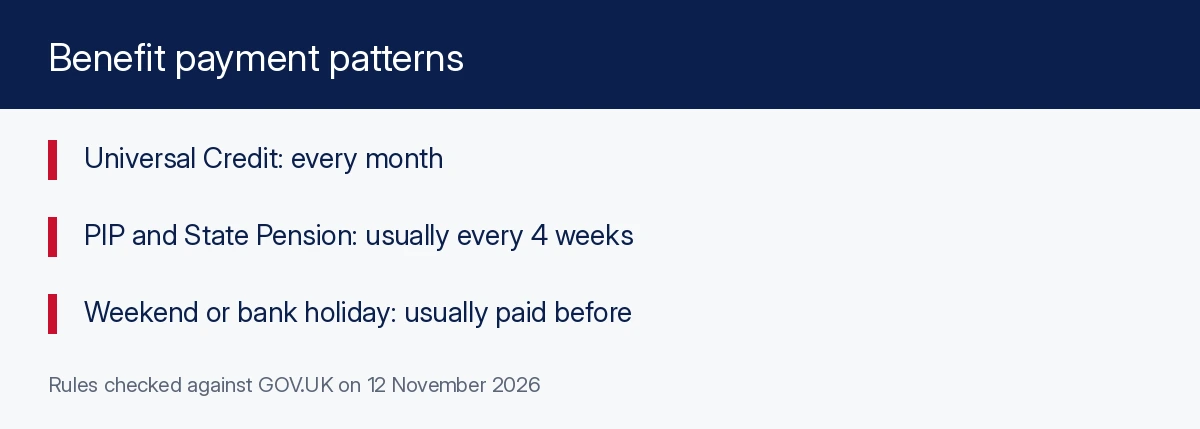
Your benefit determines your payment pattern. Universal Credit is normally monthly; State Pension and PIP are usually four-weekly. Payments due on weekends or bank holidays usually arrive on the working day before, but Child Benefit can differ. Check your own award or statement.
Find your benefit’s normal payment pattern, check official UK holiday calendars and follow the right contact route if money is missing.
In this guide
- When are DWP payment dates and HMRC benefit payments?
- How often is each benefit paid?
- How do you find your own next payment?
- What happens on weekends and bank holidays?
- Which bank holidays are coming in 2026 and 2027?
- How are Universal Credit payment dates set?
- What should pensioners and disability claimants check?
- What about Child Benefit, tax credits and winter help?
- What should you do if a benefit payment is late?
- How can you keep a reliable payment calendar?
- Common questions
- Official sources
- Related guides

When are DWP payment dates and HMRC benefit payments?
DWP payment dates depend on which benefit you receive and the payment pattern recorded on your claim. Universal Credit is normally monthly. State Pension, Personal Independence Payment and Pension Credit are usually paid every four weeks. Child Benefit is an HMRC payment with its own arrangements.
This guide covers England, Wales, Scotland and Northern Ireland, with differences flagged below. Use it to identify the right payment calendar before checking your own award letter or online account. SettleUK is an independent guide, not a government site.
There is no single payday shared by everyone receiving benefits. A calendar showing a bank holiday tells you when the holiday falls; it does not establish that your own benefit is due that day. Start with the payment date on your claim, then check the relevant official holiday guidance.
If you searched for “DWP revised payment dates”, first decide whether you need a regular payment frequency, a holiday adjustment or help with money that has not arrived. Those are different questions. The benefit-specific guides linked in the table will help you follow the right route.
How often is each benefit paid?
The table shows the usual payment patterns listed on GOV.UK. Your award letter or current statement gives the arrangement for your claim, including any agreed change to how often you are paid. Use that record to find your next payment.
A four-weekly benefit is not a monthly benefit. Keep the description used in your award when putting future entries in a diary. For seasonal help, check the individual guide instead of assuming it follows a regular pension or allowance cycle.
| Benefit | Official frequency | Detailed guide |
|---|---|---|
| Universal Credit | Every month | Universal Credit payment dates |
| State Pension | Usually every 4 weeks | State Pension payment dates |
| Personal Independence Payment (PIP) | Usually every 4 weeks | Personal Independence Payment (PIP) payment dates |
| Child Benefit | Usually every 4 weeks; weekly in some cases | Child Benefit payment dates |
| Carer’s Allowance | Weekly in advance or every 4 weeks | Carer’s Allowance payment dates |
| Employment and Support Allowance (ESA) | Usually every 2 weeks | Employment and Support Allowance (ESA) payment dates |
| Jobseeker’s Allowance (JSA) | Usually every 2 weeks | Jobseeker’s Allowance (JSA) payment dates |
| Pension Credit | Usually every 4 weeks | Pension Credit payment dates |
Attendance Allowance and Disability Living Allowance are usually paid every four weeks. Maternity Allowance is paid every two or four weeks. These are separate payments, so record them separately if you receive more than one benefit. Do not assume they will arrive together simply because their frequency looks similar.
| Other payment guides | Timing check |
|---|---|
| Winter Fuel Payment | Check the official guidance for your nation |
| Cold Weather Payment | Check the official guidance for your nation |
How do you find your own next payment?
Gather your most recent award letter, payment statement and bank entry. Write down the benefit name, the date it was expected and the date it actually arrived. If an earlier payment was moved for a bank holiday, keep that distinction visible before setting a repeating diary reminder.
For Universal Credit, your online account shows a monthly statement explaining how much you will get. For PIP, the decision letter gives the first payment date and the weekday you will usually be paid. These are more useful than a generic calendar when establishing a personal schedule.
Keep different benefits on different lines. For example, a household checking Universal Credit and Child Benefit should look up both rules. An early payment of one benefit does not demonstrate that the other payment is missing or that both have moved.
As a planning habit, save the official page you checked and note when you checked it. If the date in your letter and the payment history do not appear to match, ask the office paying that benefit to explain the schedule before relying on a calculation.
What happens on weekends and bank holidays?
GOV.UK says that, if a benefit payment date falls on a weekend or bank holiday, you will usually be paid on the working day before. Its general guide expressly says this may be different for Child Benefit. Follow the Child Benefit guide for HMRC-specific instructions.
The rule concerns a payment that is actually due on the affected day. It does not mean every claimant gets money early whenever there is a holiday. Check your normal date first, and avoid treating a seasonal headline as a replacement for your personal payment information.
When you receive money earlier than expected, label it against the payment it belongs to in your budget. As a practical precaution, confirm the following expected payment before making new spending commitments. An earlier bank entry alone does not show that your entitlement has increased.
Use our bank-holiday guide for the national calendars, and the Christmas guide for the festive period. Exact payment instructions should come from the relevant benefit service. The holiday calendar below is evidence of holidays, not a DWP or HMRC announcement of everyone’s revised payday.
Which bank holidays are coming in 2026 and 2027?
These are the remaining holidays from 12 November 2026 and the 2027 entries in the official GOV.UK bank-holiday calendar. England and Wales share one calendar. Scotland and Northern Ireland have separate entries. Read the row for the relevant nation rather than assuming every UK holiday applies everywhere.
The dates below are holiday dates only. For each entry, check whether your own normal payment is due then. Apply the relevant benefit’s published rule and check any specific notice; this table deliberately does not manufacture revised payment dates.
England and Wales
| Bank holiday date | Official holiday name |
|---|---|
| 2026-12-25 | Christmas Day |
| 2026-12-28 | Boxing Day (substitute day) |
| 2027-01-01 | New Year’s Day |
| 2027-03-26 | Good Friday |
| 2027-03-29 | Easter Monday |
| 2027-05-03 | Early May bank holiday |
| 2027-05-31 | Spring bank holiday |
| 2027-08-30 | Summer bank holiday |
| 2027-12-27 | Christmas Day (substitute day) |
| 2027-12-28 | Boxing Day (substitute day) |
Scotland
| Bank holiday date | Official holiday name |
|---|---|
| 2026-11-30 | St Andrew’s Day |
| 2026-12-25 | Christmas Day |
| 2026-12-28 | Boxing Day (substitute day) |
| 2027-01-01 | New Year’s Day |
| 2027-01-04 | 2nd January (substitute day) |
| 2027-03-26 | Good Friday |
| 2027-05-03 | Early May bank holiday |
| 2027-05-31 | Spring bank holiday |
| 2027-08-02 | Summer bank holiday |
| 2027-11-30 | St Andrew’s Day |
| 2027-12-27 | Christmas Day (substitute day) |
| 2027-12-28 | Boxing Day (substitute day) |
Northern Ireland
| Bank holiday date | Official holiday name |
|---|---|
| 2026-12-25 | Christmas Day |
| 2026-12-28 | Boxing Day (substitute day) |
| 2027-01-01 | New Year’s Day |
| 2027-03-17 | St Patrick’s Day |
| 2027-03-26 | Good Friday |
| 2027-03-29 | Easter Monday |
| 2027-05-03 | Early May bank holiday |
| 2027-05-31 | Spring bank holiday |
| 2027-07-12 | Battle of the Boyne (Orangemen’s Day) |
| 2027-08-30 | Summer bank holiday |
| 2027-12-27 | Christmas Day (substitute day) |
| 2027-12-28 | Boxing Day (substitute day) |
How are Universal Credit payment dates set?
Universal Credit is normally paid once a month. Your first assessment period begins on the day you make your claim. You usually receive payment seven days after each monthly assessment period ends, and the first payment usually takes around five weeks.
After the first payment, the normal payment date is the same date each month. A weekend or bank holiday moves it to the working day before. Check your online statement to see the amount; knowing the date alone does not tell you what your award will be.
In Scotland you can be paid once or twice a month. New claimants receive a notification about this after their first payment. Northern Ireland has separate payment arrangements: follow the Northern Ireland information linked from GOV.UK rather than assuming the standard monthly pattern applies.
If the first-payment wait is the problem, read the official advance guidance before borrowing. An advance is a separate question from a revised bank-holiday payday. Our Universal Credit guide explains how to check assessment periods, statements and the contact route together.
What should pensioners and disability claimants check?
State Pension is usually paid every four weeks. For the new State Pension, use the dedicated guide to check how the National Insurance number relates to the normal weekday. Do not use a Universal Credit monthly calendar to predict pension payments.
PIP is usually paid every four weeks. Its decision letter tells you the first payment date, usual payment weekday, award duration and when a review may happen. The official PIP page says a payment due on a bank holiday will usually be paid before it.
Scotland has Adult Disability Payment administered through its own system. If your correspondence names Adult Disability Payment, use Social Security Scotland guidance for that award rather than treating a PIP article as your personal payment timetable.
Pension Credit and State Pension should also be checked separately, even though both are usually four-weekly. Keep the benefit names with the corresponding bank entries when asking about missing money. This makes it easier to describe exactly which payment needs checking.
What about Child Benefit, tax credits and winter help?
Child Benefit is usually paid every four weeks. Weekly payments are available in some circumstances, including being a single parent or receiving certain benefits. HMRC is the relevant service, so a question about Child Benefit should not automatically be directed to a DWP benefit office.
Tax credits ended on 5 April 2025. GOV.UK says you cannot make a new claim for Child Tax Credit or Working Tax Credit. Do not use an old tax-credit payment calendar as a schedule for ongoing payments in the Christmas 2026 period.
For Winter Fuel Payment and Cold Weather Payment, follow the separate guides and check the official service covering your nation. Do not add either to your regular diary on the assumption that it arrives with State Pension, PIP or Universal Credit.
The same practical distinction applies to Christmas support: an ordinary benefit arriving early and a separate bonus have different rules. Read the Christmas guide for verified holiday entries and the official bonus source before including additional money in your household budget.
What should you do if a benefit payment is late?
First check which benefit is missing, the expected date and whether a holiday adjustment applies. Look at the actual bank transactions alongside your award or statement. If your concern is the amount rather than the date, make that clear when contacting the paying office.
For Universal Credit, sign in to your online account to contact the service. If you cannot use the account, follow the helpline link on GOV.UK. For existing JSA or ESA claims in Great Britain, the official Jobcentre Plus contact page lists the appropriate contact route.
Northern Ireland JSA enquiries go to the Jobs and Benefits office, and ESA enquiries to the ESA Centre, as the GOV.UK contact page explains. For PIP, pensions or Child Benefit, use the contact details for that particular payment instead of assuming Jobcentre Plus handles everything.
Have your National Insurance number ready when calling the numbers on the Jobcentre Plus contact page. As a practical checklist, also keep the payment date, relevant letter and bank entry in front of you. Ask what has happened, whether action is required and how the next payment will be handled.
How can you keep a reliable payment calendar?
Use this hub as a route to the right guide rather than a universal payday list. Record the normal date, any officially confirmed change and the next expected payment separately. This makes it easier to review a holiday period without losing the underlying payment pattern.
Before a holiday, check essential spending against money already received and the next confirmed payment. If you are unsure about the date, seek confirmation from the paying service. Avoid promising a bill payment based solely on a general bank-holiday rule or another person’s experience.
Review the national holiday list when planning across the year boundary. Scotland’s January entries differ from those for England and Wales, and Northern Ireland has its own additional holidays. The official calendar is useful context, while your benefit service remains the source for claim-specific payment instructions.
For a focused next step, choose the guide matching the name on your award. Use the Christmas and bank-holiday pages when the normal date overlaps a holiday, and return to the official account or contact route whenever your own payment record needs clarification.
Common questions
Does everyone have the same DWP payday?
No. Payment frequency and personal dates depend on the benefit and your claim. Check your letter or online statement.
Are benefits paid early on bank holidays?
Usually, a payment due on a weekend or bank holiday is paid on the working day before. GOV.UK notes that Child Benefit may differ.
Is four-weekly the same as monthly?
No. Use the frequency stated for your benefit. Universal Credit is normally monthly; PIP and State Pension are usually every four weeks.
Where can I see my Universal Credit statement?
Sign in to your Universal Credit online account. GOV.UK says your monthly statement tells you how much you will receive.
Are tax credits still paid regularly?
Tax credits ended on 5 April 2025. Follow GOV.UK guidance about finalising an old award rather than an old payment calendar.
Who should I contact about a missing payment?
Contact the service paying the benefit. Universal Credit has an online account contact route; Child Benefit is handled by HMRC. Northern Ireland has separate routes for JSA and ESA.
Official sources
- How and when your benefits are paid — GOV.UK · Checked 2026-11-12
- Universal Credit — GOV.UK · Checked 2026-11-12
- The new State Pension — GOV.UK · Checked 2026-11-12
- Personal Independence Payment (PIP) — GOV.UK · Checked 2026-11-12
- Child Benefit — GOV.UK · Checked 2026-11-12
- Contact Jobcentre Plus — GOV.UK · Checked 2026-11-12
- Tax credits ended on 5 April 2025 — GOV.UK · Checked 2026-11-12
- What Adult Disability Payment is — mygov.scot · Checked 2026-11-12
- Bank Holidays — official guidance — GOV.UK · Checked 2026-11-12
- The new State Pension: when you are paid — GOV.UK · Checked 2026-11-12
SettleUK is an independent guide. It is not a government website and is not affiliated with GOV.UK, DWP, HMRC or the NHS.