Cold weather payment: 2026 to 2027 dates and eligibility
When do you get a Cold Weather Payment?
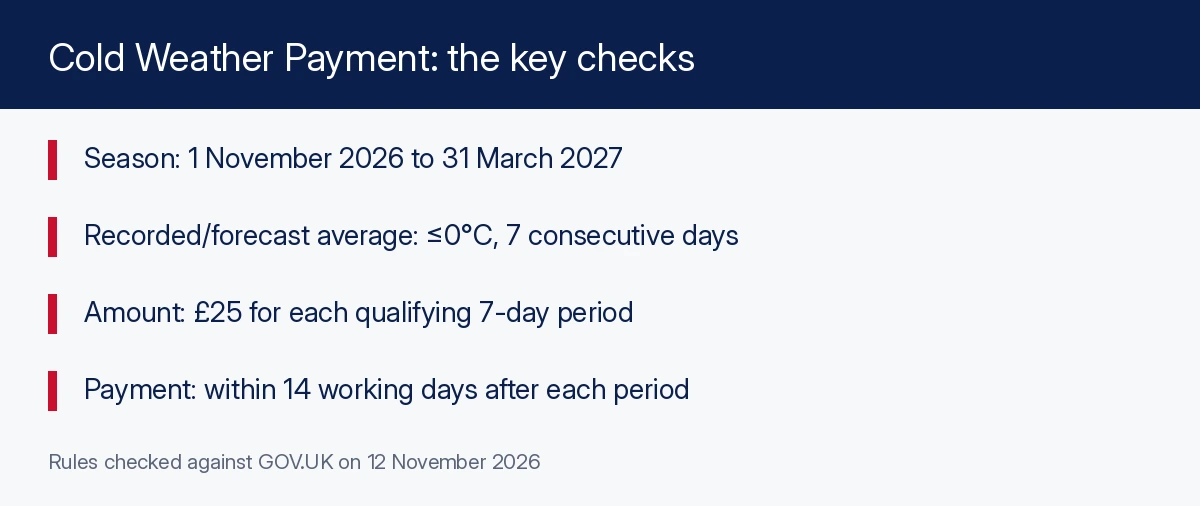
Eligible people get £25 for each qualifying seven-day cold period between 1 November 2026 and 31 March 2027. Payments should arrive within 14 working days after each period. Scotland has a separate annual Winter Heating Payment.
Check your benefit conditions and the official postcode result together. Cold weather alone does not establish entitlement.
In this guide
- When do you get a Cold Weather Payment?
- How the weather trigger and postcode check work
- Which benefits can qualify?
- Income-related ESA and mortgage-interest support
- Universal Credit: work and household conditions
- How much is paid and when should it arrive?
- Automatic payments and changes to report
- What to do if a payment is missing
- Scotland: Winter Heating Payment replaces this scheme
- How this differs from other winter support
- Common questions
- Official sources
- Related guides

When do you get a Cold Weather Payment?
A Cold Weather Payment is £25 for each qualifying seven-day period of very cold weather between 1 November 2026 and 31 March 2027. You must meet the benefit-related conditions as well as the weather trigger. One cold morning is not enough to trigger a payment.
The weather test is an average temperature recorded as, or forecast to be, zero degrees Celsius or below over seven consecutive days in your area. GOV.UK provides postcode-checker links so you can check the weather position rather than relying on a general national forecast.
This guide covers England and Wales using GOV.UK guidance, Northern Ireland using nidirect, and Scotland’s separate Winter Heating Payment. People in Scotland cannot get Cold Weather Payments under this scheme. Their replacement payment does not depend on local weather conditions.
SettleUK is an independent guide, not a government site. The rules here were checked on 12 November 2026. Use the official checker and the office responsible for your benefit to resolve a personal payment question; this article cannot confirm an individual award.
How the weather trigger and postcode check work
GOV.UK describes the trigger as a recorded or forecast average, not a requirement that every individual temperature reading stays below zero. The relevant period is seven consecutive days. This means a single overnight frost does not tell you whether your area qualifies.
For England and Wales, use the official Cold Weather Payment postcode checker. For Northern Ireland, use the nidirect postcode checker. Both routes are linked from GOV.UK’s overview of the scheme.
A postcode result addresses the weather side of the scheme. You still need to check your benefit and household conditions. It is therefore sensible to keep the result alongside the eligibility guidance rather than treating a weather trigger as proof that every resident receives money.
If the checker shows information you do not understand, save the result and ask the paying office how it relates to your circumstances. Do not use another household’s payment as the test. People living nearby can have different qualifying benefits or household conditions.
Which benefits can qualify?
For England and Wales, the GOV.UK eligibility page lists Pension Credit, income-related Employment and Support Allowance, Universal Credit and Support for Mortgage Interest. Each route has its own conditions. Read the branch matching your benefit rather than assuming that receiving any benefit is sufficient.
People receiving Pension Credit will usually receive Cold Weather Payments when the weather condition is met. If a payment seems to be missing, check your award information and contact the Pension Service.
The ESA route specifically refers to income-related ESA. Do not treat New Style ESA as an interchangeable name for it. If your letter simply says ESA and you are unsure which type you receive, check the award details or ask the paying office before applying the Cold Weather Payment rules.
Keep the name of your benefit, your household circumstances and the postcode result together. These are different parts of the check. A useful query explains all of them instead of only saying that the weather has been cold or that someone else has been paid.
| Qualifying route | Important condition to check |
|---|---|
| Pension Credit | GOV.UK says you will usually qualify |
| Income-related ESA | Group membership or additional listed conditions |
| Universal Credit | Work status and household conditions, with a disabled-child exception |
| Support for Mortgage Interest | Qualifying-benefit treatment and listed additional conditions |
Income-related ESA and mortgage-interest support
You will usually get Cold Weather Payments if you receive income-related ESA and are in the work-related activity group or support group. If you are in neither group, GOV.UK lists other possible qualifying circumstances. Check these against your award rather than assuming group membership.
Those other circumstances are a severe or enhanced disability premium, a pensioner premium, a child who is disabled, or a child under five living with you. The published conditions describe the income-related ESA route; they do not turn every disability benefit into a separate qualifying benefit.
For Support for Mortgage Interest, GOV.UK says you will usually qualify where you are treated as receiving a qualifying benefit and one of the listed circumstances applies. The circumstances are the same listed premiums or a disabled child or child under five living with you.
GOV.UK says you are usually treated as receiving a qualifying benefit if you apply but do not receive it because your income is too high. This explanation is for the England and Wales SMI route. Northern Ireland readers should check nidirect’s SMI conditions. Ask the benefit office if you are unsure which rule applies to you.
Universal Credit: work and household conditions
For the ordinary Universal Credit route, GOV.UK says you and any partner must not be employed or gainfully self-employed. It explains that self-employment is likely to be considered gainful where it is your main job, you work regularly and expect a profit.
One of two further circumstances must apply: you or your partner have a health condition or disability and limited capability for work, with or without work-related activity; or a child under five lives with you. Work status alone therefore does not settle this route.
There is an important exception for a disabled child amount in the Universal Credit claim. GOV.UK says you will also be eligible in that situation regardless of whether you or your partner are employed, self-employed or not working. Keep this exception separate from the ordinary work-status branch.
If you are checking an award for someone else, read the current Universal Credit statement and reported household details with them. Avoid assuming that a child’s circumstances or a health condition has already been recorded. The official change-reporting instructions explain what to do when relevant household information changes.
How much is paid and when should it arrive?
The payment is £25 for each qualifying seven-day period during the scheme season. It is not a weekly payment made to everyone throughout winter. The relevant weather condition and your benefit eligibility must apply before you can expect a payment for a period.
After each period of very cold weather in your area, GOV.UK says you should receive payment within 14 working days. That is a working-day timeframe rather than a promise of payment exactly two calendar weeks later. Check your account during that period.
The payment goes into the same bank or building society account as your benefit payments. Check that account when looking for it. GOV.UK says Cold Weather Payments do not affect other benefits, so this payment is separate from your ordinary benefit amount.
For budgeting, record a payment only when you can identify it in your own account or have official confirmation. A trigger result is useful evidence for a query, but it does not tell you the exact time a bank will show a credit for your individual award.
Automatic payments and changes to report
Eligible people are paid automatically and do not need to apply for Cold Weather Payment. However, GOV.UK says you may need to report a change if you have a baby or a child under five comes to live with you. Automatic payment depends on the relevant information being recorded.
If you receive Universal Credit, report the change through your online account. If you have no online account, use the Universal Credit helpline. For income-related ESA, GOV.UK says to tell Jobcentre Plus. It warns that you will not automatically receive Cold Weather Payments if you do not report the change.
A hospital stay can affect payment. GOV.UK says to tell the Pension Service or Jobcentre Plus if you go into hospital. Universal Credit recipients should add a journal note, or use the helpline if they do not have an online account.
Keep a record of what you reported and the response. You do not need a separate application. If you are unsure whether the office has the correct household information, ask it to confirm rather than submitting unrelated personal documents through an unofficial website.
What to do if a payment is missing
First check the official postcode service, your benefit’s eligibility branch and the bank account used for benefit payments. Compare the relevant cold period with the published 14-working-day timeframe. These checks help you explain the query without assuming the scheme pays immediately after a temperature drop.
In England and Wales, GOV.UK says to tell the Pension Service or Jobcentre Plus if you think you should have been paid but have not. Universal Credit recipients should sign in and add a journal note. If you have no online account, use the helpline shown on your claim letters.
In Northern Ireland, nidirect directs payment queries to the Northern Ireland Pension Centre or local Jobs and Benefits office. Universal Credit recipients should use their journal, or the helpline if they have no online account. Use the contact route for your nation and benefit.
Prepare your postcode, the relevant weather-period information, the benefit you receive and any reported household changes. Ask the office to confirm whether a payment is due and where it was sent. Avoid sending bank details in response to unsolicited messages claiming to release a payment.
Scotland: Winter Heating Payment replaces this scheme
People in Scotland cannot get Cold Weather Payments. GOV.UK points to an annual Winter Heating Payment instead, received regardless of weather conditions in the area. This is a different structure from a payment generated by each qualifying period of cold weather.
In Scotland, Winter Heating Payment is a single payment, paid from December and throughout winter. Eligible people normally receive it automatically. Social Security Scotland sends a letter or email explaining that the payment is coming.
The Scottish guidance says it appears as WHP on a bank statement and does not affect other benefits. If you think you missed a payment, use the official request route on mygov.scot. Check the current amount and qualifying-benefit guidance there before relying on an award figure.
Do not confuse Winter Heating Payment with Pension Age Winter Heating Payment. The names refer to separate Scottish schemes. If you are comparing help for an older relative with your own low-income support, check the exact scheme name before comparing timing or eligibility.
How this differs from other winter support
Cold Weather Payment and Winter Fuel Payment are different schemes. The first depends on qualifying cold periods and benefit conditions; the second has its own age, residence and winter-payment rules. A payment under one name should not be used to infer a payment date under the other.
Our Winter Fuel Payment guide explains the separate annual winter payment. For regular income, see Pension Credit payment dates or ESA payment dates. Keep the award letters for each scheme together but label the expected payments separately.
If a normal benefit date falls around a holiday, read the bank holiday payment guide. That question concerns the regular benefit schedule. It does not replace the Cold Weather Payment trigger or create a confirmed cold-weather credit date.
Before making a winter budget, distinguish confirmed income from support you are still checking. Use the official services linked here to confirm an entitlement or report a missing award. This keeps the practical plan tied to your own information rather than a general headline about winter payments.
Common questions
How much is a Cold Weather Payment?
Eligible people receive £25 for each qualifying seven-day period of very cold weather between 1 November 2026 and 31 March 2027.
Does one freezing night trigger payment?
No. The test is the average temperature recorded as, or forecast to be, zero degrees Celsius or below over seven consecutive days in your area.
When should the money arrive?
GOV.UK says you should receive payment within 14 working days after each period of very cold weather. It goes into the same bank or building society account as your benefit payments.
Do I need to apply?
No. Eligible people are paid automatically. You must still report relevant changes, including a baby or child under five joining your household if you receive Universal Credit or income-related ESA.
Can Universal Credit claimants who work qualify?
The ordinary route has work-status restrictions. However, GOV.UK says a disabled child amount in your claim makes you eligible regardless of whether you or your partner work. The weather trigger must still apply.
Can I get Cold Weather Payment in Scotland?
No. Scotland has Winter Heating Payment instead. It is an annual payment and does not depend on how cold it is in your area.
Official sources
- Cold Weather Payment overview — GOV.UK · Checked 2026-11-12
- Eligibility — GOV.UK · Checked 2026-11-12
- What you need to do — GOV.UK · Checked 2026-11-12
- When you will get paid — GOV.UK · Checked 2026-11-12
- Hospital stays — GOV.UK · Checked 2026-11-12
- Winter Heating Payment — mygov.scot · Checked 2026-11-12
- Northern Ireland Cold Weather Payment — nidirect · Checked 2026-11-12
SettleUK is an independent guide. It is not a government website and is not affiliated with GOV.UK, DWP, HMRC or the NHS.