Pension credit payment dates and rates 2026 to 2027
When are Pension Credit payments made?
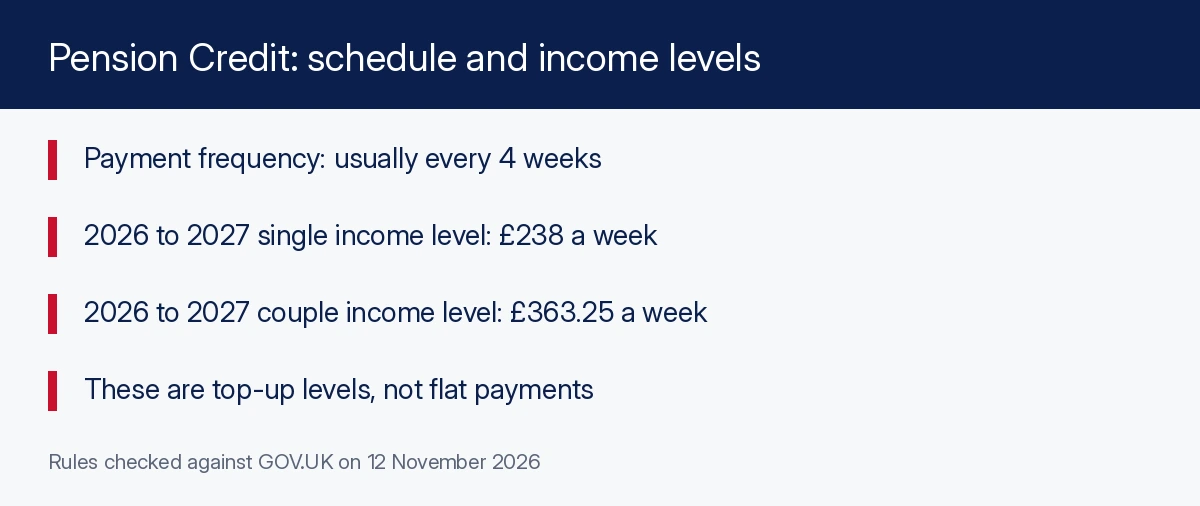
Pension Credit is usually paid every four weeks into an account. Benefits due on a weekend or bank holiday are usually paid on the working day before. Check your award information for your personal date and the period each payment covers.
The standard amounts are income top-up levels, not flat payments. Check the award calculation and schedule separately.
In this guide
- When are Pension Credit payments made?
- Finding your payment date and checking bank credits
- Bank holidays and early Pension Credit payments
- Pension Credit rates for 2026 to 2027
- Who can qualify, including couples?
- Income, savings and deferred pensions
- Extra amounts and Savings Credit
- Where to check eligibility now the calculator has closed
- Making a claim and understanding the first payment
- Northern Ireland, linked help and the next check
- Common questions
- Official sources
- Related guides

When are Pension Credit payments made?
Pension Credit is usually paid every four weeks, according to GOV.UK’s benefit-payment guide. It is normally paid into an account. For your Pension Credit payment dates, start with your award information. Each recipient has their own schedule.
If a benefit is due on a weekend or bank holiday, GOV.UK says it is usually paid on the working day before. Check your own ordinary due date before assuming a holiday changes your next payment. A new claim also needs its own payment confirmation.
This guide covers England, Scotland and Wales using GOV.UK, and Northern Ireland using nidirect. Pension Credit is separate from State Pension. Check the paying service if you need to establish whether credits in your account cover one award or more than one payment.
SettleUK is an independent guide, not a government site. The rules and 2026 to 2027 figures were checked on 12 November 2026. Use your award letter and official service for your personal calculation, payment arrangement and any change in entitlement.
Finding your payment date and checking bank credits
Start with your award letter and recent account statements. Write down the expected date, the amount awarded and the period covered. If those do not explain a credit, ask the Pension Service, or Northern Ireland Pension Centre, to identify it before deciding a payment is missing.
Four-weekly payment is different from monthly payment. Avoid budgeting on the assumption that the same calendar date repeats each month. Keep the confirmed benefit schedule separate from monthly bill dates so you can see which income needs to cover each outgoing cost.
The weekly income levels in this guide are also different from the amount of each bank credit. Pension Credit is calculated around income and circumstances, then paid on the award’s schedule. A bank payment cannot be checked accurately by comparing it only with the headline weekly income level.
If you also receive State Pension, ask the paying service to explain how your own payments are presented and scheduled. Ask which award and period each credit covers so you can match the money to your records.
Bank holidays and early Pension Credit payments
GOV.UK says a benefit payment due on a weekend or bank holiday is usually made on the working day before. Apply this to your confirmed normal date rather than moving every payment around a nearby holiday. The general rule is not a list of individual award dates.
If money arrives earlier than the date in your budget, compare it with the usual award before treating it as extra income. Check the period covered and the next confirmed payment. This prevents a timing change from making the same support appear twice in your spending plan.
Use our bank holiday benefit guide for the general approach, and the Christmas payment guide for seasonal checks. If you need your own exact date, the award information and paying service take priority over a generic online calendar.
A missing payment may need a different explanation from a holiday adjustment. Ask whether the award, destination account or calculation has changed. Have recent letters and account records ready so the service can investigate your actual payment rather than a general expectation.
Pension Credit rates for 2026 to 2027
The current standard Guarantee Credit levels top weekly income up to £238 for a single person or £363.25 in joint income for a couple. These are the 2026 to 2027 amounts confirmed in the DWP rates publication and current Pension Credit guidance.
They are not flat weekly payments added on top of all other income. State Pension and other counted income are included in the assessment. Your Pension Credit award depends on the difference established by the rules and any extra amounts for which you qualify.
You may still qualify where income exceeds the standard level if you have a disability, caring responsibilities, savings or housing costs. Do not use the simple headline levels as a complete eligibility calculator. Check the official guide or the eligibility check within the application service.
| Part of Pension Credit | 2026 to 2027 weekly figure | What it means |
|---|---|---|
| Standard Guarantee Credit: single | £238 | Income top-up level |
| Standard Guarantee Credit: couple | £363.25 | Joint income top-up level |
| Savings Credit: single | Up to £17.96 | Separate eligibility conditions apply |
| Savings Credit: couple | Up to £20.10 | Separate eligibility conditions apply |
Who can qualify, including couples?
For Great Britain, you must live in England, Scotland or Wales and have reached State Pension age. Northern Ireland has its own local residence requirement and service. Use the appropriate official page instead of assuming that an age check alone confirms entitlement.
If you have a partner, include them in the application. GOV.UK says a couple is eligible if both have reached State Pension age, or one receives Housing Benefit for people over State Pension age. Check those conditions before using the couple’s income level.
For this purpose, a partner includes a spouse or civil partner living with you, or someone you live with as a couple without marriage or civil partnership. Income is assessed together. Do not compare only one person’s income with the couple’s standard amount.
GOV.UK also describes status requirements for people from the EU, Switzerland, Norway, Iceland or Liechtenstein. Newcomers should read the full eligibility guidance and check their circumstances with the official service. Owning a home or having savings does not automatically exclude an otherwise eligible person.
Income, savings and deferred pensions
Counted income includes State Pension, other pensions, earnings from employment and self-employment, and most social security benefits such as Carer’s Allowance. The official eligibility page also lists payments that are not counted. Check the correct treatment for each income source rather than adding every bank credit together.
Examples of excluded benefits include Attendance Allowance, PIP, Adult Disability Payment, Pension Age Disability Payment and DLA. GOV.UK also lists Child Benefit, Housing Benefit and certain other payments. The exact list matters when estimating an award for a household receiving disability support.
Savings and investments of £10,000 or less do not affect Pension Credit. Above £10,000, GOV.UK says every £500 counts as £1 of weekly income. Use the official assessment for your exact balance rather than applying a savings rule from another benefit.
If you have deferred State Pension, the pension you would receive still counts as income. An unclaimed personal or workplace pension can also count. GOV.UK says you cannot build up extra State Pension for deferral while you or your partner receive Pension Credit.
Extra amounts and Savings Credit
The published guide describes possible extra amounts for severe disability, caring for another adult, responsibility for children or young people, and certain housing costs. These have their own conditions. A standard income level does not capture every household’s potential award.
For carers, the guide gives a possible extra £48.15 a week, including where Carer’s Allowance has been claimed but is not paid because another benefit is higher. Carer Support Payment is also listed. Check the full rule if an overlapping benefit prevents a separate carer payment.
For severe disability, the guide gives a possible extra £86.05 a week and lists qualifying disability benefits. Use the official guidance and contact the Pension Service if unsure. The qualifying benefit is only part of the check; ask about the other conditions before including an extra amount in your budget.
Savings Credit is a separate part of Pension Credit. GOV.UK says you may qualify if you reached State Pension age before 6 April 2016 and saved for retirement. The maximums are £17.96 a week for a single person and £20.10 for a couple, subject to the calculation.
Where to check eligibility now the calculator has closed
The official Pension Credit calculator page now says the calculator is no longer available. It directs users to the Pension Credit guide or the Apply for Pension Credit service, where eligibility can be checked before applying.
Use the guide or the check within the application service. The application guidance says the online service can be used if you have already applied for State Pension. Other claim routes are available if online application is unsuitable.
Before starting, gather income, savings and investment information for yourself and any partner. Include pension income and the benefits you receive so that each can be treated correctly. If you want a claim backdated, you also need information for the earlier date.
A preliminary check helps identify whether a claim may be worthwhile, but the official award confirms the outcome. Keep a copy of the information supplied and ask about anything you do not understand. Avoid treating an informal estimate as a confirmed payment amount or start date.
Making a claim and understanding the first payment
You can start an application up to four months before reaching State Pension age. After reaching that age, you can apply at any time, but backdating is limited to three months. Eligibility must apply during the period for which you seek backdating.
GOV.UK says the first payment can therefore include up to three months of Pension Credit if you were eligible. That can make the first credit different from a regular four-weekly amount. Do not use an unusually large first payment as the assumed value of every future credit.
The application asks for National Insurance numbers, income, savings and investment information, plus bank details. Include a partner’s information where relevant. Use the official online, telephone or postal route rather than sending these personal details to an unofficial eligibility service.
If you disagree with the decision, GOV.UK explains that you can ask for mandatory reconsideration. Keep the decision and evidence together. Ask the service when to expect a decision or follow up on a new application.
Northern Ireland, linked help and the next check
nidirect’s Pension Credit guidance confirms the same standard income levels of £238 for a single person and £363.25 for a couple. It also describes Guarantee Credit, Savings Credit, income rules and local claim arrangements. Use the Northern Ireland Pension Centre for local enquiries.
The Northern Ireland guidance says changes to personal and financial circumstances must be reported. Examples include a move, changes in household members, work, pensions, savings and bank details. Ask the centre if you are unsure whether a change affects the award.
Pension Credit can also open access to other help, but separate conditions may apply. GOV.UK points to housing support, Council Tax Reduction and heating help. For cold-weather support, Scotland uses Winter Heating Payment rather than Cold Weather Payment; check the correct national scheme.
For related planning, see State Pension payment dates, Cold Weather Payment and Winter Fuel Payment. Keep each award and its payment window separate when building your household budget, and confirm uncertain credits with the responsible service.
Before contacting the service about a missing credit, make a short note of what you expected and why. Include the award date, normal payment pattern, account checked and any recent change. Ask when you should follow up if the payment is still missing.
Common questions
How often is Pension Credit paid?
GOV.UK says Pension Credit is usually paid every four weeks. Check your award information for your own payment schedule.
Is Pension Credit the same as State Pension?
No. GOV.UK says Pension Credit is separate from State Pension. Ask the paying service to explain your own schedule and any bank credit you cannot identify.
Is £238 a flat weekly payment?
No. For 2026 to 2027, £238 is the standard single-person weekly income top-up level. The couple’s joint level is £363.25. Your award depends on counted income and circumstances.
Is the Pension Credit calculator still available?
GOV.UK says the standalone calculator is no longer available. Its page points to the guide and an eligibility check within the Apply for Pension Credit service.
Do savings automatically rule me out?
No. Savings and investments of £10,000 or less do not affect Pension Credit. Above £10,000, GOV.UK says every £500 counts as £1 of weekly income.
Can the first payment include backdating?
Yes, if eligible during the earlier period. GOV.UK says claims can be backdated by up to three months, which can be included in the first payment.
Official sources
- Pension Credit overview — GOV.UK · Checked 2026-11-12
- Amounts and payment method — GOV.UK · Checked 2026-11-12
- Eligibility, income and savings — GOV.UK · Checked 2026-11-12
- How to claim — GOV.UK · Checked 2026-11-12
- Benefit payment frequency — GOV.UK · Checked 2026-11-12
- Former Pension Credit calculator: current checking routes — GOV.UK · Checked 2026-11-12
- Confirmed 2026 to 2027 rates — GOV.UK · Checked 2026-11-12
- Pension Credit in Northern Ireland — nidirect · Checked 2026-11-12
SettleUK is an independent guide. It is not a government website and is not affiliated with GOV.UK, DWP, HMRC or the NHS.