State Pension payment dates: NI digits and 4-weekly cycle
When are State Pension payment dates?
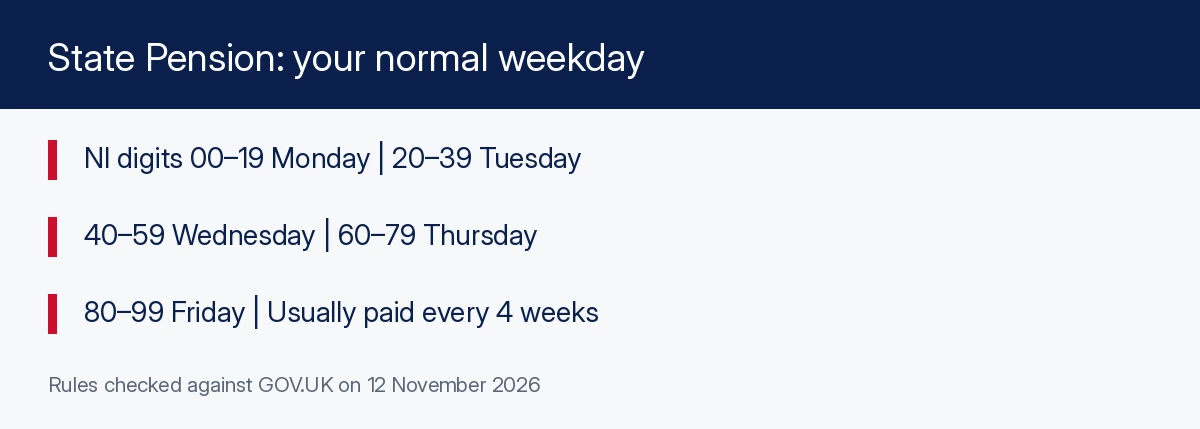
State Pension is usually paid every four weeks. Your National Insurance number’s last two digits set the normal weekday: 00–19 Monday, 20–39 Tuesday, 40–59 Wednesday, 60–79 Thursday and 80–99 Friday. Check your payment letter for your own cycle and any first part-payment.
Check the official National Insurance weekday table, first-payment timing and what to do around bank holidays or a missing pension.
In this guide
- When are State Pension payment dates?
- How do the last two National Insurance digits set payday?
- How does the four-weekly cycle work?
- When will the first new State Pension payment arrive?
- Do you need to claim before receiving payment?
- What happens when pension day is a bank holiday?
- How should you check Christmas and New Year payments?
- What if your bank account or location changes?
- What should you do if State Pension has not arrived?
- How can you build a pension payment diary?
- Common questions
- Official sources
- Related guides

When are State Pension payment dates?
State Pension payment dates normally follow a four-weekly pattern, with the usual weekday determined by the last two digits of your National Insurance number. GOV.UK publishes the weekday table for both the new and basic State Pension. Your payment letter provides the personal starting point for checking the calendar.
This guide covers UK claimants in England, Wales, Scotland and Northern Ireland, with separate Northern Ireland contact routes flagged below. Overseas payment arrangements differ and should be checked separately. SettleUK is an independent guide, not a government site.
There is no single State Pension payment date for everyone in 2026. Knowing your usual weekday helps, but it does not identify which week your own four-weekly payment falls in. Use your award letter and payment history together rather than selecting a date from a general calendar.
If you searched for “4 weekly State Pension payment dates”, the useful distinction is between the payment weekday and the payment cycle. The National Insurance table answers the first question. Your personal payment record answers the second. Holiday guidance then helps check whether a particular due date may move.
How do the last two National Insurance digits set payday?
Find the last two numbers in your National Insurance number, ignoring the final letter. Match that pair of digits with the range in the official table below. The same weekday table appears in GOV.UK guidance for the new State Pension and the basic State Pension.
Use only the pair of digits needed for the lookup when making a private diary note. You do not need to put the whole National Insurance number into a shared calendar. For an individual pension enquiry, use the official Pension Service contact route.
The result tells you the normal weekday, not a guarantee that every occurrence of that weekday is a pension payday. With a usual four-weekly payment, your payment letter still matters. If the weekday in your records seems inconsistent, ask the paying service to explain the schedule before changing your budget.
| Last two NI digits | Usual payment weekday |
|---|---|
| 00 to 19 | Monday |
| 20 to 39 | Tuesday |
| 40 to 59 | Wednesday |
| 60 to 79 | Thursday |
| 80 to 99 | Friday |
How does the four-weekly cycle work?
GOV.UK says the new State Pension is usually paid into your account every four weeks. The basic State Pension guide uses the same usual frequency. Keep that wording in your diary: a four-weekly payment is different from a payment made on the same numbered date each calendar month.
Start with a full payment confirmed in your pension letter or payment history. Keep any bank-holiday adjustment labelled separately so an early arrival does not accidentally become the starting point for an incorrect repeating reminder. Where there is uncertainty, ask the service to confirm your next due payment.
A weekly pension rate and the frequency of the bank transfer answer different questions. This guide focuses on when payments arrive and does not calculate an award from a headline weekly rate. Your entitlement and any part-payment need to be read from the official information about your claim.
If you need to know which period a payment covers, check your pension letter or ask the Pension Service. Keep any initial part-payment separate from your regular full payments when comparing the letter with your bank statement.
When will the first new State Pension payment arrive?
When claiming the new State Pension, you are asked when you want payments to start. GOV.UK says the first payment will be no later than five weeks after the date you choose. You then receive a full payment every four weeks after that.
You might receive part of a payment before the first full payment. The letter confirming your State Pension tells you what to expect. A smaller initial bank entry should therefore be checked against the letter rather than automatically treated as a missing full payment.
Keep the chosen start date, any initial part-payment and the first full payment on separate lines when setting up a calendar. This is particularly helpful if you are trying to understand the gap between the start of the award and the regular payment pattern.
Do not apply this first-payment description to every pension situation. The basic State Pension page has separate guidance for claiming a delayed pension, and overseas arrangements have their own rules. Use the official page matching the pension and circumstances named in your correspondence.
Do you need to claim before receiving payment?
The new State Pension is not paid automatically: you have to claim it. GOV.UK lists information needed for a claim, including bank or building society details, dates of time spent living or working abroad, relevant foreign social security numbers and certain marriage, civil partnership or divorce details.
For an online application, the official guide says you also need the invitation code from the State Pension letter. If you have not received an invitation and are within three months of State Pension age, you can request a code through the official guidance.
Claiming differs if you are in Northern Ireland or abroad, including the Channel Islands. Use those links from GOV.UK before following a Great Britain application route. A general guide cannot confirm that an individual claim has been made or accepted.
If you expected an automatic payment but have no payment letter, first establish whether the claim has been completed. Ask the service about the status and expected payment information. That is a different enquiry from an established pension payment not appearing in the bank on its normal date.
What happens when pension day is a bank holiday?
The new State Pension guide says you might be paid earlier if the normal payment day is a bank holiday. The general GOV.UK benefits guide says payments due on a weekend or bank holiday are usually made on the working day before.
Check whether your own payment is actually due on the holiday. A national holiday in a week when you are not expecting a four-weekly payment does not by itself establish a revised date for your pension. The normal weekday and your position in the cycle both matter.
Our bank-holiday guide lists the official calendars for England and Wales, Scotland and Northern Ireland. Those lists identify holiday dates, not a personalised pension schedule. Use any specific instruction from the paying service alongside the general rule.
For a payment that arrives early, keep the ordinary due date in your diary as a reference and record the earlier bank entry beside it. As practical budgeting advice, confirm the following expected payment before treating the early arrival as money available for additional spending.
How should you check Christmas and New Year payments?
Christmas and New Year can involve different holiday entries across the UK. Use the Christmas payment guide for the verified national calendar and any limitations on published seasonal instructions. Do not assume a date in a general festive article applies to every pensioner.
The first check is whether a normal pension payment falls on an affected holiday. The next is the payment guidance from the service handling your award. Keep those checks separate from whether you qualify for a Christmas Bonus or other seasonal help.
An ordinary pension arriving early and a separate bonus are different matters. The Pension Service contact page includes missing Christmas Bonus enquiries among the subjects it handles. Use the official bonus guidance before counting additional money in the budget.
If you also receive Pension Credit, maintain its dates separately. GOV.UK describes both State Pension and Pension Credit as usually four-weekly, but that does not establish that both arrive together for your household. Identify the precise payment when asking the service about missing money.
What if your bank account or location changes?
GOV.UK says to tell the Pension Service if you want to change the account used for State Pension payments. Use the official contact guidance rather than assuming a change made to another benefit or another organisation automatically updates your pension.
For enquiries from England, Wales or Scotland, the GOV.UK contact page directs you to the Pension Service. If you live in Northern Ireland, it directs you to the Northern Ireland Pension Centre. If you live abroad, it directs you to the International Pension Centre.
These different contact routes matter even where a general payment guide covers the whole UK. Start with where you live and what your correspondence calls the payment. That helps avoid asking an office to explain a claim it does not administer.
The UK payment guides expressly say there are different rules abroad. This page therefore does not use its domestic weekday table to promise an overseas bank arrival date. Follow the official overseas guidance and ask the International Pension Centre about a payment that does not match your records.
What should you do if State Pension has not arrived?
Check the expected payment against the award letter, the normal weekday and recent bank entries. Look for an earlier payment around a holiday before deciding the transfer is missing. If the issue is an unexpected amount, keep that separate from the question of when it was due.
Contact the Pension Service for information about your State Pension. GOV.UK lists 0800 731 0469, Monday to Friday, 8am to 6pm except public holidays. The official page also provides accessibility options and the Welsh-language route; check it before calling for current details.
Use the Northern Ireland Pension Centre if you live in Northern Ireland, or the International Pension Centre if you live abroad. Where you want information about someone else’s pension, GOV.UK points to an alternative enquiry service rather than the ordinary personal enquiry route.
As practical preparation, note the date expected, the last pension payment received, any initial part-payment and the account you checked. Explain the effect on essential bills if relevant. Ask the service what happened, whether you must supply anything and what to expect next; this guide cannot promise a correction date.
How can you build a pension payment diary?
Keep a simple record with columns for the benefit name, normal due date, actual bank arrival and any official explanation. Add State Pension and Pension Credit separately. If another person helps manage your paperwork, the labels make it easier to discuss a specific payment without confusing different awards.
Use your normal four-weekly cycle as a planning aid, then check each holiday period against official information. Do not replace the whole cycle with an early payment date. The aim is a record you can reconcile with your letter and bank history, not a prediction presented as government confirmation.
When starting a new pension, wait for the letter explaining the first payment before assuming the first bank entry represents a full regular instalment. GOV.UK explicitly allows for an initial part-payment, so keeping that entry labelled can prevent unnecessary worry later.
Return to the official sources when a personal date, amount or contact route needs confirmation. This guide gives the weekday lookup and the verified payment rules; it does not access your pension record. Keep the latest correspondence alongside your diary so future enquiries have a clear starting point.
Common questions
Which NI digits decide State Pension payday?
The last two numbers: 00–19 Monday, 20–39 Tuesday, 40–59 Wednesday, 60–79 Thursday and 80–99 Friday.
Is State Pension paid monthly?
Usually it is paid every four weeks. That differs from a payment on the same numbered date every calendar month.
When is the first new State Pension payment?
GOV.UK says no later than five weeks after your chosen start date. You may get a part-payment before the first full payment.
Does a bank holiday change pension payday?
You might be paid earlier if the normal day is a bank holiday. General GOV.UK guidance says benefits are usually paid on the working day before.
Is the pension paid automatically?
The new State Pension must be claimed. Check the official claim guidance if you have no payment letter.
Who handles missing pension enquiries?
Use the Pension Service, the Northern Ireland Pension Centre if you live in Northern Ireland, or the International Pension Centre if you live abroad.
Official sources
- The new State Pension — GOV.UK · Checked 2026-11-12
- The basic State Pension — GOV.UK · Checked 2026-11-12
- The new State Pension — GOV.UK · Checked 2026-11-12
- Contact the Pension Service — GOV.UK · Checked 2026-11-12
- How and when your benefits are paid — GOV.UK · Checked 2026-11-12
- Bank Holidays — official guidance — GOV.UK · Checked 2026-11-12
- Your State Pension explained — GOV.UK · Checked 2026-11-12
SettleUK is an independent guide. It is not a government website and is not affiliated with GOV.UK, DWP, HMRC or the NHS.