Attendance Allowance payment dates
When is Attendance Allowance paid?
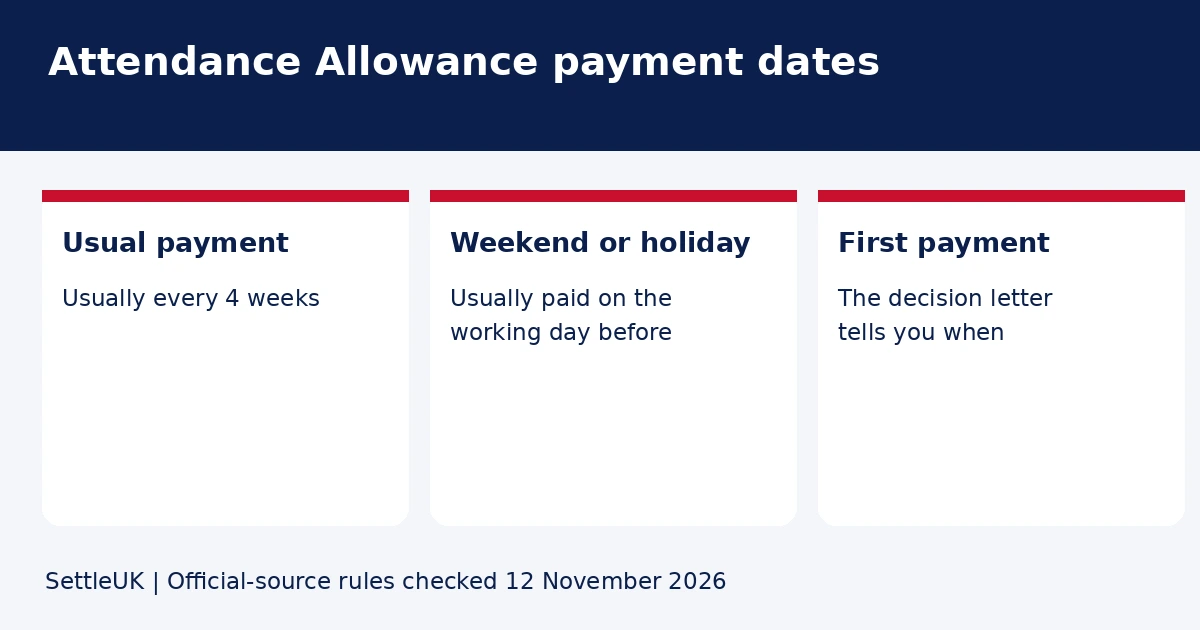
Attendance Allowance is usually paid every four weeks. If your due date falls on a weekend or bank holiday, GOV.UK says payment usually arrives on the working day before. Your decision letter gives the first-payment date.
Check Attendance Allowance payment dates, the usual four-week cycle and holiday exceptions. England and Wales are covered, with separate Northern Ireland and Scotland guidance.
In this guide
- When is Attendance Allowance paid?
- Understand the four-week cycle before planning bills
- Find your own next payment date
- What happens on weekends and bank holidays?
- Christmas 2026 and New Year: dates to check
- First payments and the claim start date
- What to do if the payment has not arrived
- Could a change in circumstances affect payment?
- Northern Ireland and Scotland: use the right route
- Keep a useful payment record
- Common questions
- Official sources
- Related guides

When is Attendance Allowance paid?
Attendance Allowance is usually paid every four weeks. GOV.UK describes the benefit using weekly rates, but that does not mean most people receive a separate bank deposit every week. Use the payment information for your own award to distinguish the rate from the date money arrives.
If your payment date falls on a weekend or bank holiday, GOV.UK says you will usually be paid on the working day before. That is a general payment rule, rather than a calendar assigning the same payday to everyone who receives Attendance Allowance.
This guide covers Attendance Allowance in England and Wales, with a separate Northern Ireland route below. Scotland uses Pension Age Disability Payment for new applications. If you live in Scotland or are moving across the border, check which benefit and paying agency appear on your latest correspondence.
For the underlying rule, read GOV.UK's payment guidance. Keep it alongside your award information rather than using another person's payday as evidence of your own.
Understand the four-week cycle before planning bills
A four-week cycle is different from being paid on a fixed date each calendar month. When you make a household budget, write down actual expected payment dates instead of assuming the benefit will always arrive on the same numbered day of the month.
Start with a date confirmed in your own paperwork. Use a diary to mark the usual cycle, then check any weekend or holiday conflict. Treat your notes as a planning aid: they cannot establish an award start date, confirm a first payment or override information from DWP.
| Information | What it tells you | What to check |
|---|---|---|
| Weekly rate | The rate used to describe entitlement | Your awarded level of support |
| Usual four-week payment | The normal frequency in GOV.UK guidance | Your personal payment arrangements |
| First-payment date | When your award starts paying | The decision letter |
| Holiday adjustment | A usual date may move earlier | The paying office's confirmation |
Keep Attendance Allowance separate from your State Pension payment notes. Receiving both does not give you a reliable basis for assuming that their bank deposits will arrive together.
If someone helps you manage bills, share the confirmed dates rather than only the weekly entitlement wording. This makes it easier to explain which income is available now and which payment you are still waiting for.
Find your own next payment date
For a new Attendance Allowance award, GOV.UK says the decision letter tells you when you will receive your first payment. Read that section before trying to predict a date from the day you submitted the application or the day you received a message.
For an existing award, bring together your latest benefit letter and recent bank transactions. The transactions help you identify what arrived, while the letter helps identify the benefit and office involved. Ask the paying office if those records leave the next expected payment unclear.
- Find the latest decision letter and any later payment correspondence.
- Note the benefit name, the date stated and the account you expected to receive it.
- Check whether a weekend or bank holiday affects the usual date.
- Ask the Attendance Allowance helpline to confirm any date you cannot establish.
A text acknowledging an application is not the same as an award decision. Keep the acknowledgement, but look for the decision letter before treating the claim as an established recurring payment.
What happens on weekends and bank holidays?
If your payment is due on a weekend or bank holiday, GOV.UK says you will usually be paid on the working day before. Check your award information if you are unsure which date applies.
Check the holiday calendar for the relevant nation. The GOV.UK bank-holidays feed lists England and Wales, Scotland and Northern Ireland separately. A date in one nation's list should not automatically be treated as a payment instruction for another nation's benefit administration.
If money appears before the date you expected, check the benefit reference and your award correspondence before treating it as a second payment. An earlier date alone does not establish any increase in entitlement. Ask the paying office if the amount or purpose is unclear.
For broader planning, our bank holiday payment guide helps organise the questions to ask. Use official benefit guidance for the actual rule and your paying office for any uncertainty about your award.
Christmas 2026 and New Year: dates to check
The official bank-holiday JSON lists Christmas Day on 25 December 2026 and the Boxing Day bank holiday on 28 December 2026 for England and Wales and Northern Ireland. It lists New Year's Day on 1 January 2027 in both of those jurisdictions.
| Official holiday | Date in England and Wales / Northern Ireland | How to use it |
|---|---|---|
| Christmas Day | 25 December 2026 | Compare with your usual payment date |
| Boxing Day bank holiday | 28 December 2026 | Check the working-day rule |
| New Year's Day | 1 January 2027 | Confirm any affected payment |
These are holiday dates, not a published Attendance Allowance payment timetable. Check GOV.UK for festive updates and ask the office paying your benefit if your expected date is unclear.
For the current payment rule and any updates, start with the official payment page and check for updates affecting your circumstances.
Our Christmas payment guide can help you keep different benefits organised. Write each confirmed date separately; do not copy a festive date from a different benefit or from a family member's award.
First payments and the claim start date
The first payment needs its own check. GOV.UK says that, if Attendance Allowance is awarded, the decision letter will explain when it will be paid. A general four-week rule cannot tell you when an application will be decided.
The official claim guidance distinguishes the start date by application method. An online claim starts on the date you make it. A printed and posted form starts on the date DWP receives it. Neither statement is a promise that money will arrive that day.
If you telephone the helpline for a form, the claim starts on the date of the call provided you return the form within six weeks. Keep a note of the call and the paperwork you send, so you can discuss the relevant dates accurately.
GOV.UK says you will get a text or letter within three weeks after sending the claim, explaining when to expect a decision. This is an update about the process, rather than a guaranteed payment deadline or an assurance that the claim will succeed.
If you are unsure whether you are waiting for a decision or an already-awarded payment, say that clearly when contacting DWP. It helps focus the conversation on the right question: the progress of the application, or the timing of money already awarded.
What to do if the payment has not arrived
Begin by checking the date you expected against your own award information. Look for an earlier deposit around a weekend or holiday, and make sure you are checking the account used for this benefit. These checks help you describe the problem clearly.
For England and Wales, use the Attendance Allowance helpline listed on GOV.UK: 0800 731 0122. The published opening hours are Monday to Friday, 8am to 6pm. Check the official contact page before calling around holidays, rather than assuming these are special festive opening hours.
- Have your benefit letter and National Insurance number available for the conversation.
- Note the payment you expected and the last payment you can see.
- Explain any recent change to your bank account, address, care or living arrangements.
- Ask whether a payment has been issued and what action, if any, you need to take.
- Write down the explanation and any next step you are given.
Ask whether the payment has been sent, which account it was sent to and when you should follow up. Keep a note of the answer with your benefit letter.
If you need Relay UK or British Sign Language support, follow the accessible contact options on GOV.UK's Attendance Allowance contact page.
Could a change in circumstances affect payment?
A missing or different payment may need an award check as well as a date check. GOV.UK says changes in circumstances can increase or reduce Attendance Allowance. Contact the helpline straight away when a reportable change happens.
The official list includes a change in the help you need, entering hospital or a care home, changes to name, address or bank details, and plans to leave the country for more than four weeks. Read the complete list before deciding that a change is irrelevant.
For a hospital or care-home stay, GOV.UK asks for the address, dates of the stay and how it is paid for. Gather those details before the conversation. This guide does not calculate a stop date from admission alone because individual circumstances need checking.
If your bank details changed recently, ask the office which details are recorded for the award. Updating your personal budget or telling a different organisation is not a substitute for reporting the change to the office handling Attendance Allowance.
GOV.UK also says an overpayment may need to be repaid, including one made by mistake. Report an unexplained payment rather than relying on its appearance in your bank account as confirmation that you can keep it.
Northern Ireland and Scotland: use the right route
In Northern Ireland, nidirect directs Attendance Allowance questions to the Disability and Carers Service. Its guidance says payment is normally made directly into an account that accepts benefit payments. Use that Northern Ireland service for questions about your claim rather than assuming the England and Wales helpline handles it.
Nidirect also explains that changes in personal details, hospital or care-home stays and changes in the help you need must be reported. Follow its local instructions if you receive Attendance Allowance in Northern Ireland, particularly when asking about a payment that changed after a move or admission.
In Scotland, GOV.UK directs applicants to Pension Age Disability Payment instead of Attendance Allowance. Adult Disability Payment is a different Scottish benefit; do not use an adult disability payment calendar as a substitute for checking a pension-age award.
If you move from England or Wales to Scotland while receiving Attendance Allowance, GOV.UK says to tell DWP and make a new claim for Pension Age Disability Payment. The guidance says Attendance Allowance stops 13 weeks after the move, so apply as soon as possible after moving.
Moving in the opposite direction also needs action: report the move to Social Security Scotland and apply for Attendance Allowance. GOV.UK says Social Security Scotland will tell you when Pension Age Disability Payment will stop. Confirm the handover with both agencies rather than assuming uninterrupted dates.
Keep a useful payment record
A simple record makes future checks easier. Keep the latest decision letter, any later change letters and your own notes of payment dates together. Label each note with the benefit name so that Attendance Allowance does not become mixed up with Pension Credit or a carer's payment.
When calling, record the date, the question you asked and the next action agreed. Separate confirmed information from your own estimate. If an adviser asks for more details, note what is needed and how the official service told you to provide it.
If someone helps with your finances, use the same record when reviewing bills. Work from confirmed money and dates, and flag anything still being checked. This is a practical budgeting approach, rather than a change to your entitlement or the official payment cycle.
Organise your other benefit dates
Use the payment hub to keep separate benefits and their official contact routes together.
Browse benefit payment guidesCommon questions
Is Attendance Allowance paid weekly or every four weeks?
GOV.UK describes entitlement using weekly rates, but says Attendance Allowance is usually paid every four weeks. Check your own award information for your payment arrangements.
Does everyone have the same Attendance Allowance payday?
Do not assume another claimant’s payday applies to you. Your first-payment date is in the decision letter; ask the office paying your benefit if your next date is unclear.
Will a bank holiday delay Attendance Allowance?
GOV.UK says benefits due on a weekend or bank holiday are usually paid on the working day before. Confirm your own arrangement if you are unsure.
Where is my first payment date?
GOV.UK says the Attendance Allowance decision letter will tell you when you will get your first payment if the benefit is awarded.
Who should I contact about a missing payment?
In England and Wales, contact the Attendance Allowance helpline through GOV.UK. In Northern Ireland, use the Disability and Carers Service linked from nidirect. Have your award information ready.
Can I apply for Attendance Allowance in Scotland?
GOV.UK directs people living in Scotland to apply for Pension Age Disability Payment instead. Moving between Scotland and England or Wales requires action with the relevant agencies.
Are Christmas 2026 payment dates confirmed here?
No personal festive payment timetable is confirmed here. The guide lists verified bank holidays and the general payment rule. Check GOV.UK and the office paying your benefit for your exact date.
Official sources
- How and when your benefits are paid — GOV.UK / DWP · Checked 2026-11-12
- Attendance Allowance: overview — GOV.UK / DWP · Checked 2026-11-12
- Attendance Allowance: what you will get — GOV.UK / DWP · Checked 2026-11-12
- Attendance Allowance: how to claim — GOV.UK / DWP · Checked 2026-11-12
- Attendance Allowance: report a change — GOV.UK / DWP · Checked 2026-11-12
- Attendance Allowance in Northern Ireland — nidirect · Checked 2026-11-12
- UK bank holidays: official JSON — GOV.UK · Checked 2026-11-12
SettleUK is an independent guide. It is not a government website and is not affiliated with GOV.UK, DWP, HMRC or the NHS.