DWP bank holiday payment dates: 2026–2027 UK calendar
How do DWP bank holiday payment dates work?
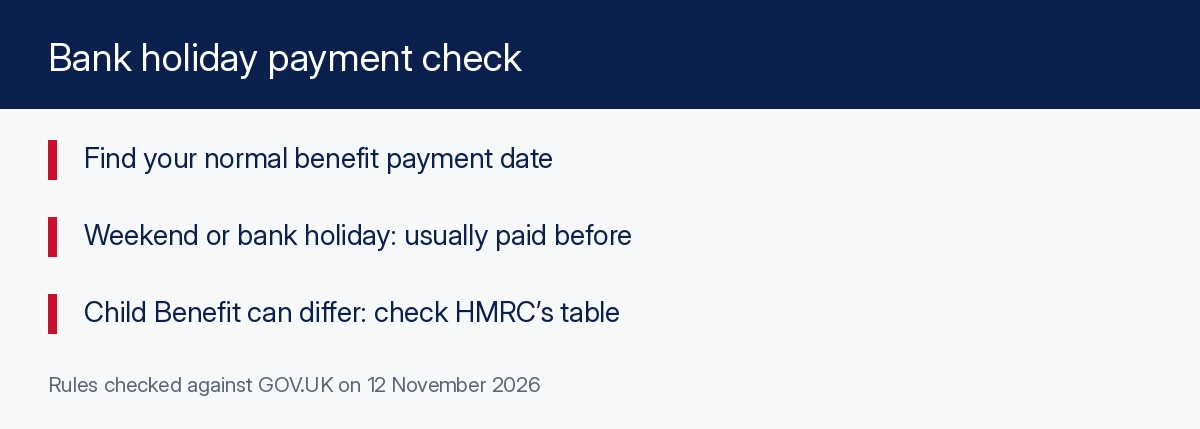
Benefits due on a weekend or bank holiday are usually paid on the working day before. Child Benefit can differ, so check HMRC’s own table. Use your personal payment date and the holiday calendar for the relevant UK nation; a holiday alone does not mean everyone is paid early.
Check every remaining 2026 and published 2027 national bank holiday, the usual benefit rule and important HMRC exceptions.
In this guide
- How do DWP bank holiday payment dates work?
- What is the official early-payment rule?
- What are the remaining England and Wales holidays?
- Which bank holidays apply in Scotland?
- Which bank holidays apply in Northern Ireland?
- How do different benefits fit around these holidays?
- Why must Child Benefit be checked separately?
- How should you read substitute days and holiday names?
- What should you do if a payment is missing after a holiday?
- How can you plan safely across the 2026–27 holidays?
- Common questions
- Official sources
- Related guides

How do DWP bank holiday payment dates work?
DWP bank holiday payment dates depend on whether your own normal payment falls on an affected day. GOV.UK says benefits due on a weekend or bank holiday are usually paid on the working day before. Child Benefit may differ and must be checked against HMRC’s specific guidance.
This guide covers England, Wales, Scotland and Northern Ireland. It lists all remaining 2026 holidays from 12 November and all 2027 holiday entries in the official GOV.UK calendar. SettleUK is an independent guide, not a government site.
The tables identify holidays and explain the applicable checking step. They are not a government announcement of revised dates for every benefit. A payment due on another day does not automatically change simply because a holiday appears in the same week.
Use the normal payment date from your award letter or online account first. Then find the relevant national holiday and read your benefit’s rule. This order helps avoid confusing a national calendar, a local bank closure and an instruction about your particular claim.
What is the official early-payment rule?
The general GOV.UK guide says that, if your payment date falls on a weekend or bank holiday, you will usually be paid on the working day before. Child Benefit can follow different dates, so check HMRC’s table for that payment.
The Universal Credit guide states that a weekend or bank-holiday due date is paid on the working day before. The PIP guide says payment will usually be made before a bank holiday and then continue as normal. The new State Pension guide says you might be paid earlier.
For a payment arriving early, keep both the normal due date and actual arrival in your diary. As practical advice, check when the next payment is expected before treating the earlier bank entry as money available for extra spending. The arrival date alone does not establish a higher award.
Do not restart an entire repeating calendar from an early bank entry without checking the benefit’s normal pattern. A short-term adjustment and a change to the underlying schedule are different questions. Ask the paying service if the letter, statement and bank record do not appear to match.
What are the remaining England and Wales holidays?
England and Wales share a division in the official calendar. The table includes the remaining 2026 entries and the complete 2027 set published there. Holiday names and dates are copied from that source, with substitute days labelled where the calendar marks them.
In the final column, “usual benefit rule” means a benefit actually due on the listed holiday is usually paid on the working day before. This is conditional guidance, not a published replacement date. For Child Benefit, follow the separate HMRC instructions later in this guide.
| Holiday date | Official holiday name | If your payment is due then |
|---|---|---|
| 2026-12-25 | Christmas Day | Usual benefit rule; Child Benefit: check HMRC |
| 2026-12-28 | Boxing Day (substitute day) | Usual benefit rule; HMRC Child Benefit: 24 December 2026 |
| 2027-01-01 | New Year’s Day | Usual benefit rule; Child Benefit: check HMRC |
| 2027-03-26 | Good Friday | Usual benefit rule; Child Benefit: check HMRC |
| 2027-03-29 | Easter Monday | Usual benefit rule; Child Benefit: check HMRC |
| 2027-05-03 | Early May bank holiday | Usual benefit rule; Child Benefit: check HMRC |
| 2027-05-31 | Spring bank holiday | Usual benefit rule; Child Benefit: check HMRC |
| 2027-08-30 | Summer bank holiday | Usual benefit rule; Child Benefit: check HMRC |
| 2027-12-27 | Christmas Day (substitute day) | Usual benefit rule; Child Benefit: check HMRC |
| 2027-12-28 | Boxing Day (substitute day) | Usual benefit rule; Child Benefit: check HMRC |
Which bank holidays apply in Scotland?
Scotland has a separate official calendar, including St Andrew’s Day and the 2nd January holiday. Do not use the England and Wales list as a complete Scottish holiday list. Equally, do not treat every Scottish calendar entry as a UK-wide payment adjustment.
The table gives the national holiday dates and the same conditional DWP checking rule. It does not assign a Scottish devolved benefit a DWP timetable. For an award administered by Social Security Scotland, check that service’s own correspondence and guidance for the payment concerned.
HMRC also warns about possible bank-closure delays in Scotland and separate local holidays. Its Child Benefit page is the appropriate source for those arrangements. A national bank-holiday calendar cannot confirm the opening arrangements of your individual bank or an exact arrival time.
| Holiday date | Official holiday name | If your payment is due then |
|---|---|---|
| 2026-11-30 | St Andrew’s Day | Usual benefit rule; Child Benefit: check HMRC |
| 2026-12-25 | Christmas Day | Usual benefit rule; Child Benefit: check HMRC |
| 2026-12-28 | Boxing Day (substitute day) | Usual benefit rule; HMRC Child Benefit: 24 December 2026 |
| 2027-01-01 | New Year’s Day | Usual benefit rule; Child Benefit: check HMRC |
| 2027-01-04 | 2nd January (substitute day) | Usual benefit rule; Child Benefit: check HMRC |
| 2027-03-26 | Good Friday | Usual benefit rule; Child Benefit: check HMRC |
| 2027-05-03 | Early May bank holiday | Usual benefit rule; Child Benefit: check HMRC |
| 2027-05-31 | Spring bank holiday | Usual benefit rule; Child Benefit: check HMRC |
| 2027-08-02 | Summer bank holiday | Usual benefit rule; Child Benefit: check HMRC |
| 2027-11-30 | St Andrew’s Day | Usual benefit rule; Child Benefit: check HMRC |
| 2027-12-27 | Christmas Day (substitute day) | Usual benefit rule; Child Benefit: check HMRC |
| 2027-12-28 | Boxing Day (substitute day) | Usual benefit rule; Child Benefit: check HMRC |
Which bank holidays apply in Northern Ireland?
Northern Ireland has its own division in the official calendar, including St Patrick’s Day and the Battle of the Boyne holiday. Match the nation when checking a holiday against your payment information. A calendar entry for England and Wales is not a complete Northern Ireland holiday timetable.
For claim-specific payment questions, use the office handling the award in Northern Ireland. GOV.UK’s existing-benefit contact guide directs Northern Ireland JSA enquiries to the Jobs and Benefits office and ESA enquiries to the ESA Centre. Do not assume a Great Britain contact route handles every UK claim.
The HMRC exceptions below are especially important for Child Benefit. Its published table includes a late-December payment moving later in Northern Ireland. Read the precise due date and restriction rather than describing all holiday-related changes as early payments.
| Holiday date | Official holiday name | If your payment is due then |
|---|---|---|
| 2026-12-25 | Christmas Day | Usual benefit rule; Child Benefit: check HMRC |
| 2026-12-28 | Boxing Day (substitute day) | Usual benefit rule; HMRC Child Benefit: 24 December 2026 |
| 2027-01-01 | New Year’s Day | Usual benefit rule; Child Benefit: check HMRC |
| 2027-03-17 | St Patrick’s Day | Usual benefit rule; Child Benefit: check HMRC |
| 2027-03-26 | Good Friday | Usual benefit rule; Child Benefit: check HMRC |
| 2027-03-29 | Easter Monday | Usual benefit rule; Child Benefit: check HMRC |
| 2027-05-03 | Early May bank holiday | Usual benefit rule; Child Benefit: check HMRC |
| 2027-05-31 | Spring bank holiday | Usual benefit rule; Child Benefit: check HMRC |
| 2027-07-12 | Battle of the Boyne (Orangemen’s Day) | Usual benefit rule; Child Benefit: check HMRC |
| 2027-08-30 | Summer bank holiday | Usual benefit rule; Child Benefit: check HMRC |
| 2027-12-27 | Christmas Day (substitute day) | Usual benefit rule; Child Benefit: check HMRC |
| 2027-12-28 | Boxing Day (substitute day) | Usual benefit rule; Child Benefit: check HMRC |
How do different benefits fit around these holidays?
The normal frequency helps identify whether a payment is actually due on a holiday. Universal Credit is normally monthly. PIP, State Pension and Pension Credit are usually four-weekly. ESA and JSA are usually fortnightly. Carer’s Allowance is weekly in advance or every four weeks.
A four-weekly award does not arrive every month on the same numbered date. A monthly award should not be entered as a four-weekly reminder. Keep the normal pattern separate from holiday adjustments when checking your own calendar.
PIP decision letters give the first payment date and usual weekday. New State Pension payment letters explain what to expect, including the possibility of an initial part-payment. Universal Credit provides a monthly statement in the online account. Use the relevant record rather than the holiday table alone.
If several awards reach one account, label each bank entry with the benefit name. An early pension payment does not establish that Universal Credit has also moved. Check each payment independently before contacting a service about a missing transfer.
| Benefit | Normal frequency in GOV.UK guide | Personal starting point |
|---|---|---|
| Universal Credit | Every month | Online statement and account |
| State Pension | Usually every 4 weeks | Payment letter |
| PIP | Usually every 4 weeks | Decision letter |
| Pension Credit | Usually every 4 weeks | Your award correspondence |
| ESA and JSA | Usually every 2 weeks | Your claim payment information |
| Carer’s Allowance | Weekly in advance or every 4 weeks | Your claim payment information |
Why must Child Benefit be checked separately?
The general benefits guide expressly says Child Benefit may differ. HMRC publishes its own table of normal due dates and revised payment dates. Some changes are early, while some Scotland or Northern Ireland entries move later. Use that table rather than a blanket DWP explanation.
For the remaining December 2026 entries, HMRC lists a payment due on 28 December for payment on 24 December. It lists a payment due on 29 December for payment on 30 December in Northern Ireland only. The latter is not a UK-wide early-payment instruction.
HMRC says a payment might also be delayed where a bank is closed for a public holiday in Scotland or Northern Ireland on the day HMRC pays you. Check with the bank for the arrival date. This guide does not calculate an unsupported set of 2027 Child Benefit replacement dates.
The Child Benefit payment guide says you can normally count four weeks forward from the last payment, but warns not to do that for a payment due on a bank holiday. Keep the original due date alongside a holiday-adjusted arrival to avoid extending a temporary change into the next cycle.
| Child Benefit normal due date | Published HMRC payment date | Scope |
|---|---|---|
| 28 December 2026 | 24 December 2026 | UK-wide |
| 29 December 2026 | 30 December 2026 | Northern Ireland only |
How should you read substitute days and holiday names?
Where the official calendar marks a substitute day, the table labels it. Read the date in the holiday row rather than assuming the familiar holiday name alone identifies the day relevant to the calendar. The source’s date is what this guide reproduces.
For example, the Christmas Day entry in the 2027 calendar is dated 27 December and marked as a substitute day. The Boxing Day entry is dated 28 December. These are official holiday-calendar entries, not confirmation that every pension or benefit will be paid on a particular earlier date.
The Scottish 2027 entry for 2nd January is dated 4 January and marked as a substitute day. Keep the Scottish restriction when discussing it. Do not convert that row into a general instruction that all UK payments due nearby move.
When several holidays appear close together, ask the paying service for the precise payment information if needed. This page deliberately leaves replacement dates unstated unless they are actually published by the relevant service. The practical goal is a reliable distinction between verified holidays and a personal payment timetable.
What should you do if a payment is missing after a holiday?
Check the normal due date, the bank transactions and any official holiday message first. Look for an earlier payment before assuming money has not been sent. For Child Benefit, check HMRC’s specific table and its instruction to contact your bank before calling the Child Benefit Office about a late payment.
For Universal Credit, use the online account to contact the service. The official existing-benefit contact page says a helpline is available if you cannot use the account. For JSA and ESA, use the benefit-specific contact route and the Northern Ireland alternatives where applicable.
For PIP or State Pension, start with the decision or payment letter and contact the service handling that award. Prepare the expected date, latest payment and relevant statement. Identify whether the issue is a missing arrival or a different amount, because a holiday calendar cannot explain an award decision.
As practical preparation, note the official page checked and what the bank has told you. Explain any immediate difficulty meeting essential costs and ask what action is needed. This article cannot access a claim, confirm that a transfer has been issued or promise an individual correction date.
How can you plan safely across the 2026–27 holidays?
Keep a separate diary line for each benefit, showing the normal date, any published change and actual receipt. Use the tables as a prompt to check possible holiday clashes. Treat a calculated reminder as a planning aid until it matches official claim information.
Before committing money to a bill, compare the due date with funds already available and the next confirmed payment. A payment arriving early still needs to be placed within the normal benefit cycle. Do not assume the following payment also moves earlier unless the service confirms it.
Recheck the official calendar and benefit guidance closer to the holiday concerned. This guide records the calendar and payment rules fetched on 12 November 2026. A later official notice or a personal message can provide information that was not verified in this review.
Use the Christmas guide for the festive period and the Easter guide for focused holiday planning. For a personal question, return to the payment service named in your correspondence. The national calendar helps you ask the right question; it cannot replace the answer from your own claim record.
Common questions
Are all DWP benefits paid early for every bank holiday?
No. Check whether your own normal payment is due on an affected day. The usual rule is payment on the working day before a weekend or bank holiday.
Does Child Benefit follow the same rule?
Not always. GOV.UK flags Child Benefit as an exception. Use HMRC’s specific payment table, including Scotland and Northern Ireland restrictions.
Are England and Wales on the same calendar?
Yes. The official bank-holidays JSON groups England and Wales together, with separate divisions for Scotland and Northern Ireland.
Is Easter Monday in the Scottish 2027 list?
No. The official Scottish 2027 division includes Good Friday but does not list Easter Monday.
What is the Scottish January 2027 substitute holiday?
The JSON lists 4 January 2027 as the substitute holiday for 2nd January in Scotland.
Are these confirmed revised benefit dates?
The tables show official bank holidays with conditional payment guidance. Only the separately identified HMRC Child Benefit changes are published replacement dates.
What if my Child Benefit is late?
HMRC advises checking the payment date and contacting your bank before calling the Child Benefit Office.
Official sources
- Bank Holidays — official guidance — GOV.UK · Checked 2026-11-12
- How and when your benefits are paid — GOV.UK · Checked 2026-11-12
- Universal Credit — GOV.UK · Checked 2026-11-12
- The new State Pension — GOV.UK · Checked 2026-11-12
- Personal Independence Payment (PIP) — GOV.UK · Checked 2026-11-12
- Child Benefit payment dates — GOV.UK · Checked 2026-11-12
- Child Benefit payment dates — GOV.UK · Checked 2026-11-12
- Contact Jobcentre Plus — GOV.UK · Checked 2026-11-12
SettleUK is an independent guide. It is not a government website and is not affiliated with GOV.UK, DWP, HMRC or the NHS.