Family allowance payment dates: Child Benefit 2026
When are family allowance payment dates for Child Benefit?
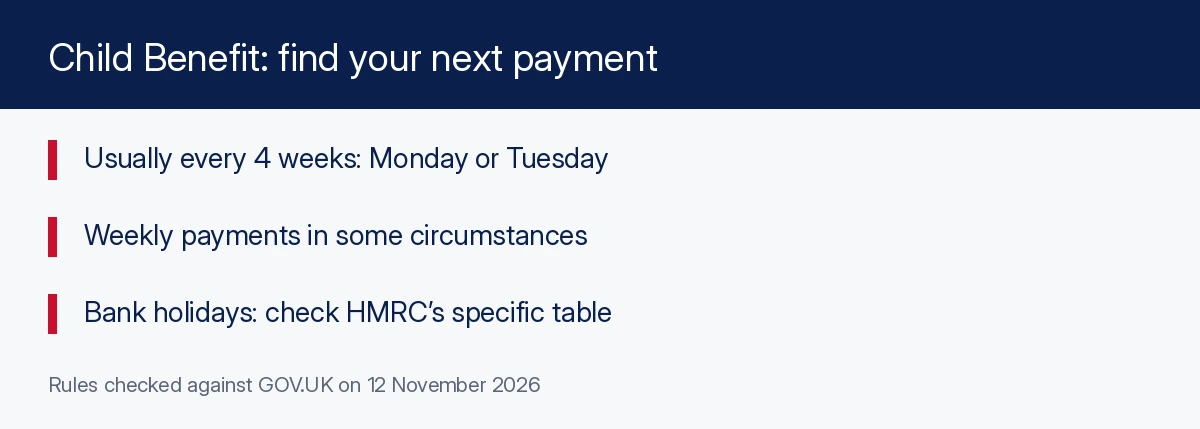
Child Benefit is usually paid every four weeks on a Monday or Tuesday. Weekly payments are available in some circumstances. Check your award notice for the first date and HMRC’s specific bank-holiday table for changes, including Scotland and Northern Ireland exceptions.
Check Child Benefit payment dates, the weekly option, published Christmas changes and HMRC’s steps for missing payments.
In this guide
- When are family allowance payment dates for Child Benefit?
- Is Child Benefit four-weekly or weekly?
- How do you work out your next Child Benefit payment?
- When will your first Child Benefit payment arrive?
- What happens to Child Benefit on bank holidays?
- What are the published Christmas 2026 Child Benefit changes?
- What extra checks matter in Scotland and Northern Ireland?
- Does the High Income Child Benefit Charge affect the calendar?
- What should you do if Child Benefit has not arrived?
- How can you keep the payment record reliable?
- Common questions
- Official sources
- Related guides

When are family allowance payment dates for Child Benefit?
If you are searching for family allowance payment dates, check the official Child Benefit timetable. HMRC says Child Benefit is usually paid every four weeks on a Monday or Tuesday. Some claimants can receive weekly payments. Bank-holiday arrangements must be checked in the specific Child Benefit table.
This guide covers Child Benefit payment information for England, Wales, Scotland and Northern Ireland. Scotland and Northern Ireland have particular public-holiday exceptions, explained below. SettleUK is an independent guide, not a government site, and cannot access or confirm your personal HMRC payment record.
The useful starting point is your award notice or a normal payment in your bank history. There is no single Monday or Tuesday on which every claimant receives Child Benefit. Your own payment cycle matters just as much as the usual weekday.
Use this page to separate a regular four-weekly payment, an agreed weekly arrangement, a first payment still being processed and a holiday adjustment. Each has a different check. Avoid treating a general DWP payment calendar as the final answer for an HMRC Child Benefit claim.
Is Child Benefit four-weekly or weekly?
The standard pattern is every four weeks on a Monday or Tuesday. GOV.UK says you can have weekly payments if you are a single parent or receive certain other benefits, giving Universal Credit as an example in its main Child Benefit guide.
The separate payment-date guide also mentions weekly payments where you or your partner receive certain benefits. If you need to check whether your circumstances qualify, use the official guidance or ask HMRC. Do not assume every family can choose any payment frequency without checking.
A four-weekly payment is different from a monthly payment on the same numbered date. Keep the frequency attached to the benefit name in your diary. This is especially useful where Child Benefit and monthly Universal Credit both reach the same account.
If you are paid weekly, do not use the four-weekly counting method below as though it were your own schedule. Check your HMRC payment information instead. The purpose of a calendar is to reflect the arrangement on your claim, not to replace it with the most common pattern.
| Arrangement | Official description | Where to start |
|---|---|---|
| Usual Child Benefit pattern | Every 4 weeks, Monday or Tuesday | Award notice or normal payment history |
| Weekly payments | Available for single parents or certain benefit circumstances | Check your claim arrangement with HMRC |
| Bank-holiday payment | Different dates can apply | HMRC Child Benefit holiday table |
How do you work out your next Child Benefit payment?
GOV.UK says you can count forward four weeks from your last payment to work out the next one. It expressly warns not to do this if the payment was due on a bank holiday, because the dates are different. Keep the normal due date separate from an adjusted bank arrival.
You can check the bank statement for the last payment. The official guide says its reference begins with “HMRC Child Benefit” and contains eighteen characters. This can help distinguish it from other government payments when several benefits reach the same account.
You can also view Child Benefit payment history online, with up to five previous payments shown. The service requires sign-in. Follow the official link rather than supplying personal details to an unofficial calendar or a site claiming to display your HMRC record.
As practical organisation, record the normal due date, actual arrival and any holiday explanation in separate columns. If the last bank entry was adjusted, return to the award information or HMRC guidance before setting another repeating reminder. This avoids carrying a temporary change into the rest of the year.
When will your first Child Benefit payment arrive?
Check your award notice for the first payment due date. GOV.UK says you might not receive the first payment for twelve weeks, and it can take longer if you have just moved to the UK. Your award notice is the place to check the date for your claim.
The payment-date page says Child Benefit will be backdated for up to three months. The claim page specifies that backdating is for up to three months from the date you make the claim. Check the award notice to see what was decided for your own claim.
If you are a newcomer, keep the claim details and any requests for supporting information together. The official claim page explains the documents needed when a child’s birth was registered outside the UK. Missing or additional evidence is a different question from an established payment being due on a bank holiday.
Do not interpret a friend’s first-payment experience as a promise for your application. If your award notice is unavailable or unclear, ask HMRC about the claim status and expected payment information. Once you have a confirmed normal payment, the usual frequency becomes easier to track.
What happens to Child Benefit on bank holidays?
HMRC publishes a specific Child Benefit bank-holiday table. This is important because the general GOV.UK benefits guide says Child Benefit may differ from the usual working-day-before rule. Check the actual HMRC entry rather than assuming all affected payments must arrive early.
The published table includes payment-date changes that fall after a normal due date in Scotland or Northern Ireland. HMRC also says a payment might be delayed if a bank is closed for a public holiday on the day HMRC pays you. Check with the bank for the arrival date.
Use the official GOV.UK bank-holiday calendar to identify the national holiday dates, then the separate HMRC guidance to understand Child Benefit arrangements. These are different sources answering different questions. A bank being closed and HMRC specifying a revised payment date should not be merged into an invented universal rule.
If your normal payment does not fall on one of the affected dates, the table does not establish that it has moved. Start with your own record and match the exact due date and nation. Check GOV.UK again before committing money to a bill around a holiday period.
What are the published Christmas 2026 Child Benefit changes?
As checked on 12 November 2026, HMRC’s Child Benefit bank-holiday page includes the following late-December entries. These are published Child Benefit instructions, not calculations based on the general DWP rule. Read the Northern Ireland restriction in the second row carefully.
A payment due on 28 December 2026 is listed for 24 December. A payment due on 29 December 2026 is listed for 30 December in Northern Ireland only. The second row must not be described as a UK-wide change or as an early payment.
The presence of these rows does not confirm a revised date for every other payment over Christmas or New Year. If your normal due date is not shown, check the current official table and your payment information. This guide does not add unsupported January 2027 Child Benefit dates.
For budgeting, keep an adjusted payment attached to the normal due date it represents. Check the next normal payment with HMRC if necessary rather than counting forward from a holiday-adjusted bank arrival. The official guide specifically warns against using the usual counting method for a bank-holiday payment.
| Normal due date | Published payment date | Scope |
|---|---|---|
| 28 December 2026 | 24 December 2026 | UK-wide |
| 29 December 2026 | 30 December 2026 | Northern Ireland only |
What extra checks matter in Scotland and Northern Ireland?
HMRC says public holidays in Scotland and Northern Ireland can delay a payment where the bank is closed on the day HMRC pays you. Its advice is to check with your bank for the date you will receive the payment.
Scotland also has local-holiday guidance on the HMRC page. If a local closure might affect your bank, follow that official guidance and ask the bank about your own arrival date. A national holiday list does not replace information about local banking arrangements.
Do not assume that a Scotland-only or Northern-Ireland-only row applies in England or Wales. Equally, do not apply a general early-payment explanation to a row that explicitly lists a later payment. Keep the nation beside the due date when taking notes.
The bank-holiday guide provides the national calendars from the official calendar. Use it as context, then return to HMRC’s Child Benefit page for payment exceptions. This two-source approach helps distinguish a holiday itself from a confirmed change to your benefit transfer.
Does the High Income Child Benefit Charge affect the calendar?
The official Child Benefit guide says you or your partner may have to pay the High Income Child Benefit Charge where adjusted net income is over the relevant threshold. This page does not quote a threshold or calculate tax: use the official guidance and calculator for your circumstances.
The same guidance says you can make a claim and opt out of receiving payments if you do not want to pay the charge. Other advantages, such as National Insurance credits, may still apply. A claim and an active bank-payment arrangement are therefore not always the same thing.
If you deliberately opted out of payments, do not use an ordinary payment calendar to conclude HMRC owes a missing four-weekly transfer. Check the payment choice recorded on the claim and ask HMRC if you want to understand or change it.
For the amount of a current award or a tax-charge question, follow the official Child Benefit pages rather than inferring an amount from another family’s bank entry. This payment-date guide avoids rate figures so it does not confuse the calendar with a calculation of personal entitlement.
What should you do if Child Benefit has not arrived?
HMRC’s payment-date guidance says to check the due date and contact your bank before calling the Child Benefit Office about a late payment. Look at the award notice, normal payment pattern and holiday table, including any Scotland or Northern Ireland restriction.
The official guide lists possible reasons payments have stopped: a bank change not reported, missing information about education plans after a child turns sixteen, an unanswered HMRC letter, a child living with someone else, or no longer being eligible. Check correspondence rather than assuming every missing entry is a holiday delay.
The official contact page says the HMRC app can show payment information and help manage the claim. For general enquiries it lists 0300 200 3100, Monday to Friday, 8am to 6pm, closed on bank holidays. Check the page for current details and accessibility support.
You will need your National Insurance number when calling HMRC. As practical preparation, also keep the due date, bank’s response and relevant letter in front of you. Ask whether the payment was issued, whether the claim needs attention and what to do next; this guide cannot promise a resolution date.
How can you keep the payment record reliable?
Keep Child Benefit separate from DWP benefits in your calendar. Add the normal frequency, usual weekday and latest confirmed payment. Where HMRC publishes a holiday adjustment, note the due date and actual payment date together so the change remains understandable when reviewing the next entry.
Before changing a reminder, check whether the last payment was a normal transfer, an adjusted holiday payment or the first payment on an award. The official counting method applies to the normal four-weekly pattern and comes with an explicit warning about bank-holiday cases.
If someone else helps manage the claim, remember that HMRC can only discuss personal claim details with you or an authorised representative. A partner can obtain general advice but must be authorised to discuss the claim. Use the official contact page for that distinction.
For your next check, open the payment-date guide or HMRC account service linked in the sources. Use this article to organise the questions, then rely on official information for a personal due date, claim status or payment change.
Common questions
When is Child Benefit normally paid?
Usually every four weeks on a Monday or Tuesday.
Can I get weekly Child Benefit?
GOV.UK says weekly payment is available for single parents or people in certain benefit circumstances. Check the official guidance for your claim.
Can I count four weeks from the last payment?
Yes for the normal pattern, but GOV.UK says not to do this if the payment was due on a bank holiday because the dates differ.
When is Child Benefit due on 28 December 2026 paid?
HMRC’s published table lists 24 December 2026 for a payment due on 28 December 2026.
What about 29 December 2026 in Northern Ireland?
HMRC lists 30 December 2026 for a payment due on 29 December 2026, in Northern Ireland only.
How long can the first payment take?
GOV.UK says you might not get it for twelve weeks, and it can take longer if you have just moved to the UK. Check your award notice.
What should I do if payment is late?
Check your payment date and contact your bank before calling the Child Benefit Office, as HMRC advises.
Official sources
- Child Benefit — GOV.UK · Checked 2026-11-12
- Child Benefit payment dates — GOV.UK · Checked 2026-11-12
- Child Benefit — GOV.UK · Checked 2026-11-12
- Child Benefit: enquiries — GOV.UK · Checked 2026-11-12
- Child Benefit — GOV.UK · Checked 2026-11-12
- How and when your benefits are paid — GOV.UK · Checked 2026-11-12
- Bank Holidays — official guidance — GOV.UK · Checked 2026-11-12
- Child Benefit payment dates — GOV.UK · Checked 2026-11-12
SettleUK is an independent guide. It is not a government website and is not affiliated with GOV.UK, DWP, HMRC or the NHS.