Universal Credit payment dates: 2026 rules and first payment
When are Universal Credit payment dates?
Universal Credit is normally monthly, with payment usually seven days after each assessment period ends. The first payment usually takes around five weeks. A payment due on a weekend or bank holiday arrives on the working day before. Scottish claimants can choose twice-monthly payments.
Understand your assessment period, first-payment wait, Scottish choices and what to check if a payment is missing.
In this guide
- When are Universal Credit payment dates?
- How does the monthly assessment period work?
- How long does the first payment take?
- Is Universal Credit monthly or every four weeks?
- How do twice-monthly payments work in Scotland?
- What if the payment date is a weekend or bank holiday?
- Can an advance help while you wait?
- What if monthly payments are difficult to manage?
- Could the amount change even if the date stays the same?
- What should you do if Universal Credit has not arrived?
- Common questions
- Official sources
- Related guides

When are Universal Credit payment dates?
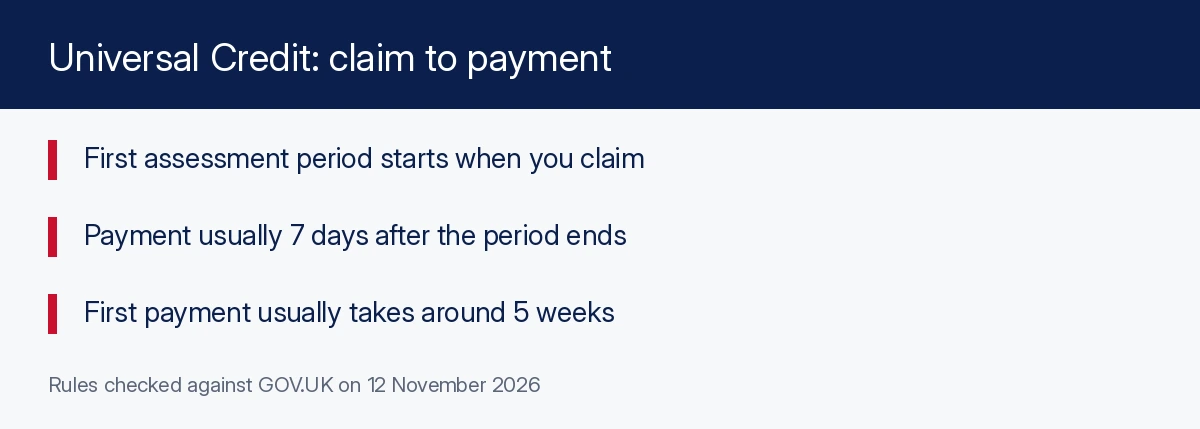
Universal Credit payment dates normally follow a monthly cycle. Your first assessment period starts on the day you claim, and payment usually arrives seven days after each monthly assessment period ends. The first payment usually takes around five weeks. After that, the normal payment date stays the same each month.
This guide explains the standard Great Britain arrangement for England and Wales, Scottish payment choices, and where Northern Ireland claimants should check separate arrangements. SettleUK is an independent guide, not a government site. Your account and the service handling your claim remain the sources for personal payment information.
For Universal Credit payment dates in 2026, the key question is your own assessment period, not a national payday. Two people making claims on different dates should not assume their money arrives together. Check your statement before using someone else’s experience to plan rent or other essential spending.
There are three dates worth recording separately: when your claim begins, when the assessment period ends, and when payment is due. Keeping those labels in your diary helps distinguish a payment moved by a bank holiday from a change in the amount awarded.
How does the monthly assessment period work?
GOV.UK calls the monthly period used to calculate Universal Credit an assessment period. Your circumstances during that period affect the payment. Report changes so the service has the correct information; do not assume a regular payday guarantees the same amount every month.
The first period starts on the day you make your claim. In the official example, Sam claims on 10 September. The first assessment period runs to 9 October, the next starts on 10 October, and the first payment arrives on 17 October.
Sam then has the 17th as the normal payment date each month. This is an official illustration of the calculation, not a prediction of your own dates. Use the dates in your online account to apply the same distinction to your claim.
If you are checking why the amount changed, compare the assessment periods and the information used for each. If you are checking whether money is late, compare the scheduled payment date with the bank entry. Those questions may need different explanations from Universal Credit.
| Stage in GOV.UK example | Date or period |
|---|---|
| Claim made | 10 September |
| First assessment period | 10 September to 9 October |
| Next assessment period begins | 10 October |
| First payment | 17 October |
| Normal later payment date | 17th of each month |
How long does the first payment take?
The official guide says it usually takes around five weeks to receive the first payment. This reflects the monthly assessment period followed by the usual payment interval. Check your account for your expected date and any tasks you still need to complete.
If you have just applied, check the account for your payment information and any requests relating to the claim. A budgeting problem during the first-payment wait is different from an established monthly payment failing to arrive on its scheduled date.
Where you need help with bills or other costs before the first payment, the official route is to apply for an advance. Read the repayment section before deciding how much to request. A payment brought forward through borrowing affects the money available from later payments.
As practical preparation, make a list of essential costs due before your expected first payment and compare it with money already available. Use that list when explaining why you need an advance. Keep any application decision alongside the expected first-payment details so you can check what happens next.
Is Universal Credit monthly or every four weeks?
Under the standard arrangement, Universal Credit is paid once a month, usually into a bank, building society or credit union account. After the first payment, GOV.UK says you are paid on the same date every month. That differs from the four-weekly pattern used by benefits such as PIP.
If you receive another benefit alongside Universal Credit, put it on a separate diary line. Do not repeat a Universal Credit date at four-week intervals or use a PIP payment as evidence of when Universal Credit should arrive. Each award has its own payment information.
Where both partners claim Universal Credit, the standard arrangement is one payment each month for the household. In Scotland, a household choosing twice-monthly payment receives two payments each month. GOV.UK advises contacting the Universal Credit helpline if you are worried about accessing this money.
Your Universal Credit payment can include money for rent or other housing costs. GOV.UK says you will usually need to pay this to your landlord. When planning a monthly payment, keep any housing commitment visible rather than treating the whole bank entry as money available for other spending.
How do twice-monthly payments work in Scotland?
If you live in Scotland, you can be paid once or twice a month. For a new claim, a notification about the choice arrives after the first payment. If you already receive Universal Credit without having had that notification, ask your work coach about being paid twice a month.
The first payment under the twice-monthly arrangement is still for a full month. The first half of the second month’s payment comes a month later. The other half arrives fifteen days after that. GOV.UK explains that this leaves about a month and a half before the full second payment has arrived.
The official example uses a first full payment on 14 December, half of the second payment on 14 January and the other half on 29 January. These are example dates from GOV.UK, not Christmas 2026 payment confirmations or an instruction that every Scottish claimant uses those days.
Before choosing a payment pattern, compare essential bills with when each part of the award would be available. Ask Universal Credit to explain the transition for your own claim if the example is unclear. Twice-monthly payment should not be entered in a diary as a new payment every two weeks.
| Scottish official example | What arrives |
|---|---|
| 14 December | First payment for a full month |
| 14 January | First half of second payment |
| 29 January | Second half of second payment |
What if the payment date is a weekend or bank holiday?
The Universal Credit payment guide says that, when the payment date is on a weekend or bank holiday, you are paid on the working day before. Start with your normal payment date. A holiday elsewhere in the month does not itself establish that your payment moves.
Use the official bank-holiday calendar for the appropriate nation when checking a possible clash. England and Wales share one calendar, while Scotland and Northern Ireland have different entries. The calendar identifies holidays; your statement and any official payment notice identify what applies to your claim.
Our Christmas and bank-holiday guides show the official calendar without presenting calculated dates as a published DWP payment announcement. When an exact festive payment date has not been confirmed for your claim, check the account or ask Universal Credit rather than relying on a general online list.
For budgeting, label an early arrival against the normal payment it represents and check when the following payment is expected. The fact that money appeared before a holiday is not a reason to assume your assessment period, award amount or usual monthly payment pattern has changed.
Can an advance help while you wait?
You can apply for an advance if you need help with bills or other costs before the first Universal Credit payment. The amount depends on your circumstances. The official maximum is the amount of your first estimated payment; this is not a guarantee that every applicant will receive that amount.
To apply, explain why you need an advance, verify your identity, provide bank account details and explain any money or savings you have. The official application routes are your online journal, a Universal Credit contact at the jobcentre or your work coach, or the Universal Credit helpline.
GOV.UK says you will usually find out the same day whether you can get an advance. You must usually repay it within twenty-four months, normally starting from the first Universal Credit payment. Read the decision carefully so you understand what will be deducted and what remains available for bills.
If you cannot afford the repayments, you can ask for them to be delayed for three months. You still have to repay an advance if you stop claiming Universal Credit. Ask the service about your own repayment position rather than assuming a claim ending clears the outstanding balance.
What if monthly payments are difficult to manage?
You can ask for an alternative payment arrangement, known as an APA, after making a Universal Credit claim. GOV.UK lists possible arrangements including rent paid directly to the landlord, payments twice a month, or a separate payment from a partner.
Universal Credit decides whether an APA is appropriate based on your circumstances. The official guide says circumstances such as rent arrears, addiction problems, mental health issues, learning difficulties, homelessness or domestic abuse can make an arrangement more likely. A request is not the same as automatic approval.
Explain what is making the current arrangement difficult and which bills or access problems you need help with. Keep the request focused on your own situation. If you live in Scotland, ask how an APA relates to the separate once- or twice-monthly choice before assuming the processes are identical.
For Northern Ireland, GOV.UK directs claimants to separate payment information and a different Universal Credit Service Centre contact route. This guide does not assign the Great Britain monthly timetable to Northern Ireland. Check the Northern Ireland guidance linked from the official page for your own arrangement.
Could the amount change even if the date stays the same?
Yes. Universal Credit is calculated each month. GOV.UK says the amount should stay the same where an employer pays the same amount on the same date and personal circumstances do not change. Different earnings or payment timing within an assessment period can affect the calculation.
The official wages guide highlights periods in which you receive no wages, more than one wage payment, or a different earnings amount. Those are reasons to check the statement rather than assuming a smaller bank entry means part of the payment is late.
Most employers report wages for you, according to GOV.UK. Self-employed claimants normally need to report monthly earnings. If the earnings shown do not appear to match the relevant assessment period, ask Universal Credit about the information used instead of trying to alter the payment calendar yourself.
A useful enquiry separates the issues: identify the assessment period, the scheduled payment, the amount shown on the statement and the money actually received. This is practical preparation for a conversation with the service, not a replacement for its explanation of your award.
What should you do if Universal Credit has not arrived?
Check your online statement and the date the payment was due. Compare it with your bank transactions and the official weekend or holiday rule. If the amount shown is different from what you expected, ask about the calculation as well as whether a transfer has been made.
Contact Universal Credit through your online account or by calling the official helpline. GOV.UK lists 0800 328 5644 for the Universal Credit helpline, Monday to Friday, 8am to 6pm. Check the official contact page for accessibility routes and current contact information before calling.
If you live in Northern Ireland and want to use a helpline, the official page directs you to the Universal Credit Service Centre instead. Avoid using a Great Britain contact route simply because a general payment-date article lists it.
As a practical enquiry checklist, give the date expected, the relevant assessment period, what the statement says and what the bank shows. Explain if the missing money leaves you unable to meet essential costs. Ask what action is needed and how to follow up; this guide cannot promise an individual resolution time.
Common questions
Does Universal Credit have a national payday?
No. Your claim has its own assessment periods and payment date. After the first payment, the standard pattern is the same date each month.
How long is the first-payment wait?
GOV.UK says the first payment usually takes around five weeks. You can apply for a repayable advance if you need help before it arrives.
When is payment made after an assessment period?
Usually seven days after the monthly assessment period ends. Check your account for your own statement and payment information.
Can I be paid twice a month in Scotland?
Yes. Scottish claimants can choose once- or twice-monthly payments. New claimants receive a notification after their first payment.
What happens if payday falls on a weekend?
The Universal Credit guide says payment is made on the working day before a weekend or bank holiday.
Do I repay a first-payment advance?
Yes. You usually repay within twenty-four months, normally starting from your first payment. If repayments are unaffordable, you can ask for a three-month delay.
Where do I report a missing payment?
Use your Universal Credit online account or the official helpline. Northern Ireland claimants should use the Universal Credit Service Centre contact route.
Official sources
- Universal Credit — GOV.UK · Checked 2026-11-12
- How and when your benefits are paid — GOV.UK · Checked 2026-11-12
- Apply for a Universal Credit advance or hardship payment — GOV.UK · Checked 2026-11-12
- Universal Credit — GOV.UK · Checked 2026-11-12
- Universal Credit — GOV.UK · Checked 2026-11-12
- Bank Holidays — official guidance — GOV.UK · Checked 2026-11-12
SettleUK is an independent guide. It is not a government website and is not affiliated with GOV.UK, DWP, HMRC or the NHS.