PIP payment dates: 2026 four-weekly and bank holiday rules
When are PIP payment dates?
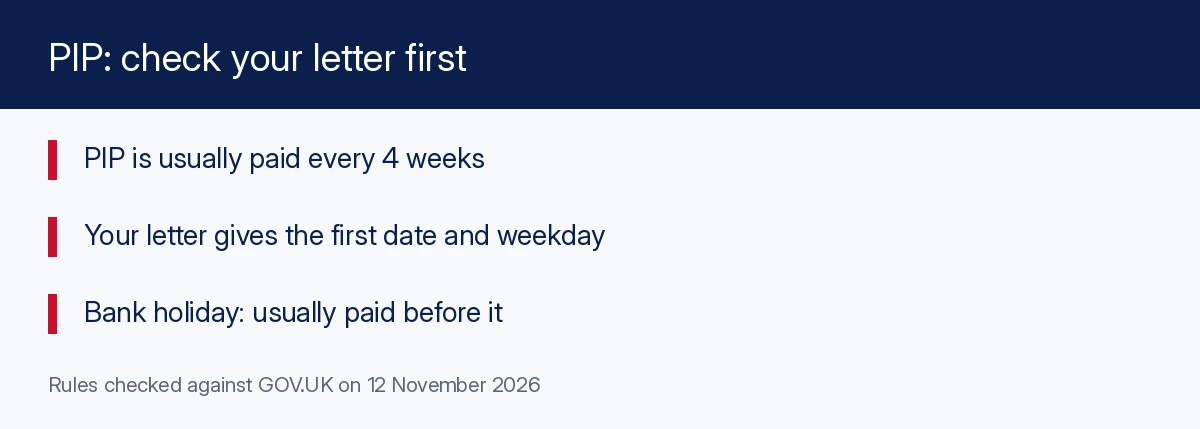
PIP is usually paid every four weeks. Your decision letter gives the first payment date and usual weekday. If payday falls on a bank holiday, GOV.UK says payment is usually made before it, with normal payments continuing afterwards. Scotland uses Adult Disability Payment for new applications.
Find your personal PIP payment pattern, check holiday adjustments and use the right service if money has not arrived.
In this guide
- When are PIP payment dates?
- What does your decision letter tell you?
- Is PIP paid monthly or every four weeks?
- What happens when PIP payday is a bank holiday?
- How should you check Christmas PIP payment dates?
- What changes if you live in Scotland?
- Does a changed amount always mean a payment is late?
- Which changes should you report?
- What should you do if PIP has not arrived?
- How can you keep a useful PIP payment record?
- Common questions
- Official sources
- Related guides

When are PIP payment dates?
PIP payment dates normally follow a four-weekly cycle. Your decision letter tells you the first payment date and the weekday you will usually be paid. If a payment date falls on a bank holiday, GOV.UK says it will usually be paid before the holiday, with normal payments continuing afterwards.
This guide focuses on PIP payment information for England and Wales. It flags Scotland’s Adult Disability Payment system and directs Northern Ireland readers to their own paying office for claim-specific instructions. SettleUK is an independent guide, not a government site.
There is no single PIP payday for everyone in 2026. A general table of holiday dates cannot tell you where your award sits in its four-week cycle. Start with your decision letter, then compare the expected payment with your actual bank entries.
Use this guide when checking a regular payment, an early bank-holiday arrival or a missing bank entry. If you are waiting for a decision on a new claim, the regular four-weekly rule does not establish when that decision or the first payment will arrive.
What does your decision letter tell you?
The official PIP payment page says the decision letter provides the first payment date, the usual payment weekday, how long you will get PIP and when or whether the claim will be reviewed. Keep that letter available when setting up reminders or asking about a payment.
Those details answer different questions. The first payment date anchors the personal schedule; the weekday helps check later entries; the award duration and review information describe the decision. Do not treat a regular bank entry as a replacement for reading the correspondence about your award.
If you cannot find the letter or cannot reconcile it with the bank history, ask the service handling the claim to explain the payment information. Do not adopt a friend’s payment weekday or a date from a general article as a substitute.
As practical organisation, keep a copy of the relevant page of the letter with your payment diary. Record the date expected and what arrived. This gives a clear starting point if you later need to explain which payment appears to be missing.
| Information in the PIP letter | What to use it for |
|---|---|
| Date of first payment | Establish the start of your own payment record |
| Usual payment weekday | Check the normal weekday |
| How long the award lasts | Understand the decision’s duration |
| When and if a review will happen | Keep track of review correspondence |
Is PIP paid monthly or every four weeks?
GOV.UK says PIP is usually paid every four weeks. It is not described as a payment made on the same numbered date each calendar month. Keep the official frequency in your diary so it does not get confused with a monthly Universal Credit payment.
For a household receiving both benefits, maintain separate lines for PIP and Universal Credit. An arrival on one award does not show that the other is late. Different payment frequencies also mean that a combined monthly budget needs to identify which money has actually arrived.
Use a known payment together with the decision letter when checking the pattern. If that payment arrived early for a holiday, keep the ordinary due date alongside the bank arrival. Otherwise, an early entry can become the wrong starting point for later reminders.
This page does not turn a weekly award rate into a predicted transfer amount. The official PIP page lists rates separately from payment frequency, and individual circumstances can affect the award. For the amount due to you, use the decision and any later correspondence from the paying service.
What happens when PIP payday is a bank holiday?
The PIP guide says a payment due on a bank holiday will usually be paid before the bank holiday. After that, payments continue as normal. The general GOV.UK benefits guide says a weekend or bank-holiday payment is usually made on the working day before.
Begin by checking whether your own normal payment is due on the affected day. A holiday appearing in the national calendar does not mean all PIP claimants are paid early. Your personal four-weekly position determines whether the holiday is relevant.
Use the official calendar for the nation concerned and read any specific payment notice from the service. Our bank-holiday guide lists the verified holiday dates without presenting a calculated schedule as a DWP announcement for your claim.
If money appears earlier than expected, label it as the relevant regular payment when reviewing your budget. As a practical precaution, check the following expected payment before making commitments based on the earlier arrival. A change in arrival date alone does not establish a change in the award.
How should you check Christmas PIP payment dates?
Christmas payment searches can mix normal benefit transfers, public holidays and bonus eligibility. For PIP, first check the normal payment date in your records. Then read the official bank-holiday rule and any seasonal instructions applying to that particular payment.
The Christmas guide links the verified holiday calendar and explains the distinction between a holiday date and an officially confirmed payment date. Do not treat a general festive headline as a timetable applying to every PIP recipient.
Where a payment is brought forward, keep the underlying normal date visible in your diary. GOV.UK says payments continue as normal after the holiday adjustment. Use the award information to check the next payment rather than restarting the regular pattern from an early bank arrival.
If you are also checking a Christmas Bonus or another benefit, make that a separate enquiry. The regular PIP payment rule does not by itself explain the amount or timing of another payment. Identify each benefit by name when comparing your bank transactions with official information.
What changes if you live in Scotland?
GOV.UK says people living in Scotland need to apply for Adult Disability Payment, or ADP, instead of PIP. ADP is the Scottish route for new applications, so a PIP payment article should not be used as a personal ADP calendar.
If you already have an ADP award, check the correspondence and guidance from Social Security Scotland for payment information. The official mygov.scot guide explains what Adult Disability Payment is and links to the sections about applications and receiving the award.
If you receive PIP and move from England or Wales to Scotland, GOV.UK says you must tell DWP and make a new ADP claim. If you receive ADP and move from Scotland to England or Wales, it says to notify Social Security Scotland and make a new PIP claim.
The official page warns that payments can be affected if you do not apply promptly after moving. Read the current moving instructions rather than assuming the transfer is automatic. Keep both services’ correspondence together so you can ask about the timing for your own move.
Does a changed amount always mean a payment is late?
No single payment-date rule explains every difference in the amount received. PIP has a daily living part and a mobility part, and entitlement depends on how difficult daily living and getting around are for you. Read the award information before assuming a smaller bank entry is an incomplete transfer.
GOV.UK says PIP is tax free and the amount is not affected by income or savings. It also says to report relevant changes straight away. A payment enquiry should therefore distinguish a question about the award decision from a question about a bank entry not arriving.
If the letter shows a different amount or a later decision changed the award, ask the service to explain that decision. If the expected transfer has not appeared, identify the due date and bank record. Keeping those issues separate makes the enquiry clearer.
Check the official PIP page for current weekly rates and your decision letter for the award you receive. If a bank transfer differs from what the letter leads you to expect, ask the PIP enquiry line to explain the payment.
Which changes should you report?
The official change-of-circumstances guidance says to contact the PIP enquiry line straight away for relevant changes to needs or circumstances. These include needing more or less help with daily living or mobility tasks and going into hospital, a hospice, a nursing home or a care home.
You must also report changes to personal details such as your name, address, phone numbers, bank account or doctor. GOV.UK says these personal-detail changes will not normally affect eligibility or the amount, but the service still needs to be told.
Changes in care needs or certain circumstances can mean the award goes up, goes down, stays the same or stops. Do not assume an unexplained bank difference can be resolved only by checking a holiday calendar. Read any new correspondence and ask which decision or payment is involved.
If someone helps you deal with the service, the official page explains how they can join a call or call on your behalf with you present. Check the current guidance for the appropriate route. As practical preparation, keep the details of the reported change alongside the date you contacted the service.
What should you do if PIP has not arrived?
Compare your decision letter and usual payment pattern with the bank transactions. Check whether the expected date was affected by a weekend or bank holiday, and whether an earlier payment is already present. If the award amount changed, identify that separately from the missing arrival.
For an existing PIP claim in Great Britain, GOV.UK lists the PIP enquiry number as 0800 121 4433, Monday to Friday, 9am to 5pm. The official Disability Service Centre page also gives accessibility routes and options for alternative formats such as braille, large print or audio CD.
Northern Ireland readers should check the contact route on their own PIP correspondence or through the official Northern Ireland service, rather than assuming this Great Britain number administers their claim. Scottish ADP enquiries belong with the Scottish award service.
As a practical checklist, prepare the expected payment date, last payment received, relevant letter and account checked. Explain any immediate difficulty meeting essential costs. Ask what happened, whether you need to provide information and how to follow up. This page cannot check the claim or promise when missing money will arrive.
How can you keep a useful PIP payment record?
A useful record separates the usual payment date from the date money actually appeared. Add a note for any official holiday explanation and keep the relevant letter accessible. This helps prevent a temporary early payment from being mistaken for a permanent change to the four-weekly pattern.
If your household receives other benefits, label each entry with its benefit name. Keep PIP, Universal Credit, State Pension or a carer’s payment separate when planning bills. The same bank account can contain payments governed by different schedules.
Before a holiday period or a move between nations, check the official guidance and your own correspondence together. General payment rules are useful context, but they cannot confirm whether a particular claim has been transferred, a bank change has been processed or an award decision has changed.
Return to the official source whenever you need a personal date or amount confirmed. Use the related guides for the general benefit pattern or holiday calendar, then contact the paying service with a clear description of the specific payment you are checking.
Common questions
How often is PIP paid?
Usually every four weeks, according to GOV.UK.
Where is my first PIP payment date?
Your decision letter tells you the first payment date and the weekday you will usually be paid.
Does PIP arrive early for a bank holiday?
Usually it is paid before the bank holiday if the normal date falls on one. Payments then continue as normal.
Is PIP monthly like Universal Credit?
No. PIP is usually four-weekly; the standard Universal Credit pattern is monthly.
Do new applicants in Scotland claim PIP?
GOV.UK says people living in Scotland should apply for Adult Disability Payment instead of PIP.
Who can help with an existing PIP claim?
In Great Britain, the official PIP enquiry line handles existing claims. For Northern Ireland, check your award’s official contact route; for Scottish ADP, use Social Security Scotland.
Official sources
- Personal Independence Payment (PIP) — GOV.UK · Checked 2026-11-12
- Personal Independence Payment (PIP) — GOV.UK · Checked 2026-11-12
- Personal Independence Payment (PIP) — GOV.UK · Checked 2026-11-12
- Contact the Disability Service Centre — GOV.UK · Checked 2026-11-12
- How and when your benefits are paid — GOV.UK · Checked 2026-11-12
- What Adult Disability Payment is — mygov.scot · Checked 2026-11-12
- Bank Holidays — official guidance — GOV.UK · Checked 2026-11-12
SettleUK is an independent guide. It is not a government website and is not affiliated with GOV.UK, DWP, HMRC or the NHS.