DWP Easter payment dates 2027: bank holiday rules
Will DWP payments arrive early for Easter 2027?
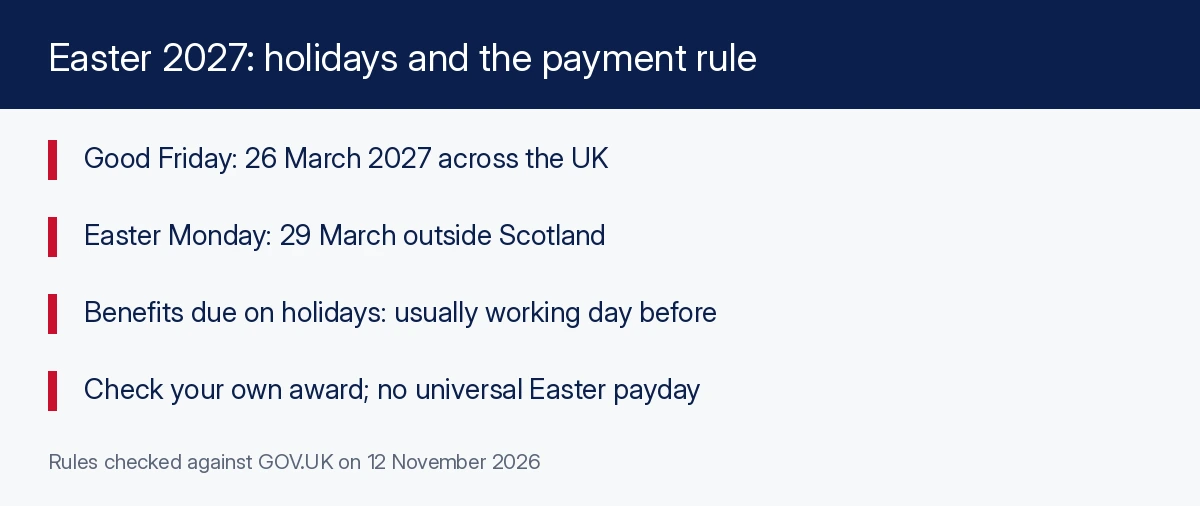
Benefits due on a weekend or bank holiday are usually paid on the working day before. Good Friday is 26 March 2027 across the UK. Easter Monday is 29 March in England, Wales and Northern Ireland, but is not listed for Scotland. Check your personal award and benefit-specific guidance.
A rule-based Easter 2027 guide: verified holidays, ordinary payment frequencies and the checks needed before relying on a payment date.
In this guide
- Will DWP payments arrive early for Easter 2027?
- Official Easter bank holidays by UK nation
- How the weekend and bank-holiday rule works
- Universal Credit: check the statement and national arrangement
- State Pension, Pension Credit and disability benefits
- ESA, JSA and Carer’s Allowance
- Child Benefit needs a separate HMRC check
- Scotland and Northern Ireland: avoid calendar mix-ups
- Budgeting when money arrives before its usual date
- What to check if your expected payment is missing
- Common questions
- Official sources
- Related guides

Will DWP payments arrive early for Easter 2027?
They usually will if the normal payment date falls on a weekend or bank holiday. GOV.UK says benefits are usually paid on the working day before in that situation. The rule does not mean every claimant receives an early payment over Easter.
The official 2027 calendar lists Good Friday on 26 March across England, Wales, Scotland and Northern Ireland. Easter Monday is 29 March in England, Wales and Northern Ireland. It is not listed as a Scottish bank holiday in the GOV.UK data checked for this guide.
This guide explains DWP Easter payment dates using the official rule and holiday calendar. Your payment still depends on your normal due date. Check the normal date in your award information, then use the official paying service if the adjustment is unclear.
SettleUK is an independent guide, not a government site. The evidence was checked on 12 November 2026. Child Benefit is paid by HMRC and needs its own check, while Universal Credit has national differences in ordinary payment frequency.
Official Easter bank holidays by UK nation
Use the nation-specific list before applying a holiday rule. England and Wales share a calendar, while Scotland and Northern Ireland have separate entries. This matters at Easter because Scotland’s official list includes Good Friday but does not include Easter Monday.
The table below reproduces the Easter entries from the GOV.UK bank-holidays JSON. It is a holiday table, not a payment-date table. None of these Easter entries is marked as a substitute day in the source used for this guide.
A national holiday list also does not establish the timetable for every bank branch, helpline or local service. If you need an appointment or help with an account around the break, check that organisation’s published arrangements separately from the benefit-payment rule.
| Nation | Good Friday | Easter Monday |
|---|---|---|
| England | 26 March 2027 | 29 March 2027 |
| Wales | 26 March 2027 | 29 March 2027 |
| Scotland | 26 March 2027 | Not listed as a bank holiday |
| Northern Ireland | 26 March 2027 | 29 March 2027 |
How the weekend and bank-holiday rule works
GOV.UK says that if a benefit payment date is on a weekend or bank holiday, you will usually be paid on the working day before. Check your award information for the normal date, then contact the paying service if an adjustment is unclear.
Start with the normal due date, not the day someone else was paid. If your payment is not due on an affected day, the existence of the holiday alone does not establish a change. Different benefit frequencies mean that claimants can have different dates in the same week.
Use your benefit’s official payment guidance to confirm any change. The holiday dates alone do not tell you when a new claim will be ready for payment.
If DWP or HMRC publishes a benefit-specific holiday timetable, use that current official guidance when planning. Check that it covers the correct year, nation and benefit. A table from a previous Easter is not evidence that the same payment dates apply in 2027.
Universal Credit: check the statement and national arrangement
GOV.UK says Universal Credit is normally paid once a month, with payment on the same date after the first award. Its payment page explicitly says that a date falling on a weekend or bank holiday is moved to the working day before.
Your online monthly statement tells you how much Universal Credit you will receive. Check it alongside the normal payment date rather than assuming that an earlier bank credit changes the amount awarded. Changes in circumstances can affect the assessment-period calculation separately from holiday timing.
Scotland offers a choice of once- or twice-monthly payments, described in the GOV.UK payment guidance. Northern Ireland’s benefit-payment page lists Universal Credit as twice monthly. Establish the actual arrangement for your household before using a standard monthly example.
A new Universal Credit claim has its own first-payment rules. Easter does not, by itself, establish a different assessment period or guarantee that a new claim is ready to be paid. Use the official service for an application query and our Universal Credit payment guide for the wider schedule.
State Pension, Pension Credit and disability benefits
GOV.UK’s general table lists State Pension and Pension Credit as usually paid every four weeks. Attendance Allowance, Disability Living Allowance and Personal Independence Payment are also usually four-weekly in that table. The holiday check starts with the ordinary date for each separate award.
Do not treat “every four weeks” as “on the same date each month”. Compare the confirmed payment schedule with Easter rather than relying on a monthly diary reminder. If you receive several awards, record each one so an early credit for one benefit does not mask a query about another.
For pension income, keep the State Pension and Pension Credit award information available when asking the service to identify a credit. A normal benefit-frequency table does not establish how every individual bank entry is presented or whether an unexplained amount covers a particular award.
If you live in Scotland and receive a benefit administered by Social Security Scotland, check that service’s own payment information. Do not assume every disability-related payment has the same administering body simply because the benefit names are similar. This Easter guide does not publish a separate Scottish disability-payment timetable.
| Benefit in GOV.UK’s general guide | Ordinary frequency to check against your award |
|---|---|
| State Pension | Usually every four weeks |
| Pension Credit | Usually every four weeks |
| Personal Independence Payment | Usually every four weeks |
| Employment and Support Allowance | Usually every two weeks |
| Jobseeker’s Allowance | Usually every two weeks |
| Carer’s Allowance | Weekly in advance or every four weeks |
ESA, JSA and Carer’s Allowance
ESA and JSA are usually paid every two weeks under GOV.UK’s general guidance. Carer’s Allowance can be weekly in advance or every four weeks. These different patterns are why a single “DWP Easter payday” would be misleading for readers with different awards.
For ESA or JSA, use the regular due date established for your own claim. The fortnightly schedule does not tell a new applicant when their first payment will arrive. A claim decision, assessment or waiting period should be checked separately from the holiday adjustment.
For Carer’s Allowance, establish whether the award is weekly or four-weekly before checking the Easter period. If the credit is unexpected, ask which period it covers. Do not infer from a weekly headline rate that the same amount should arrive every time regardless of the payment choice.
Keep any recent award change with your payment notes. If a lower amount appears, ask about the calculation as well as the date. A holiday explanation concerns timing; it does not resolve every question about deductions, eligibility or the period included in a credit.
Child Benefit needs a separate HMRC check
GOV.UK’s general benefit-payment guide warns that Child Benefit may differ. The specific Child Benefit guide says it is normally paid every four weeks on a Monday or Tuesday, with weekly payment possible in certain circumstances. Do not assume the DWP explanation supplies an HMRC-specific Easter date.
The official HMRC bank-holiday page has a table of changed payment dates. In the version fetched for this guide, it does not include an Easter 2027 row. Check again nearer Easter for HMRC’s published dates.
Check the official Child Benefit bank-holiday table again before the holiday. HMRC also says not to count forward from a payment that was due on a bank holiday, because the dates are different.
For a late Child Benefit payment, GOV.UK says to check the payment date and contact your bank before calling the Child Benefit Office. Its guide also explains payment-history access and how changes in circumstances can affect an award. Use that benefit-specific route for an unresolved query.
Scotland and Northern Ireland: avoid calendar mix-ups
Scotland’s absence of Easter Monday from the bank-holiday list is a calendar fact, not a universal assurance that every payment or banking service operates normally that day. Establish the benefit’s own payment arrangements and check the bank where necessary.
Northern Ireland lists both Good Friday and Easter Monday in the official calendar. nidirect says a benefit due on a bank holiday is usually paid on the last working day before. Its table also identifies the local ordinary frequencies, including twice-monthly Universal Credit.
Child Benefit guidance specifically warns that a bank closure for a public holiday in Scotland or Northern Ireland can delay receipt. It says to check with your bank for the date you will receive payment. This is another reason to keep HMRC advice separate from the general DWP rule.
If your household has moved between nations, check the current address and paying service before using a saved schedule. Ask which official guidance applies to your claim. Do not assume a family member’s arrangement in another nation confirms the timing for your own account.
Budgeting when money arrives before its usual date
Treat an identified early credit as part of the award it covers. Before using it, check the next confirmed payment and the costs that money must cover. A change in the bank-credit date should not lead you to count the same expected benefit twice.
Make a short list of essential outgoings before the next payment you have confirmed. Keep rent, energy, food and any agreed repayments visible in your plan. Check outgoing payment dates separately with your bank or the organisation you pay.
If you rely on several benefits, enter each award separately with its own date and amount. Mark uncertain dates as needing confirmation. That makes it easier to see whether a gap comes from missing information or a real mismatch between confirmed income and planned spending.
If the plan does not cover essential costs, use the official benefit service to ask about your circumstances and available support. Do not assume an early holiday credit is an extra award or that another payment will arrive simply because someone else received one.
What to check if your expected payment is missing
First confirm the benefit name, normal due date and destination account. Then review the official holiday guidance and any recent decision or change reported on the claim. Keep those records together so the paying office can investigate a precise question.
For Universal Credit, check the online statement and use the official account or contact route. For other DWP benefits, use the office responsible for the award. In Northern Ireland follow nidirect’s local service links. For Child Benefit, follow HMRC’s instruction to check with the bank first.
Ask whether a payment has been issued, which period it covers and whether the award has changed. Ask when you should follow up if the money is still missing. The paying service can check the details for your claim.
For further planning, use the payment dates hub, our bank holiday guide, the State Pension guide or the Child Benefit guide. Recheck official Easter guidance before relying on a date for a bill or booking.
Common questions
What are the Easter 2027 bank holidays?
Good Friday is 26 March 2027 in all UK nations. Easter Monday is 29 March 2027 in England, Wales and Northern Ireland. It is not listed as a Scottish bank holiday.
Will everyone get benefits early for Easter?
No. The general rule concerns benefits whose normal due date falls on a weekend or bank holiday. Check your own award date rather than assuming every payment moves.
What is the DWP bank-holiday rule?
GOV.UK says benefits due on a weekend or bank holiday are usually paid on the working day before. Your award information and current official guidance should confirm your own arrangement.
Are exact Easter 2027 payment dates confirmed here?
Check your award information and the official guidance for your benefit. This guide gives the published bank holidays and the usual payment rule; it does not confirm a replacement date for your individual claim.
Is Child Benefit paid under the same rule?
The general GOV.UK guide warns that Child Benefit may differ. Check HMRC’s bank-holiday table. The fetched table did not contain an Easter 2027 entry, so no Child Benefit date is assumed here.
Does Scotland have Easter Monday as a bank holiday?
Easter Monday is absent from Scotland’s 2027 GOV.UK bank-holiday list. This does not establish every service’s opening hours or your individual payment arrangement; check the paying service and bank if needed.
Official sources
- UK bank holidays: official data — GOV.UK · Checked 2026-11-12
- How and when benefits are paid — GOV.UK · Checked 2026-11-12
- Child Benefit payment dates — GOV.UK · Checked 2026-11-12
- Child Benefit bank-holiday table — GOV.UK · Checked 2026-11-12
- Universal Credit: how you are paid — GOV.UK · Checked 2026-11-12
- Northern Ireland benefit-payment rules — nidirect · Checked 2026-11-12
SettleUK is an independent guide. It is not a government website and is not affiliated with GOV.UK, DWP, HMRC or the NHS.