Bank holidays 2027: full UK lists and work rules
When are the bank holidays in 2027?
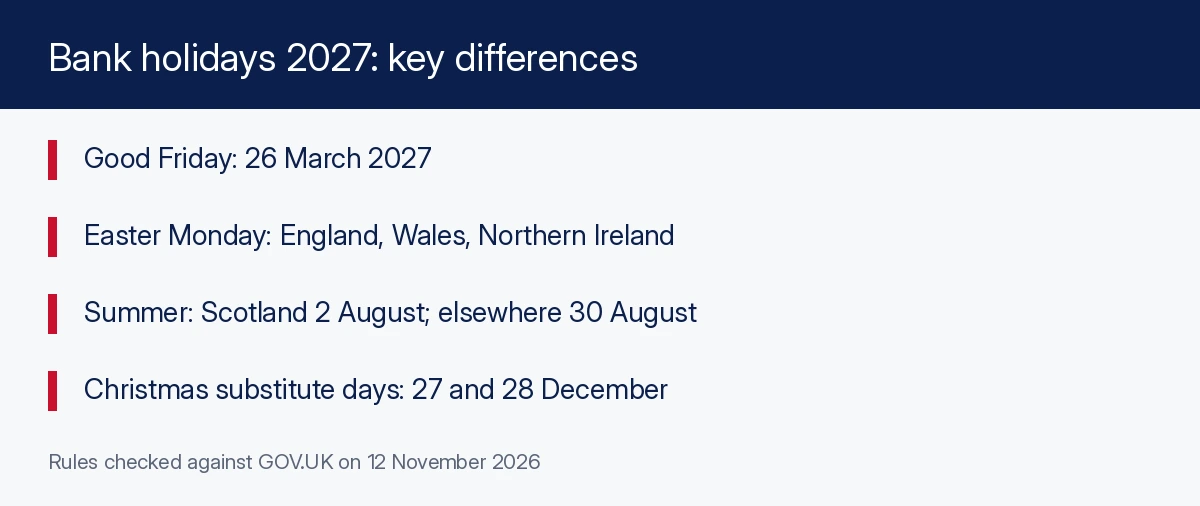
The official 2027 dates differ by nation. Good Friday is 26 March. Easter Monday is 29 March in England, Wales and Northern Ireland, but is not listed for Scotland. Christmas substitute bank holidays are 27 and 28 December.
Choose your nation’s calendar, then check your work, school and payment arrangements separately. All dates below are from the official GOV.UK feed.
In this guide
- When are the bank holidays in 2027?
- England and Wales: full 2027 bank holiday list
- Scotland: full 2027 bank holiday list
- Northern Ireland: full 2027 bank holiday list
- What does a substitute bank holiday mean?
- Do you have a right to paid time off?
- How should you plan around banks and payments?
- What happens to benefits on a bank holiday?
- Are school holidays the same as bank holidays?
- A practical checklist before booking leave or travel
- Common questions
- Official sources
- Related guides

When are the bank holidays in 2027?
Bank holidays 2027 differ between England and Wales, Scotland and Northern Ireland. Choose the table for the nation where you need the dates. The dates below come from the GOV.UK bank-holidays data checked on 12 November 2026.
England and Wales share a list. Scotland has a different summer bank holiday and its own January and November entries. Northern Ireland includes St Patrick’s Day and the Battle of the Boyne holiday. A date appearing in one table does not mean it applies everywhere.
Workplaces, bank branches, schools and local services can have different opening arrangements. Check the organisation’s own arrangements before making a booking. The sections below explain how to use the calendar for leave, benefit payments and family planning.
SettleUK is an independent guide, not a government site. You can check the latest dates in the GOV.UK calendar linked under Sources.
England and Wales: full 2027 bank holiday list
Use this list for England and Wales. The Christmas and Boxing Day entries are substitute days, so their bank-holiday dates are later than the named celebrations. Keep the holiday name and the official date together when adding them to a calendar.
For leave planning, start with the date rather than the name alone. Ask your employer whether the day is included in your annual leave allowance and whether you are scheduled to work. Your contract or employer can confirm your paid time off.
| Bank holiday | Date | Official note |
|---|---|---|
| New Year’s Day | Friday 1 January 2027 | — |
| Good Friday | Friday 26 March 2027 | — |
| Easter Monday | Monday 29 March 2027 | — |
| Early May bank holiday | Monday 3 May 2027 | — |
| Spring bank holiday | Monday 31 May 2027 | — |
| Summer bank holiday | Monday 30 August 2027 | — |
| Christmas Day | Monday 27 December 2027 | Substitute day |
| Boxing Day | Tuesday 28 December 2027 | Substitute day |
Scotland: full 2027 bank holiday list
Use this list for Scotland. The January substitute day, the summer bank holiday and St Andrew’s Day are especially useful cross-border checks. Easter Monday is not listed as a Scottish bank holiday in the official feed used for this guide.
If you live in Scotland but work for an organisation elsewhere, ask which holiday arrangements your contract follows. Do not substitute another nation’s list without checking. Likewise, confirm individual opening hours with your bank or service provider rather than assuming the Scottish list guarantees a closure.
| Bank holiday | Date | Official note |
|---|---|---|
| New Year’s Day | Friday 1 January 2027 | — |
| 2nd January | Monday 4 January 2027 | Substitute day |
| Good Friday | Friday 26 March 2027 | — |
| Early May bank holiday | Monday 3 May 2027 | — |
| Spring bank holiday | Monday 31 May 2027 | — |
| Summer bank holiday | Monday 2 August 2027 | — |
| St Andrew’s Day | Tuesday 30 November 2027 | — |
| Christmas Day | Monday 27 December 2027 | Substitute day |
| Boxing Day | Tuesday 28 December 2027 | Substitute day |
Northern Ireland: full 2027 bank holiday list
Use this list for Northern Ireland. It includes St Patrick’s Day and the Battle of the Boyne holiday as well as the dates shared with England and Wales. Keep these additional dates in mind when checking local appointments and planning leave.
For a household with work, school or family commitments in different nations, save each relevant list separately. This makes it easier to spot where one person may have a holiday and another does not. Confirm the practical arrangements with the employer or school concerned.
| Bank holiday | Date | Official note |
|---|---|---|
| New Year’s Day | Friday 1 January 2027 | — |
| St Patrick’s Day | Wednesday 17 March 2027 | — |
| Good Friday | Friday 26 March 2027 | — |
| Easter Monday | Monday 29 March 2027 | — |
| Early May bank holiday | Monday 3 May 2027 | — |
| Spring bank holiday | Monday 31 May 2027 | — |
| Battle of the Boyne (Orangemen’s Day) | Monday 12 July 2027 | — |
| Summer bank holiday | Monday 30 August 2027 | — |
| Christmas Day | Monday 27 December 2027 | Substitute day |
| Boxing Day | Tuesday 28 December 2027 | Substitute day |
What does a substitute bank holiday mean?
The official feed marks some entries “Substitute day”. In these tables that note is copied directly beside the relevant date. Use the listed date for bank-holiday planning rather than moving it again yourself or assuming the calendar date of the celebration is the working-day holiday.
For Christmas 2027, the feed lists Christmas Day on 27 December and Boxing Day on 28 December across all three regional lists. Both are marked as substitute days. Scotland also lists its 2nd January holiday on 4 January with the substitute-day note.
A useful diary entry includes the holiday name, the listed date and the nation. For example, label a substitute day explicitly rather than simply writing “Christmas”. This reduces confusion when comparing an employer’s calendar with a payment schedule or a family member’s diary.
For another year, use that year’s official calendar. Substitute dates can change, so copying this list into a later year could leave you planning around the wrong day.
Do you have a right to paid time off?
GOV.UK says bank or public holidays do not have to be given as paid leave. An employer can include bank holidays within statutory annual leave. This means you should read your holiday terms before assuming each date in the tables is an additional paid day away from work.
Almost all people classed as workers are entitled to 5.6 weeks’ paid holiday a year. GOV.UK says most workers on a five-day week must receive at least 28 days. These are annual-leave rules; they do not create a separate automatic right to paid bank holidays.
For part-time workers with regular hours throughout the year, GOV.UK describes the entitlement as at least 5.6 weeks, amounting to fewer than 28 days. If your hours vary or you work only part of the year, use the official guidance and calculator rather than applying a full-time example.
Before requesting leave, ask whether your allowance includes bank holidays, which dates your workplace observes and what happens when you are rostered to work. Keep the answer with your contract or leave record. These questions help distinguish your own terms from the general public calendar.
If you believe your paid annual leave rights are not being met, use the dispute guidance linked from GOV.UK’s holiday-entitlement page. This guide cannot decide a contract dispute. Keep records of your hours, leave requests and the explanation your employer gives you.
How should you plan around banks and payments?
A bank-holiday calendar is a starting point for checking access to services. It does not tell you the opening hours of a particular bank branch or the processing timetable for a particular transfer. Check your own bank’s information before relying on access or a transaction deadline.
If you need help at a branch, look up the specific location and date. For an important transfer, ask the bank which timing applies to that payment. Avoid assuming that every banking service has the same arrangements merely because a date appears in the official holiday list.
For benefit income, use the government payment rule rather than a general assumption about banks. GOV.UK says benefits are usually paid directly into a bank, building society or credit union account. It also explains the usual change when a payment date falls on a weekend or bank holiday.
Keep planned outgoing bills separate from expected benefit income in your diary. If you are unsure when money will arrive or leave, check the paying office and your bank before committing it. Keep any confirmation with your payment records.
What happens to benefits on a bank holiday?
GOV.UK says that if your payment date is on a weekend or bank holiday, you will usually be paid on the working day before. Its general guide warns that Child Benefit may be different. Check the benefit-specific guidance before treating the general rule as your personal schedule.
The holiday tables above show official holidays. They are not a list of confirmed payment dates for every claimant. To work out whether a holiday matters to you, first find your usual payment date in your award information, then check the relevant benefit’s official payment guidance.
An earlier payment date should be recorded as a timing change in your budget. Do not add an expected holiday payment twice simply because the bank credit arrives before the date written in your diary. Compare the payment with your award information before deciding it is additional income.
Read our bank holiday benefit payment guide for the general approach, or use the payment dates hub to find your benefit. For the Easter break specifically, see Easter payment dates.
If the expected money is missing, gather your award letter, normal payment date and bank statement before contacting the office that pays you. Ask about your own payment rather than relying on another claimant’s experience. Different benefit schedules make other people’s bank-credit dates an unreliable comparison.
Are school holidays the same as bank holidays?
No single bank-holiday table gives your child’s complete school calendar. GOV.UK says school term and holiday dates vary across the UK and directs families to their local council’s website. Its postcode service is available for England and Wales, with separate links for Scotland and Northern Ireland.
Use the council lookup to find the local school-term information, then check the school’s own published calendar before arranging childcare or travel. The practical question is when your child is expected to attend, which cannot be answered by the national bank-holiday list alone.
For planning, put bank holidays and school dates in different diary entries. That makes it easier to see a school break extending beyond a public holiday. It also avoids treating every bank holiday as the start of a longer school holiday without checking the local information.
If you have recently moved, use the postcode for the area where you need school information. Do not reuse a calendar from your previous council without checking. For any uncertainty about an individual school’s attendance dates, ask the school or follow the council’s published contact route.
A practical checklist before booking leave or travel
Start by choosing the correct national list and noting any substitute-day labels. Then compare the dates with your work schedule, the relevant school calendar and any appointments. Treat each check as a separate task: the bank-holiday list cannot confirm all the other arrangements for you.
Next, confirm your paid-leave position with your employer before making plans that depend on time off. If you are coordinating with someone in another UK nation, compare both calendars. Scotland’s different summer date is a useful reminder that shared UK plans can involve different local holiday arrangements.
Check important banking needs and benefit income separately. Keep your normal payment date and any official advice together so you can explain what you expected if you need help. Use the official paying office for a personal payment query, rather than assuming a date from an online discussion applies.
Finally, save the source and the date you checked it. This guide reflects the GOV.UK feed read on 12 November 2026. Revisit the official calendar before a booking that depends on a particular holiday, and recheck local opening hours closer to the day.
For more help organising your first months in the UK, visit the settling-in hub. If your main concern is income around winter holidays, our Christmas payment dates guide explains how to approach that separate check.
Common questions
Is Easter Monday a bank holiday in Scotland in 2027?
It is not listed in Scotland’s 2027 GOV.UK bank-holidays data. England, Wales and Northern Ireland list Easter Monday on 29 March 2027.
When is Good Friday in 2027?
The GOV.UK feed lists Good Friday on 26 March 2027 for England and Wales, Scotland and Northern Ireland.
When is the summer bank holiday in 2027?
Scotland lists 2 August 2027. England and Wales, and Northern Ireland, list 30 August 2027.
Are bank holidays automatically paid leave?
No. GOV.UK says bank or public holidays do not have to be given as paid leave. Employers can include them within statutory annual leave.
Which Christmas dates are substitute days in 2027?
The official lists mark 27 December 2027 for Christmas Day and 28 December 2027 for Boxing Day as substitute days in all UK nations.
Will my benefit be paid early?
GOV.UK says a benefit due on a weekend or bank holiday is usually paid on the working day before. Child Benefit may differ. Check your benefit’s official guidance and personal payment information.
Official sources
- UK bank holidays: official data — GOV.UK · Checked 2026-11-12
- Holiday entitlement — GOV.UK · Checked 2026-11-12
- How and when your benefits are paid — GOV.UK · Checked 2026-11-12
- School term and holiday dates — GOV.UK · Checked 2026-11-12
SettleUK is an independent guide. It is not a government website and is not affiliated with GOV.UK, DWP, HMRC or the NHS.