ESA payment dates and rates 2026 to 2027
When are ESA payments made?
ESA is paid every two weeks. If a benefit payment date falls on a weekend or bank holiday, GOV.UK says you will usually be paid on the working day before. Check your award for your own regular date.
Understand your ESA award type, payment frequency and assessment stage before comparing a bank credit with a published weekly rate.
In this guide
- When are ESA payments made?
- How to identify your regular ESA payment date
- Bank holidays and early payments
- New Style ESA and income-related ESA are different
- ESA rates for 2026 to 2027
- Assessment delays and moving to the main phase
- Eligibility, Statutory Sick Pay and claim preparation
- Universal Credit, pensions and the amount actually paid
- How long ESA can continue and changes to report
- Northern Ireland and resolving payment problems
- Common questions
- Official sources
- Related guides

When are ESA payments made?
ESA is paid every two weeks. Your own award information establishes your regular schedule; GOV.UK does not publish one ESA payday shared by every claimant. For your ESA payment dates, start with the schedule for your own award.
GOV.UK says benefits due on a weekend or bank holiday are usually paid on the working day before. That general rule helps explain a moved payment, but it does not establish the first payment date for a new claim or the outcome of an assessment.
This guide covers England, Scotland and Wales through DWP guidance, with Northern Ireland differences signposted through nidirect. Use the GOV.UK New Style ESA route if you live in Scotland.
SettleUK is an independent guide, not a government site. The payment rules and 2026 to 2027 rates below were checked on 12 November 2026. For a missing payment or an unclear decision, contact the office responsible for your own award.
How to identify your regular ESA payment date
Find the latest award or payment information and compare it with recent bank credits. Record the benefit name, the normal due date and the period covered. If the letter and statement appear inconsistent, ask the paying office to explain the difference before using a guessed date.
Fortnightly means every two weeks, rather than twice a calendar month. This distinction matters when comparing ESA income with monthly rent or utility bills. Build a budget around the confirmed payment pattern instead of assuming the same calendar dates will repeat every month.
A weekly benefit rate is also different from the frequency of bank credits. The rate tables below show weekly amounts, while GOV.UK says ESA is paid every two weeks. Do not compare a whole bank credit with a weekly rate without checking the period covered.
For a new award, ask which period the first payment covers and when the regular schedule starts. The standard frequency alone cannot answer those questions. If you are helping someone else manage the claim, work from their decision letter with them rather than another claimant’s timetable.
Bank holidays and early payments
GOV.UK’s general rule is that benefits due on a weekend or bank holiday are usually paid on the working day before. Your award information and the paying office can help confirm an uncertain date.
Check whether your normal due date actually falls on the holiday. A nearby public holiday does not automatically move every claimant’s payment. Use official benefit information for a disputed date, particularly if your award has recently started, changed or been reassessed.
An early credit should be matched to your normal award before you count it as additional income. Note the amount and period covered, then check the next expected payment in your own information. This helps avoid budgeting twice for the same fortnight’s support.
Our bank holiday payment guide, Christmas guide and Easter guide explain seasonal checks. They do not replace your individual ESA payment information or guarantee the date a new claim will first be paid.
New Style ESA and income-related ESA are different
New Style ESA is a contributory benefit for people whose health condition or disability limits their ability to work. Normally, entitlement depends on having paid or been credited with enough National Insurance contributions. GOV.UK describes the usual test using the two full tax years before the year of claim.
You cannot make a new claim for income-related ESA. GOV.UK says existing recipients continue while eligible until their claim ends. When reading an older award, establish which type it is before applying rules about savings, partner income or a move to Universal Credit.
For New Style ESA, your or your partner’s savings do not affect the amount paid, and a partner working does not affect the claim. Some pension income can affect it. Income-related ESA has different household-income and savings rules, so the two labels should not be treated as interchangeable.
Neither the fortnightly schedule nor the name ESA tells you the whole award calculation. Keep the claim type alongside the rate, assessment stage and any deductions. If your letter includes information you do not understand, ask the office to identify the exact benefit and calculation.
ESA rates for 2026 to 2027
The amounts below are weekly maximums in the current GOV.UK ESA guide, checked against the DWP rates publication for 2026 to 2027. They describe the standard assessment and group rates, not a guarantee of the amount every individual will receive.
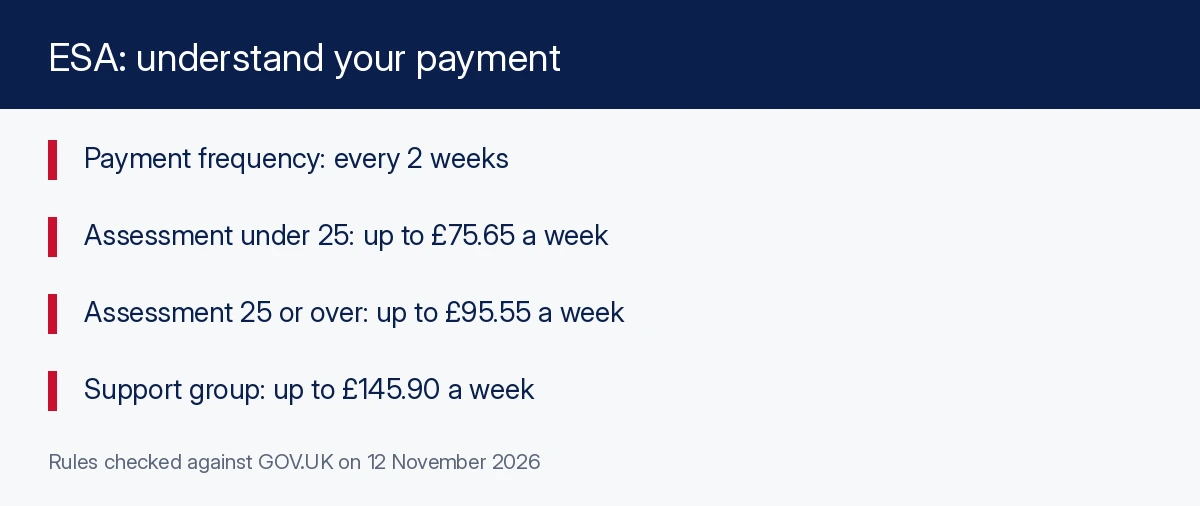
During assessment, the published amount is up to £75.65 a week if you are under 25, or up to £95.55 if you are 25 or over. GOV.UK says the assessment rate is normally paid for 13 weeks while the claim is assessed.
After assessment, the guide lists up to £95.55 a week for the work-related activity group and up to £145.90 for the support group. Older or income-related awards can involve additional rules, so use your decision notice rather than applying the simplified table to every historic claim.
| Stage or group | Published weekly amount, 2026 to 2027 |
|---|---|
| Assessment: under 25 | Up to £75.65 |
| Assessment: 25 or over | Up to £95.55 |
| Work-related activity group: current standard guide | Up to £95.55 |
| Support group | Up to £145.90 |
Assessment delays and moving to the main phase
GOV.UK says that if assessment takes longer than 13 weeks, you continue on the assessment rate until a decision is made or ESA is due to end. A higher payment depends on the decision, rather than simply reaching week 14.
The guide says ESA will be backdated if money is owed after 13 weeks. Any backdated amount depends on the decision and what you have already received. Ask the paying office about the period and calculation if a backdated credit is unclear.
A Work Capability Assessment considers how illness or disability affects the amount of work you can do. You may be asked to complete a capability-for-work questionnaire and attend an assessment. Follow the instructions in your letter, including where to send information and what happens next. Keep a copy of the questionnaire and any supporting evidence for your records.
After assessment, an eligible claimant is placed in the work-related activity group or support group. The detailed guidance explains different expectations for each. If you claim Universal Credit and New Style ESA together, GOV.UK says you have only one Work Capability Assessment.
Eligibility, Statutory Sick Pay and claim preparation
To apply for New Style ESA, you must be under State Pension age and have a disability or health condition affecting how much you can work. You also need the relevant work and National Insurance history. Check your National Insurance record if you are unsure about contributions.
You cannot receive New Style ESA while receiving Statutory Sick Pay or claiming JSA. GOV.UK says you can apply up to three months before Statutory Sick Pay ends and start receiving ESA when it ends. Use the official eligibility guidance to coordinate the change.
The detailed application guidance asks for your National Insurance number, account details, doctor’s contact details and relevant income information. It also asks for a fit note where you have been unable to work for more than seven consecutive days because of a health condition or disability.
DWP says it contacts applicants within 10 working days, with different information depending on eligibility. That contact timeframe is not a universal first-bank-credit date. Read the appointment and Claimant Commitment instructions carefully, and use the official route if you cannot complete an online application.
Universal Credit, pensions and the amount actually paid
You may receive Universal Credit at the same time as New Style ESA, depending on eligibility. If you receive both, Universal Credit is reduced by the amount of New Style ESA. Do not add the two headline awards together without allowing for the published deduction rule.
New Style ESA does not include extra amounts for children or housing costs. The detailed guidance points to Universal Credit as a possible source of household support. Eligibility for Universal Credit has its own household assessment and should be checked separately.
For New Style ESA, private pension income above £85 a week affects payment. GOV.UK says half the amount above £85 is subtracted from weekly ESA. If pension income is high enough, there may be no ESA payment, while Class 1 National Insurance credits can still continue.
For income-related ESA, household income and savings worth £6,000 or more may affect the amount paid. This is another reason to identify the award type before explaining a lower payment. A missing or reduced credit should be investigated using the calculation for that particular award.
How long ESA can continue and changes to report
The detailed New Style ESA guidance says the work-related activity group has a 365-day limit. There is no time limit for the support group. You must still meet the eligibility conditions and report relevant changes.
To keep receiving ESA, report changes in circumstances and provide fit notes where required. The guidance also explains that payment can be reduced if agreed interviews or work-related activities are missed without a good reason. Read any decision letter promptly rather than treating a changed credit as a bank error.
If income-related ESA ends because you make a new Universal Credit claim, GOV.UK describes a normal two-week continuation of the existing ESA amount while still eligible. DWP writes to explain how it works. The guide says that continuation does not need to be repaid and does not affect Universal Credit.
Do not interpret that transition rule as permission to ignore a letter or as advice that everyone should make a new claim. Follow the instructions applying to your own award. If a change is unclear, ask the service to explain the effect before relying on an estimated future income.
Northern Ireland and resolving payment problems
Northern Ireland uses its own ESA service and claim route through nidirect. The local guidance distinguishes New Style, contribution-based and income-related awards, and says fresh claims are accepted only for New Style ESA. Use that local route for claims, changes and payment queries.
nidirect publishes the same current assessment figures of up to £75.65 for under-25s and £95.55 for people aged 25 or over, and up to £145.90 for the support group. Its table also identifies a different work-related activity amount for some older claims.
For an unexplained payment, gather the award type, decision letter, expected date, recent bank credits and any change you reported. Ask the paying office to confirm the period covered, the current rate and any deduction. Avoid sharing personal claim details with an unofficial payment-date checker.
For other income planning, see Universal Credit payment dates and the payment dates hub. If your question concerns cold-weather support, check the separate qualifying rules rather than assuming New Style ESA automatically qualifies you.
Common questions
How often is ESA paid?
ESA is paid every two weeks. Check your own award information for your regular due date; there is no single payday for every claimant.
Is ESA paid early on a bank holiday?
GOV.UK says benefits due on a weekend or bank holiday are usually paid on the working day before. Check the normal due date and your official payment information.
What are the assessment rates for 2026 to 2027?
The current weekly assessment rates are up to £75.65 if under 25 and up to £95.55 if aged 25 or over.
How much is ESA in the support group?
The current GOV.UK guide lists up to £145.90 a week for 2026 to 2027. Your personal calculation can depend on the award type and relevant deductions.
Can I make a new claim for income-related ESA?
No. GOV.UK says new income-related ESA claims cannot be made. Existing awards continue while eligible until they end.
Can I receive Universal Credit and New Style ESA together?
Potentially, if eligible for both. Universal Credit is reduced by the amount of New Style ESA received. The two headline amounts should not simply be added together.
Official sources
- ESA overview — GOV.UK · Checked 2026-11-12
- ESA amounts and payment frequency — GOV.UK · Checked 2026-11-12
- ESA eligibility — GOV.UK · Checked 2026-11-12
- Benefit payment timing — GOV.UK · Checked 2026-11-12
- New Style ESA detailed guidance — GOV.UK · Checked 2026-11-12
- Confirmed 2026 to 2027 rates — GOV.UK · Checked 2026-11-12
- ESA in Northern Ireland — nidirect · Checked 2026-11-12
SettleUK is an independent guide. It is not a government website and is not affiliated with GOV.UK, DWP, HMRC or the NHS.