JSA payment dates and New Style rates 2026 to 2027
When are JSA payments made?
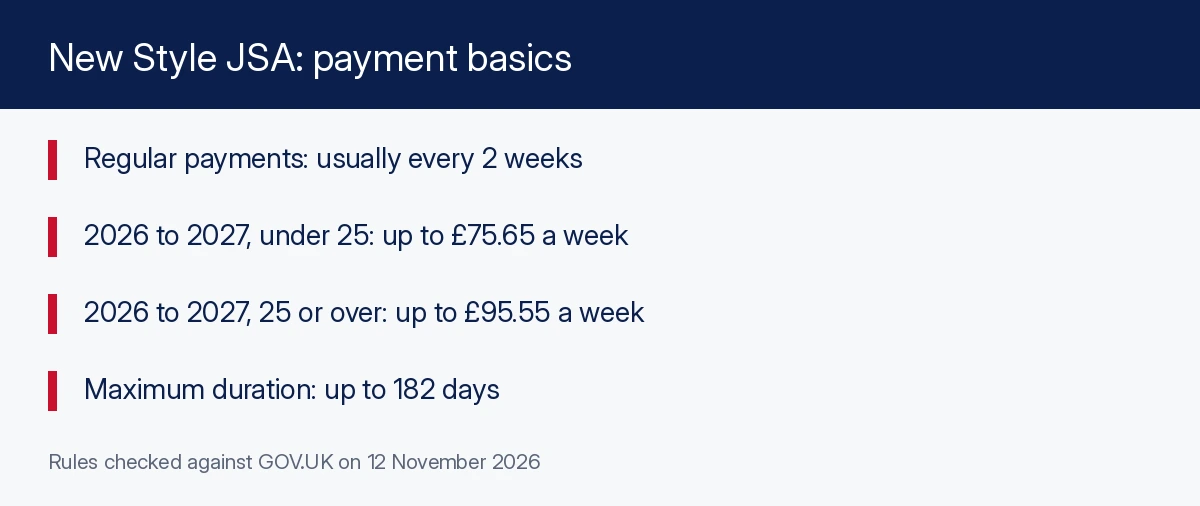
New Style JSA is usually paid every two weeks after the first payment. Benefits due on a weekend or bank holiday are usually paid on the working day before. First payments have separate waiting rules, and your award determines your own schedule.
Check your personal award before planning around a payment date. The first payment and later fortnightly payments can cover different amounts.
In this guide
- When are JSA payments made?
- Your first payment can differ from later payments
- How to follow the regular fortnightly schedule
- Bank holidays and seasonal payment changes
- JSA rates for 2026 to 2027
- Who can apply for New Style JSA?
- Savings, earnings, pensions and Universal Credit
- Interviews, your Claimant Commitment and keeping payment
- How long can you receive JSA?
- Northern Ireland and checking a missing payment
- Common questions
- Official sources
- Related guides

When are JSA payments made?
After the first payment, New Style Jobseeker’s Allowance is usually paid every two weeks. Your JSA payment dates depend on your own claim. Use the award information and your own account to identify your normal due date.
For benefits due on a weekend or bank holiday, GOV.UK says payment is usually made on the working day before. This general rule does not establish when a new claim will first be paid. The first-payment guidance has separate waiting-period information.
This guide covers England, Scotland and Wales through GOV.UK, with a separate Northern Ireland section based on nidirect. New Style JSA is not the same as Universal Credit, and new income-based JSA applications are no longer accepted.
SettleUK is an independent guide, not a government site. The payment rules and 2026 to 2027 rates were checked on 12 November 2026. The paying service must confirm your own entitlement, deductions and payment schedule.
Your first payment can differ from later payments
GOV.UK says you may have to wait up to seven days after applying for JSA to start, and up to two weeks after that for the first payment. Your first credit may not be the full amount. Do not budget on the assumption that application day is payday.
These are the published first-payment rules, not a promise of a specific bank-credit date for every applicant. Your claim still needs to be processed and the required steps completed. Keep the submission confirmation and any appointment information so you can ask about progress clearly.
The detailed Great Britain guidance says DWP contacts you within 14 days of applying, either inviting you to an interview or explaining why you are not eligible. It says you do not need to contact DWP unless more than 14 days have passed without hearing anything.
That contact period is distinct from the first-payment waiting information. An invitation to interview is not itself confirmation that money has been credited. Read each message for what it actually confirms, and check the bank account details supplied in the application if payment information seems wrong.
How to follow the regular fortnightly schedule
Once payments have started, GOV.UK says they are usually made every two weeks. That is a fortnightly pattern, not twice a month. Use the dates confirmed for your award when comparing income with bills that fall on a fixed calendar date.
The published rate is weekly, while the regular bank-credit frequency is fortnightly. Check the period covered before comparing a credit with the weekly figure. If the amount differs from what you expected, ask about the calculation rather than assuming the standard rate has changed.
A useful record includes the expected date, actual credit, amount and any decision or change reported around the same time. Keep the source of the expected date beside it. This helps distinguish an official date from a reminder you created for budgeting.
If you receive more than one benefit, identify each credit separately. New Style JSA can be paid alongside Universal Credit, but the JSA income reduces Universal Credit. Different credit dates do not mean the two awards can be added together without considering that interaction.
Bank holidays and seasonal payment changes
GOV.UK’s general benefits guide says that a benefit due on a weekend or bank holiday is usually paid on the working day before. Start with your ordinary due date and then check whether it falls on the relevant holiday. Do not move all payments merely because a holiday is nearby.
For a payment arriving early, match it to the normal award before spending it as extra income. Check which period it covers and keep enough for your planned costs until the next confirmed payment. An early payment still needs to cover its usual period.
Our bank holiday payment guide explains the general rule. For particular seasons, see Christmas payment dates and Easter payment dates. Those guides do not replace your own award information.
Check your bank account and your award information if an expected payment has not arrived. If the normal date or an expected adjustment is unclear, ask the office responsible for your claim to confirm it. Another claimant’s early credit is not reliable evidence for yours.
JSA rates for 2026 to 2027
The current GOV.UK guide lists a maximum weekly amount of £75.65 for people aged up to 24 and £95.55 for people aged 25 or over. The DWP rates publication confirms the 2026 to 2027 figures. Your actual entitlement can be lower.
Keep the tax year attached to the figures when comparing an old payment or award notice. Do not assume a lower credit means that an outdated rate has been used. Earnings, pension income, the period covered or a decision affecting the claim may need to be checked.
The first payment may not be for the full amount. Later regular payments are normally the full amount you are entitled to, which is not necessarily the headline maximum. Ask for the personal calculation if the amount cannot be reconciled with your award.
| Age | Maximum weekly amount, 2026 to 2027 | Regular frequency after first payment |
|---|---|---|
| Under 25 | Up to £75.65 | Usually every two weeks |
| 25 or over | Up to £95.55 | Usually every two weeks |
Who can apply for New Style JSA?
For Great Britain, GOV.UK says applicants normally need employee work history and Class 1 National Insurance contributions, usually in the last two to three years. It says contributions for the previous two tax years are normally required, with National Insurance credits able to count for one year.
The exact relevant years can depend on when you apply and whether an exception applies. Use the official eligibility page for its dated examples rather than assuming that any recent work automatically satisfies the test. Check your National Insurance record if you are uncertain.
You must normally be at least 18, under State Pension age, in Great Britain and not working 16 or more hours a week. GOV.UK also excludes people involved in a trade dispute and people whose illness or disability stops them working. Northern Ireland has its own eligibility guidance.
Self-employment with only Class 2 contributions does not normally qualify you for New Style JSA. GOV.UK lists exceptions for share fishermen and volunteer development workers. If your work history includes different contribution types, use the full guidance rather than treating all National Insurance payments as identical.
Savings, earnings, pensions and Universal Credit
Your savings and your partner’s savings do not affect a New Style JSA claim. The detailed guidance also says a partner’s capital and income are not taken into account. Your own earnings and pension payments can affect the amount you receive.
Working fewer than 16 hours a week does not automatically mean the maximum JSA rate is payable. GOV.UK says earnings can reduce payment. Check the work-reporting instructions and tell the service about work rather than relying only on the number of hours.
You may be eligible for Universal Credit alongside or instead of New Style JSA. If both are paid, JSA counts as income and reduces Universal Credit. A partner working or household savings can have different implications for Universal Credit, which uses a separate household assessment.
New Style JSA does not include extra amounts for children or housing costs. The detailed guidance points to Universal Credit as potential support for those needs. Check eligibility for each scheme separately instead of assuming that JSA alone covers the same household costs.
Interviews, your Claimant Commitment and keeping payment
To claim, GOV.UK says to apply and attend the required Jobcentre Plus interview. At the interview, you make an agreement about looking for work called a Claimant Commitment. Read the agreed actions carefully so that your payment planning includes the steps needed to maintain the award.
The detailed guidance says to bring photographic identity, proof of address and a further proof of identity. Bring a P45 if you have one. Use the official appointment instructions for the accepted documents and ask the service if you need help meeting the requirements.
JSA payments can be reduced or stopped if you do not keep the agreement and cannot give a good reason. If you cannot attend or complete an agreed action, contact the service and explain promptly. Do not assume a reduced credit is automatically a bank delay.
For a decision you dispute, the official guidance explains mandatory reconsideration. Keep the decision letter and any supporting information together. Use the official process to explain why you disagree and provide any evidence requested.
How long can you receive JSA?
New Style JSA can be paid for up to 182 days, described by GOV.UK as about six months. After that, speak to your work coach about your options. You must remain eligible throughout the claim.
If you have already received the full 182 days, GOV.UK describes conditions for a later claim. These include at least 12 weeks since the previous entitlement ended and a new claim in a different benefit year. Check the complete rules rather than assuming entitlement renews automatically.
A benefit year is not simply the tax year or the anniversary of your application. GOV.UK says it lasts 12 months and starts on the first Sunday in January. This distinction matters when checking the official contribution-year examples and repeat-claim rules.
Plan the end of a limited award before relying on it for ongoing bills. Ask the work coach what support you may be able to claim next and use one of the benefits calculators linked from GOV.UK. A possible future award should remain separate from confirmed JSA income in your budget.
Northern Ireland and checking a missing payment
Northern Ireland’s nidirect guidance confirms New Style JSA as a fortnightly payment and gives the same current weekly maximums of £75.65 for under-25s and £95.55 for people aged 25 or over. It has its own claim process and local service contacts.
nidirect says applicants are contacted by phone within five working days to arrange an interview. Its first-payment guidance says there may be seven waiting days and the first payment date depends on review meetings. Do not substitute the Great Britain contact timeframe for Northern Ireland’s instructions.
For a payment query, have your award letter, expected date, recent statement and any reported work or pension change ready. Ask the paying service which period the credit covers and whether anything has changed. Use the Jobseeker’s Allowance Processing Centre route linked from nidirect for Northern Ireland.
If illness prevents you from working, check the official ESA guidance rather than assuming JSA is the right claim. Our ESA payment dates guide explains the separate schedule. For other support, see Universal Credit payment dates and the payment dates hub.
Common questions
How often is JSA paid?
After the first payment, New Style JSA is usually paid every two weeks. Use your award information for your personal due date.
How long can the first payment take?
GOV.UK says you may wait up to seven days for JSA to start, then up to two weeks for the first payment. The first payment may not be for the full amount. Northern Ireland has separate first-payment guidance.
Is JSA paid early on bank holidays?
GOV.UK says benefits due on a weekend or bank holiday are usually paid on the working day before. Check your normal due date and the official information for your claim.
What are the 2026 to 2027 JSA rates?
The maximum weekly amounts are £75.65 if under 25 and £95.55 if aged 25 or over. Your personal entitlement may be lower.
Can I still apply for income-based JSA?
No. New income-based JSA applications are no longer accepted. GOV.UK points to Universal Credit instead, subject to its eligibility rules.
Do savings affect New Style JSA?
Your and your partner’s savings do not affect New Style JSA. Your earnings and pension income can affect the amount. Universal Credit has separate household rules.
Official sources
- JSA: how it works — GOV.UK · Checked 2026-11-12
- JSA eligibility — GOV.UK · Checked 2026-11-12
- Benefit payment timing — GOV.UK · Checked 2026-11-12
- New Style JSA detailed guidance — GOV.UK · Checked 2026-11-12
- Benefit and pension rates 2026 to 2027 — GOV.UK · Checked 2026-11-12
- New Style JSA in Northern Ireland — nidirect · Checked 2026-11-12
SettleUK is an independent guide. It is not a government website and is not affiliated with GOV.UK, DWP, HMRC or the NHS.