Carers allowance payment dates and rates 2026 to 2027
When are Carer’s Allowance payments made?
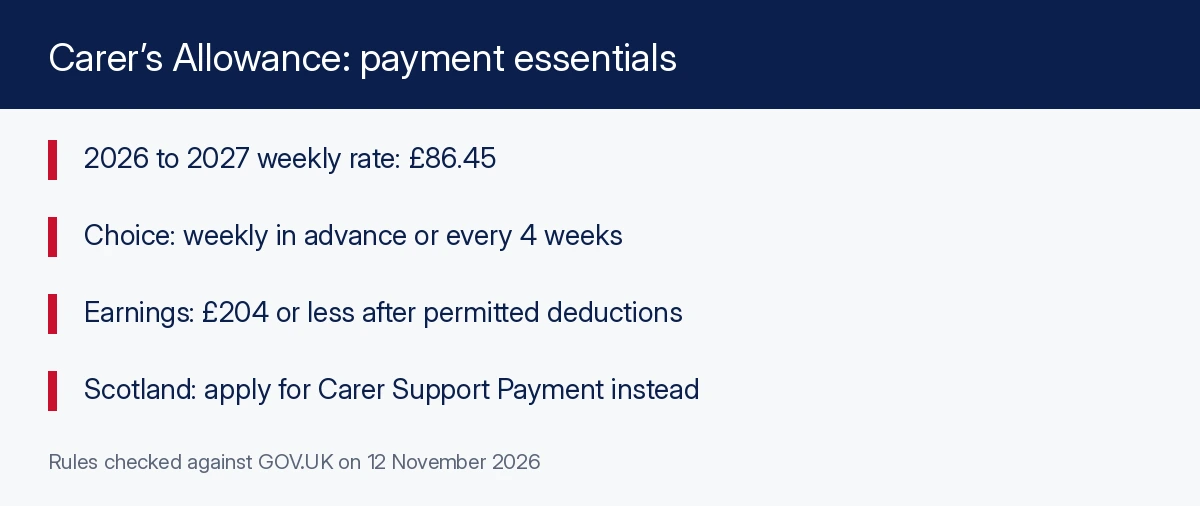
Carer’s Allowance can be paid weekly in advance or every four weeks. The confirmed 2026 to 2027 rate is £86.45 a week. Payments due on a weekend or bank holiday are usually made on the working day before. Scotland has Carer Support Payment instead.
Use your award information for your personal schedule, and check how earnings and other benefits affect the amount you receive.
In this guide
- When are Carer’s Allowance payments made?
- Weekly payments and four-weekly payments
- Carer’s Allowance rates for 2026 to 2027
- What happens around a bank holiday?
- Eligibility: caring time and the person you support
- Working and the earnings limit
- State Pension, Universal Credit and other benefits
- Scotland: Carer Support Payment and other support
- Northern Ireland and moving between nations
- Checking a missing or unexpected payment
- Common questions
- Official sources
- Related guides

When are Carer’s Allowance payments made?
You can choose to receive Carer’s Allowance weekly in advance or every four weeks. GOV.UK does not give a single payment date for every carer. For your own Carer’s Allowance payment dates, check your award information and account.
The verified weekly rate for 2026 to 2027 is £86.45. The current eligibility page sets an earnings limit of £204 a week after tax, National Insurance and allowable expenses. These are different figures: one is the benefit rate, while the other is an eligibility condition.
This guide covers England and Wales through GOV.UK, Northern Ireland through nidirect, and Scotland’s separate Carer Support Payment. Scottish residents should use Social Security Scotland’s scheme rather than making a new Carer’s Allowance claim under the England and Wales route.
SettleUK is an independent guide, not a government site. All figures and rules here were checked on 12 November 2026. Your award letter and the relevant paying service remain the sources for your personal entitlement and payment arrangements.
Weekly payments and four-weekly payments
Weekly in advance means you are paid ahead of the period the money covers. The alternative is payment every four weeks. Check your award information for your usual payday.
Four-weekly payment is not the same as monthly payment. Use your award’s actual frequency when planning rent, bills and food spending. A calendar reminder based on the same date each month is not a substitute for the schedule confirmed by the paying office.
For a new award, separate the first payment from the regular arrangement. If your letter leaves you uncertain about which period a credit covers, ask the paying service to explain it. This guide does not infer a first-payment date or a backdated amount from the standard weekly rate.
Keep a simple record with the date credited, the amount and any explanation in your award information. If the credit differs from what you expected, compare those records before assuming the rate has changed. Another carer’s payment can cover a different period or different circumstances.
Carer’s Allowance rates for 2026 to 2027
The DWP benefit-and-pension-rates publication confirms £86.45 as the Carer’s Allowance weekly rate for 2026 to 2027. GOV.UK’s current overview gives the same figure. Label the tax year whenever comparing this rate with an older award or a previous winter’s budget.
The standard rate is not a promise that everyone who provides care receives that amount. Eligibility conditions apply, and other benefits can reduce or prevent an actual Carer’s Allowance payment. The State Pension overlap is particularly important for older carers.
GOV.UK says you do not receive extra Carer’s Allowance for caring for more than one person. You do not have to be related to the person you care for or live with them. Scotland’s additional carer support is explained below.
The overview also says you must pay tax on Carer’s Allowance if your income exceeds the Personal Allowance. Your total income determines whether tax is due. Check GOV.UK’s linked tax guidance if you need to understand your own position.
| Figure or rule | Meaning |
|---|---|
| £86.45 a week | Standard Carer’s Allowance rate, 2026 to 2027 |
| £204 or less a week | Current earnings limit after tax, National Insurance and expenses |
| At least 35 hours a week | Required caring time, with other eligibility conditions |
| Weekly in advance or every four weeks | Published payment choices |
What happens around a bank holiday?
GOV.UK’s general benefit-payment guidance says that if a payment date falls on a weekend or bank holiday, you will usually be paid on the working day before. Apply this as a general rule, then check any official advice about your own award.
Do not assume every bank holiday changes every Carer’s Allowance payment. First establish the date on which yours is normally due. A holiday elsewhere in the calendar does not, by itself, prove that your next credit has moved or that a new award has been processed.
If money arrives earlier than expected, match it to the ordinary award before treating it as additional income. Record the amount and ask about the period covered if you cannot identify it. A timing change should not cause you to count the same expected support twice.
Our bank holiday payment guide explains the wider rule. For seasonal planning, see Christmas payment dates and Easter payment dates. Use your award information to confirm your own schedule.
Eligibility: caring time and the person you support
You must spend at least 35 hours a week caring for someone who receives a qualifying disability benefit. GOV.UK gives examples including help with washing and cooking, taking someone to a medical appointment, and helping with bills or shopping.
The qualifying benefit matters. Examples include the daily living component of PIP, the middle or highest care rate of DLA, and Attendance Allowance. The official page lists other qualifying benefits, including Scottish disability payments. Read the exact component or rate rather than assuming every disability award qualifies.
GOV.UK also lists conditions about age, education, residence and immigration status. You must be at least 16, not in full-time education and not studying for 21 hours a week or more. Newcomers should check the full residence and immigration rules before assuming caring hours alone establish entitlement.
If another person also provides care, check whether they already claim a relevant carer benefit for the same person. GOV.UK lists restrictions involving Carer’s Allowance, Carer Support Payment and the Universal Credit caring amount. Do not assume both carers can be paid without an official decision.
Working and the earnings limit
For 2026 to 2027, the earnings limit is £204 or less a week after tax, National Insurance and permitted expenses. Do not compare that figure only with gross pay or assume every cost can be deducted. GOV.UK defines the earnings calculation and lists examples of allowable expenses.
Examples include 50% of pension contributions, equipment needed for work, unreimbursed travel between different workplaces and certain self-employed business costs. Follow the official rules for the actual expense rather than treating the list as permission to deduct every work-related purchase.
Some care costs while you work can count as expenses, subject to the official limit and restrictions on who provides the care. GOV.UK says qualifying care costs can be no more than 50% of your earnings for this purpose, and the carer must not be a listed close relative.
Keep payslips, pension details and evidence of relevant expenses together. If earnings vary or you are unsure about a deduction, ask the paying service how it assesses your situation. Do not invent a safe number of working hours from the earnings threshold; pay rates and deductions differ.
State Pension, Universal Credit and other benefits
You cannot receive the full amount of both Carer’s Allowance and State Pension at the same time. GOV.UK says that if State Pension is £86.45 a week or more, you will not receive a Carer’s Allowance payment. A lower pension can result in a payment making up the difference.
An entitlement question can still matter even where no Carer’s Allowance is paid. GOV.UK explains that Pension Credit may increase for an eligible carer. Use the official benefits guidance to check the whole position rather than judging entitlement only by whether a separate bank credit appears.
For Universal Credit, the payment is reduced by an amount equal to Carer’s Allowance. GOV.UK says you may also receive an extra Universal Credit amount for caring for someone with a disability-related benefit, whether you receive Carer’s Allowance or not. Report the change through the Universal Credit account.
A claim can also affect the person you care for. GOV.UK says they will usually stop receiving a severe disability premium or the extra amount for severe disability in Pension Credit. They may also lose reduced Council Tax. Check the combined effect before assuming the household gains the full headline amount.
Scotland: Carer Support Payment and other support
People living in Scotland apply for Carer Support Payment instead of Carer’s Allowance. The Scottish overview checked for this guide lists support of up to £86.45 a week. Certain other benefits, including State Pension, can reduce the amount received.
The same Scottish page lists Scottish Carer Supplement at £11.70 a week and Carer Additional Person Payment at £10.40 a week for each additional qualifying person cared for. It says eligible people are awarded the applicable support together. Check the Scottish eligibility guidance for your own circumstances.
Scottish payments normally arrive every four weeks, at the end of the four weeks. One payment includes Carer Support Payment, Scottish Carer Supplement and any Carer Additional Person Payment. There are circumstances where weekly payment is available, explained on the official page.
The Scottish weekly-in-advance option applies where you or a person you care for have a terminal illness and already receive another benefit through the special terminal-illness rules. Use mygov.scot for the exact conditions rather than assuming all Scottish recipients can freely select a weekly schedule.
Northern Ireland and moving between nations
nidirect confirms a weekly Carer’s Allowance rate of £86.45 and earnings of £204 or less after tax, National Insurance and expenses. It says recipients can choose weekly or four-weekly payments. For local claims and enquiries, follow its Disability and Carers Service route.
Northern Ireland has its own residence guidance. Do not use an England and Wales residence summary as a replacement for nidirect’s conditions. The local page also explains changes to report and how to challenge a decision through mandatory reconsideration.
If you move from England or Wales to Scotland, GOV.UK says to tell DWP and make a new Carer Support Payment claim. It says Carer’s Allowance stops 13 weeks after the move and advises applying as soon as possible to avoid affecting payments.
If you move from Scotland to England or Wales, report the move to Social Security Scotland and make a new Carer’s Allowance claim. Social Security Scotland tells you when its payment stops. A cross-border move therefore needs an active check rather than an assumption that the same award continues.
Checking a missing or unexpected payment
Start with your award information, payment frequency and account statement. Write down the last payment you can identify and any recent change in work, caring arrangements, address or other benefits. This gives the paying office a clearer question than a request for a universal payment date.
In England and Wales, use the Carer’s Allowance Unit for official enquiries. In Northern Ireland use the service linked by nidirect, and in Scotland use Social Security Scotland. Check the contact details on those pages before sending personal information.
Ask which period the payment covers, whether the award has changed and what evidence is needed if something is missing. Keep the reply with your records. Ask when you should follow up if the issue remains unresolved.
For related household budgeting, see Pension Credit payment dates and the payment dates hub. Treat each benefit separately when matching bank credits, especially where an overlapping-benefit rule means entitlement and the actual amount paid differ.
Common questions
When is Carer’s Allowance paid?
There is no universal date for everyone. GOV.UK says you can choose weekly payment in advance or payment every four weeks. Check your award information for your own schedule.
What is the Carer’s Allowance rate for 2026 to 2027?
The confirmed weekly rate is £86.45, subject to eligibility and overlapping-benefit rules.
What is the earnings limit?
The current official limit is £204 or less a week after tax, National Insurance and permitted expenses. Check GOV.UK for how earnings and allowable expenses are assessed.
Does a bank holiday change the payment?
GOV.UK says benefits due on a weekend or bank holiday are usually paid on the working day before. Check your normal due date and official award information.
Can I receive the full amount alongside State Pension?
No. GOV.UK says you cannot receive the full amount of both. If State Pension is £86.45 a week or more, no Carer’s Allowance payment is made. Other entitlement effects may still matter.
What do carers in Scotland receive?
Scotland has Carer Support Payment instead. Its official guidance also describes Scottish Carer Supplement and Carer Additional Person Payment, subject to eligibility. Payments normally arrive every four weeks in arrears.
Official sources
- Carer’s Allowance: how it works — GOV.UK · Checked 2026-11-12
- Eligibility and earnings — GOV.UK · Checked 2026-11-12
- Effect on other benefits — GOV.UK · Checked 2026-11-12
- Benefit payment timing — GOV.UK · Checked 2026-11-12
- Benefit and pension rates 2026 to 2027 — GOV.UK · Checked 2026-11-12
- Carer Support Payment — mygov.scot · Checked 2026-11-12
- Carer’s Allowance in Northern Ireland — nidirect · Checked 2026-11-12
- Contact the Carer’s Allowance Unit — GOV.UK · Checked 2026-11-12
SettleUK is an independent guide. It is not a government website and is not affiliated with GOV.UK, DWP, HMRC or the NHS.