National insurance number: apply, find it and start work
How do you get a National Insurance number?
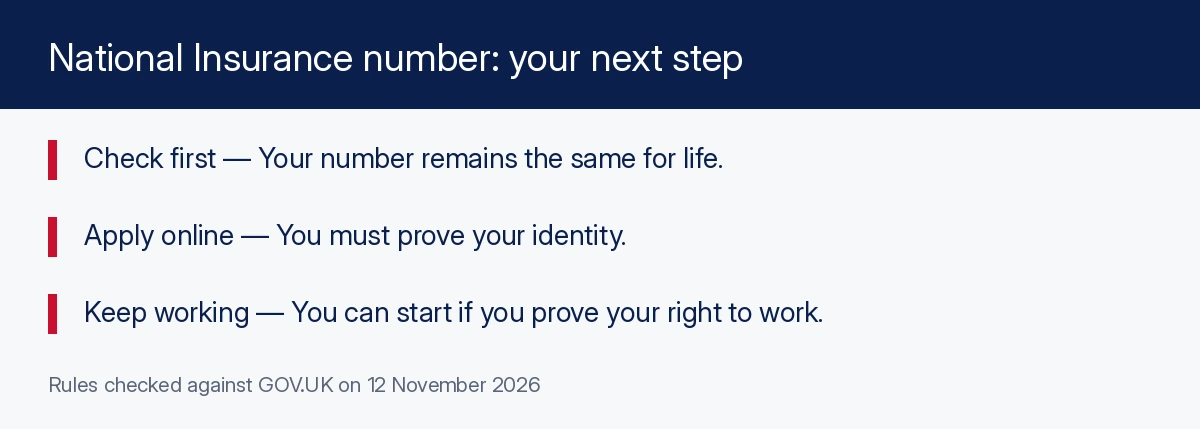
Check whether you already have a National Insurance number, then apply online through GOV.UK if eligible. You must prove your identity. You can start work before receiving the number if you can prove your right to work.
Find the right route for a first application or a lost number, with document preparation and practical steps for starting work.
In this guide
- How do you get a National Insurance number?
- What is the number for, and who needs one?
- Check whether a BRP or eVisa already shows your number
- What if you grew up in the UK and never received a number?
- Which documents should you get ready?
- How to apply online and prove your identity
- How long does it take, and when should you ask for help?
- Can you start work while waiting?
- How do you find a lost National Insurance number?
- Keep the number safe and finish your paperwork
- Common questions
- Official sources
- Related guides

How do you get a National Insurance number?
Apply online through GOV.UK if you live in the UK, have the right to work and are working, looking for work or have a job offer. First check whether you already have a number. If you do, keep using it: your National Insurance number stays the same for life.
This guide covers England, Scotland, Wales and Northern Ireland. The online guidance lists separate application helplines for Great Britain and Northern Ireland. SettleUK is an independent guide, not a government site. Apply through the official service rather than sending identity documents to this website.
First decide whether you need to find an existing number or apply for your first one. Losing a letter, changing your name or returning to the UK does not mean you should automatically request another number.
What is the number for, and who needs one?
Your number helps make sure National Insurance contributions and tax are recorded against your name only. It is made up of two letters, six numbers and a final letter. The number identifies your record; it does not replace the separate evidence your employer needs about your right to work.
The GOV.UK eligibility guidance says you can apply if you live in the UK, have the right to work, and are working, seeking work or have an offer. You can only apply once you are in the UK. Plan the application around your actual arrival rather than treating it as an overseas pre-departure task.
You do not need a number to start a benefit or student loan application. If one is needed to pay the benefit or loan, you will be contacted and told how to get it. You also do not need one to apply to the EU Settlement Scheme.
If your immediate concern is employment, separate the tasks in your checklist: establish your right to work, check for an existing number, then apply if necessary. This keeps an identity or immigration question from being confused with a tax-record question.
Check whether a BRP or eVisa already shows your number
GOV.UK says BRP or eVisa holders might already have a National Insurance number. Check the back of your BRP or sign in to your UK Visas and Immigration account to view your eVisa. Do not assume every immigration record includes one.
If there is no number and you plan to work, the guidance says to apply. You must be in the UK to do so. Checking first is particularly useful when you have an old residence document and a digital immigration record: look for an existing number before starting another application.
Finding a number on a BRP is a number-finding step. It is not advice to use that document as current proof of immigration status. For the digital status process, use our eVisa guide and follow the official links there.
Keep a private note of where you found the number so you can retrieve it again. Avoid putting a photograph of a residence document in an ordinary shared checklist. A task list can say “number located” without displaying the number itself.
What if you grew up in the UK and never received a number?
GOV.UK says a UK resident will normally be sent a number in the three months before their sixteenth birthday if a parent or guardian completed a Child Benefit claim form for them. Not remembering the letter is a reason to check for an existing number first.
For people aged 16 to 19 who did not receive a number, the guidance distinguishes checking an existing record from applying online where no parent or guardian completed a Child Benefit claim form. Use the official eligibility page for that route instead of assuming the adult newcomer example fits every young applicant.
Which documents should you get ready?
The official online application guidance asks you to get a passport from any country ready if you have one. It also lists a national identity card from an EU country, Norway, Liechtenstein or Switzerland. You might need to enter information from one or more of those documents.
You can still apply if you do not have these documents. The guidance says you may need an in-person appointment to prove your identity. Do not abandon the process simply because your paperwork does not match the most straightforward example.
| What you have | How to prepare | Important distinction |
|---|---|---|
| Passport | Have it available before starting | Follow the application’s photo instructions |
| Listed national identity card | Have the details ready | The listed countries determine this document option |
| Neither listed document | Continue with the official guidance | An identity appointment may be needed |
| Existing NI number | Use the number-finding route | Do not apply for another number |
As a practical preparation step, choose a time when you can read the instructions without rushing. Have your documents beside you and use details exactly as shown. If something is unclear, use the help route on GOV.UK rather than inventing an answer to get past a screen.
How to apply online and prove your identity
Start from the official GOV.UK application guidance and follow its Apply link. You will need to prove your identity. Where possible, the process asks you to take and upload a photograph of yourself holding your passport and photographs of other identity documents.
You can use a smartphone, tablet or digital camera. The application explains how the photographs must look, and somebody else can take them for you. Follow those instructions at the time you apply rather than relying on an older screenshot or a general passport-photo checklist.
- Check you meet the eligibility conditions and do not already have a number.
- Open the GOV.UK application route and prepare the listed documents you have.
- Enter the requested information and complete the identity steps shown.
- After submission, read the confirmation email and save the application reference.
- Complete any further identity instructions in that email.
If you cannot upload photographs, you can still apply online, but the application will take longer. You may need an appointment or to post photocopies of documents. The email after submission tells you what to do; do not send documents elsewhere simply because another website asks.
How long does it take, and when should you ask for help?
GOV.UK says it can take up to four weeks to get your National Insurance number after you have proved your identity. Count this waiting time from when you proved your identity.
The eligibility page says you can call the application helpline if you applied more than four weeks ago, have moved house since applying, or your personal details have changed. Have your application reference ready if you have one; it is at the top of the confirmation email.
Use the official online application guidance to find the appropriate helpline for England, Scotland and Wales or for Northern Ireland. The same page lists Welsh-language and accessibility options. Check the live page for telephone details and opening times rather than relying on a saved search snippet.
If you still need to prove your identity, focus on those instructions first. Repeating the application is not a substitute for dealing with an outstanding request. When asking for help, explain what you submitted and what the latest email asked you to do.
Can you start work while waiting?
Yes. GOV.UK explicitly says you can start work before receiving your number if you can prove you have the right to work in the UK. Tell the employer that your application is in progress, and deal separately with the evidence needed for the employment check.
Our right to work share code guide explains the digital route. Whether you use that route depends on your circumstances. A National Insurance application reference is not a substitute for the right-to-work evidence the employer needs.
Tell payroll whether you already have a number, are trying to recover one, or have applied for the first time. These are different situations. Keep any application reference separate from the field asking for the actual National Insurance number.
When the number arrives, give it to the employer through the channel they ask you to use. Keep the confirmation securely so you can find it again. For wider arrival tasks, our first-week checklist helps you keep employment paperwork alongside other essentials.
How do you find a lost National Insurance number?
Start with a payslip, P60 or a letter about tax, pensions or benefits. GOV.UK says you will usually already have a number if you have lived or worked in the UK, even if you do not know it. A missing document does not mean a missing record.
You can also find the number in the HMRC app if you live in the UK, in your personal tax account if you already have one, or in Apple or Google Wallet if you previously saved it there. The app and personal tax account can provide a downloadable letter showing the number.
HMRC cannot give you the number over the telephone or through webchat. Use the GOV.UK number-finding service to work out where to look or how to ask for it. The tool asks questions about your situation so you reach the appropriate route.
If you are returning after time abroad, check your old documents before starting a new application. The number remains the same for life. If you cannot find it, follow the recovery instructions rather than trying to reconstruct it from memory or borrowing an example number.
Keep the number safe and finish your paperwork
GOV.UK advises against sharing your National Insurance number with anyone who does not need it, to help prevent identity fraud. Your employer, HMRC and certain other organisations may need it. Treat the number as personal information rather than something to include on a public profile.
For your own records, keep the official letter or a secure digital copy where you can retrieve it. Keep track of whether you have found the number, applied, proved your identity and given it to payroll. You can record those steps without displaying the number in a shared checklist.
Check your first payslip and use official guidance if something looks wrong. National Insurance identification and your tax code are different parts of your employment records. Our tax code guide can help you understand the next question without assuming that a new number fixes a tax issue.
If your circumstances change while an application is pending, use the help conditions above and check GOV.UK. Keep the reference available and explain the change clearly. This guide cannot see your application or confirm its outcome; the official service is the place to resolve an individual case.
Common questions
Can I apply before I arrive in the UK?
No. GOV.UK says you can only apply when you are in the UK. You must also meet the residence, right-to-work and work-related eligibility conditions.
Can I work without a National Insurance number?
Yes, you can start work before receiving it if you can prove you have the right to work in the UK.
How long does the application take?
GOV.UK says it can take up to four weeks after you have proved your identity. If further identity evidence is needed, follow the instructions in your confirmation email.
Do I get a new number after changing my name?
No. Your National Insurance number remains the same for life, even if your personal details change.
Can HMRC tell me my number over the phone?
No. HMRC cannot provide it over the telephone or webchat. Check the HMRC app, an existing personal tax account or the official number-finding service.
Does an eVisa always contain a National Insurance number?
No. GOV.UK says you might already have one. Check your UKVI account; if you do not have a number and plan to work, follow the application guidance.
Official sources
- Apply for a National Insurance number — GOV.UK · Checked 2026-11-12
- How to apply — GOV.UK · Checked 2026-11-12
- Find your National Insurance number — GOV.UK · Checked 2026-11-12
- Your National Insurance number — GOV.UK · Checked 2026-11-12
SettleUK is an independent guide. It is not a government website and is not affiliated with GOV.UK, DWP, HMRC or the NHS.