Right to work share code: get it and fix problems
How do you get a right to work share code?
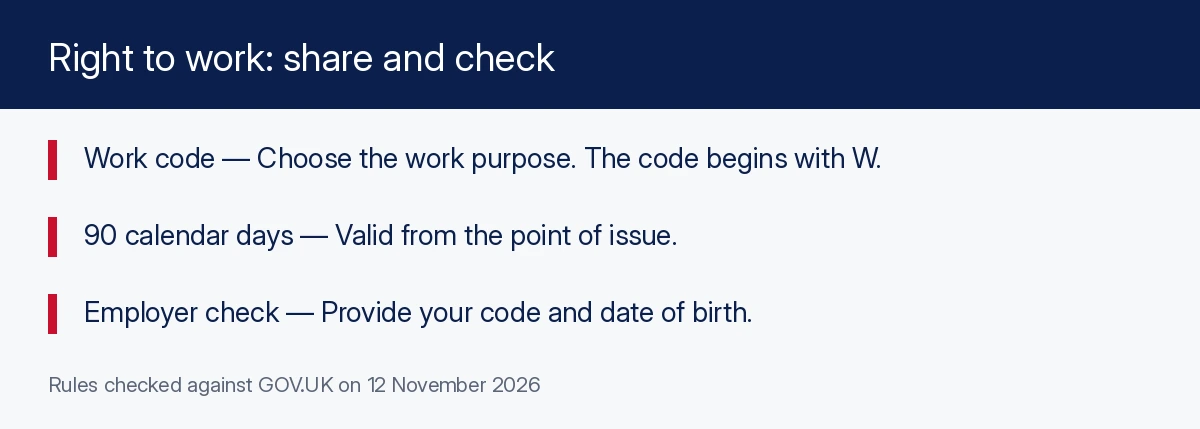
Get a right to work share code through GOV.UK and give it, with your date of birth, to your employer. Work codes begin with W and are valid for 90 calendar days from issue. The employer checks the official result.
Use the official work-sharing route, understand what the employer checks and find the next step if a code or account will not work.
In this guide
- How do you get a right to work share code?
- Who can use the share-code route?
- What should you have ready before signing in?
- Get the code and give it to your employer
- How long is a right to work share code valid?
- What does the employer check?
- What if you are British or Irish?
- Troubleshoot an expired code, wrong purpose or account problem
- Finish your employment paperwork without mixing up checks
- Common questions
- Official sources
- Related guides

How do you get a right to work share code?
Use the GOV.UK service to get a right to work share code, sign in with the identity details linked to your immigration record, and choose the work purpose. Give the code and your date of birth to your employer. The employer then uses its own GOV.UK checking service.
This guide covers employment checks in England, Scotland, Wales and Northern Ireland. SettleUK is an independent guide, not a government site. We do not issue codes, check immigration records or ask you to enter passport details here.
A share code is a way to let an employer view your right-to-work information. It is not a job offer, a visa application or a new grant of permission. The result of the official check shows the work you are allowed to do and any time limit.
Who can use the share-code route?
The official share-code guidance says you can use the service with a UK Visas and Immigration account or an eligible biometric residence permit reference. It lists ways an account may have been created, including an EU Settlement Scheme application or access to an eVisa.
If you already have an eVisa, start with the details connected to your UKVI account. Our eVisa guide explains the relationship between the digital immigration record and account access. Creating another account should not be your default response to forgetting how you signed in.
GOV.UK also lists a route for British or Commonwealth citizens with a digital certificate of entitlement proving the right of abode. A vignette sticker certificate does not provide the share-code route described there. Follow the specific right-of-abode instructions if that is your situation.
If you cannot use the online service, check whether eligible original immigration documents can be used instead. The alternative depends on your actual documents and status. It is not a general invitation to replace the check with any letter mentioning your name.
What should you have ready before signing in?
The share-code page lists your BRP number, passport or national identity card as the details you may need. Use the document linked to your account. Read the prompts carefully if your passport has changed since you first created your account or applied for immigration permission.
As a preparation step, have access to the contact methods you use for your UKVI account. Keep the employer’s request beside you so you know this is an employment check. A code requested by a letting agent concerns a different purpose, even if both requests arrive during the same week.
| Prepare | Why it matters | Avoid this confusion |
|---|---|---|
| Linked identity details | Used to access your record | A new passport may need an account update |
| Work purpose | Generates the correct kind of code | A rental code is for a different check |
| Date of birth | Employer needs it alongside the code | The code alone is not all the required information |
| Employer’s request | Helps you send the correct information | Do not send your account password |
Use the official prove your right to work page as your starting point. This guide is an explanation of that process. There is no SettleUK login or separate application that can generate an official share code for you.
Get the code and give it to your employer
Open the official share-code service from GOV.UK. Follow the sign-in instructions and select the option to prove your right to work to an employer. The Home Office guide says the code is nine characters long and begins with W.
Pass the code to your employer with your date of birth. You can provide it directly, or use the sending option in the official service. You do not need to hand over your account password so that the employer can sign in as you.
- Start at GOV.UK and open the right-to-work share-code route.
- Use your linked identity details and follow the sign-in prompts.
- Select the reason for sharing that relates to work.
- Give your employer the W code and your date of birth.
- Ask the employer to use its own online checking service.
As a practical check, compare the information you send with the original request. A mistyped character, wrong date of birth or code for another purpose can create an avoidable delay. If the employer reports a problem, establish which part failed before assuming your permission has changed.
How long is a right to work share code valid?
The Home Office employer guide says share codes are valid for 90 calendar days from issue. They can be used as many times as needed during that period, but only for the purpose originally selected. An employer cannot use a renting or other-purpose code as a work code.
If the code expires, generate a new right to work code and give it to the employer. The guide says an employer must ask for a new work code if the supplied code has expired or was generated by another service.
Code validity and immigration permission are separate things. The code provides access to information; the official result tells the employer how long you can work and what work you can do. Do not use the code’s expiry as your visa expiry or as a promise of continued permission.
If recruitment is taking longer than expected, ask which code the employer is trying to use and whether a fresh one is needed. A screenshot of your personal status page does not replace the employer’s check.
What does the employer check?
The employer opens Check a job applicant’s right to work: use their share code and enters your code and date of birth. The result includes the types of work allowed and how long you can work in the UK if a time limit applies.
The Home Office guide requires the employer to make sure the photograph on the online result is of the person being checked. It also explains that simply viewing the worker-facing service or a printed copy of that output is not enough for the employer’s online check.
Your employer must check permission for the job being offered, including relevant restrictions. For students, the general checking guidance also refers to evidence of study and vacation times. A code does not remove the need to understand the conditions shown by the check.
The employer retains evidence of its check. The Home Office guide describes keeping a copy of the profile result with the photograph and check date, during employment and for two years afterwards. You do not need to reproduce that employer recordkeeping process in your own personal account.
If your right to work is time-limited, the official checking guidance says a follow-up check is needed when it is due to expire. Ask your employer what information they need and use GOV.UK if the record appears incorrect; this guide cannot assess a personal immigration condition.
What if you are British or Irish?
British and Irish citizens normally use the document route described in the official overview. A British passport or Irish passport or passport card can be current or expired for that route. An employer may offer an identity service provider option where appropriate.
Without a passport or passport card, the overview lists a UK or Irish birth or adoption certificate, or a certificate of registration or naturalisation as a British citizen. You must also provide an official document showing your name and National Insurance number.
That additional document can be from a previous employer or government agency, such as HMRC or DWP. Do not assume a birth certificate alone completes the combination described in the guidance. Check the listed evidence before handing documents to the employer.
If you have a digital certificate of entitlement proving right of abode, GOV.UK also provides a share-code route for British or Commonwealth citizens. Follow that specific route if it applies to you.
If you are simply trying to find the National Insurance number for the document combination, our National Insurance number guide explains where to look. Having a number by itself does not establish your right to work.
Troubleshoot an expired code, wrong purpose or account problem
Begin with the straightforward checks: is this a work code, is it within its validity period, and has the employer entered the same date of birth? If the code begins with R or S, the Home Office guide says it cannot be accepted for the employer’s work check.
If you cannot access your record, use the official account and eVisa help routes. Keep a private note of the error and the task you were trying to complete. Give those details when asking for help.
For technical problems preventing a share code or online check, the Employer Checking Service guidance lists circumstances where the employer can ask the Home Office to check. It also covers some outstanding applications, reviews or appeals. The employer, rather than the worker, submits that check.
Eligible original documents may be an alternative, but BRP cards are no longer accepted as physical right-to-work evidence. The general employer guidance tells employers to ask for a share code instead. Do not confuse using an old document reference to access a service with accepting the card as proof.
When reporting a technical problem, tell the employer whether you could sign in, generate a code or reach the sharing screen. Ask them to confirm whether their checking service showed an error too. This helps you explain where the process stopped.
Finish your employment paperwork without mixing up checks
Right-to-work checking happens before you start work. Payroll information is a separate part of joining the employer. Keep your code, National Insurance information and bank details in distinct parts of your personal checklist so that a request for one does not get answered with another.
Our bank account guide and first-week checklist help you organise the other arrival tasks. For England housing checks, use the separate right to rent guide; do not reuse the work code for that purpose.
If an employer asks a question about a restriction in the online result, refer back to your official record and the relevant GOV.UK guidance. A successful code generation confirms access to the sharing process, not permission to ignore the conditions attached to your status.
Keep a short record of what you supplied and when, without circulating your full account access details. If the process stalls, ask whether the problem is account access, code validity, the employer’s check or the underlying status information. Each question has a different next step.
Common questions
How long does a right to work share code last?
It is valid for 90 calendar days from issue. It can be used repeatedly during that period for the original purpose. Generate a new work code if it expires.
What does my employer need besides the code?
Your date of birth. The employer uses its own GOV.UK service to check the code and view your right-to-work information.
Can I use my right to rent code for work?
No. The employer guide says work codes begin with W. Codes beginning with R or S are for other services and cannot be used for the work check.
Do British and Irish citizens need a share code?
They normally use the document routes in GOV.UK’s overview. The specific share-code guidance also lists a digital certificate of entitlement route for British or Commonwealth citizens with right of abode.
What if I cannot generate a code because of a technical error?
Tell your employer. The Employer Checking Service guidance includes technical problems preventing share-code or online checks, where applicable. Use official account help for access problems.
Is a National Insurance number proof of right to work?
It does not replace the relevant right-to-work evidence. Some document routes require an official letter showing your name and NI number alongside another listed document.
Official sources
- Prove your right to work: overview — GOV.UK · Checked 2026-11-12
- Get a right to work share code — GOV.UK · Checked 2026-11-12
- Using eligible immigration documents — GOV.UK · Checked 2026-11-12
- Employer: view a right to work share code — GOV.UK · Checked 2026-11-12
- Employer Checking Service — GOV.UK · Checked 2026-11-12
- Checking a job applicant’s right to work — GOV.UK · Checked 2026-11-12
- Home Office employer’s guide to right to work checks — GOV.UK · Checked 2026-11-12
SettleUK is an independent guide. It is not a government website and is not affiliated with GOV.UK, DWP, HMRC or the NHS.