Open a bank account UK: documents and basic accounts
How do I open a bank account in the UK?
Check the provider’s eligibility and document requirements, then apply through its official route. Ask about alternative checks if you lack proof of address, and a fee-free basic account if a standard account is unsuitable. Verify the legal provider and FSCS protection before transferring money.
Prepare your documents, understand basic accounts and check deposit protection without relying on product recommendations or assumed bank policies.
In this guide
- How do I open a bank account in the UK?
- Choose the account's purpose before applying
- Prepare identity documents and personal details
- Open a bank account without proof of address
- What a basic bank account offers
- Apply through the provider's official route
- If a bank refuses your application
- FSCS protection: the current limit and shared licences
- Larger balances, extra services and careful comparisons
- Your account-opening checklist
- Common questions
- Official sources
- Related guides
How do I open a bank account in the UK?
Choose the type of account you need, check the provider's eligibility and document requirements, then apply through its official channel. If a standard current account is unsuitable, ask about a fee-free basic bank account. Do not assume every provider accepts the same identity documents or proof of address.
If you have just arrived in the UK, start with the documents you have now. Ask the provider how it handles newcomers and which alternatives it accepts if you do not yet have the usual address paperwork.
This guide covers England, Scotland, Wales and Northern Ireland. Individual providers decide their application processes within the applicable rules. Some official document examples below come from Homes for Ukraine guidance and are labelled accordingly; they are not universal bank policies.
SettleUK is an independent guide, not a government site. We do not recommend products or rank providers. The aim is to help you ask useful questions, understand basic accounts and check protection before moving money.
Choose the account's purpose before applying
Write down what you need the account to do: receive wages or benefits, pay household bills, make everyday purchases or handle cash. Use that list when reading the provider's account information. Avoid applying only because an account has a familiar name.
Ask about the practical features you will use, including how to contact support and how to pay money in or take it out. Read the actual account's terms and charges before accepting. This guide does not assume a particular app, branch network or service is included.
For a basic account, HM Treasury says the required core services are broadly the same as a standard personal current account, without an overdraft. Standard operations in sterling must be fee-free. That does not mean every possible extra service or currency transaction is free.
- Will the account support the payments you need to receive?
- How will you manage it if you cannot use the app?
- What charges apply beyond standard operations?
- What identification and eligibility checks are required?
- Which legal institution holds the money and what protection applies?
Keep these questions with the document checklist. They help you compare the fit of an account without relying on a product recommendation or an assumption about a bank's current policy.
Prepare identity documents and personal details
The government's Homes for Ukraine banking guidance lists basic information such as name, date of birth, nationality and contact details. It tells guests to have an email address in their own name and a valid phone number.
That guidance gives identity examples including a passport, eVisa, driving licence or recognised identity card. They are examples from a specific official guide, not a guarantee that a chosen provider accepts every document for every applicant.
Check the provider's current list before applying. Ask whether documents can be checked online, whether originals are needed in a branch and how it verifies a digital immigration status. Do not assume the same process as an employer's right-to-work check.
| Prepare | Question for the provider |
|---|---|
| Your identity information | Which documents are accepted for this account? |
| Your current address | What evidence or alternative verification can you use? |
| Contact details | How will application updates be sent? |
| Digital status, where relevant | How does the provider verify this? |
If names or addresses differ across your documents, explain why and ask what supporting information is needed. Avoid changing information merely to make an online form accept it.
Open a bank account without proof of address
If you have no utility bill, ask about other ways to verify your address. The government guidance for supporting Ukrainian guests says some banks may ask for proof of address, but proof of address is not required by law to open a bank or building society account.
A provider still needs to identify and verify customers. Ask what alternative checks it offers in your circumstances. The official guidance encourages banks and building societies to find alternative ways to identify customers who lack standard identification documents.
The related guest guidance describes proof of address as usually an official letter showing name and current address, such as one from government or a utility company. It tells guests to check the bank's website before applying.
For guests on that scheme, it says some banks allow a host to help verify where they live, with the host's own ID and address evidence. This is a scheme-specific possibility to ask about, not a general entitlement for anyone staying with friends.
- Explain which address documents you do and do not have.
- Ask for the account's accepted alternatives in writing if available.
- Ask whether a branch or assisted application is appropriate.
- Take the information you have rather than assuming nothing is usable.
What a basic bank account offers
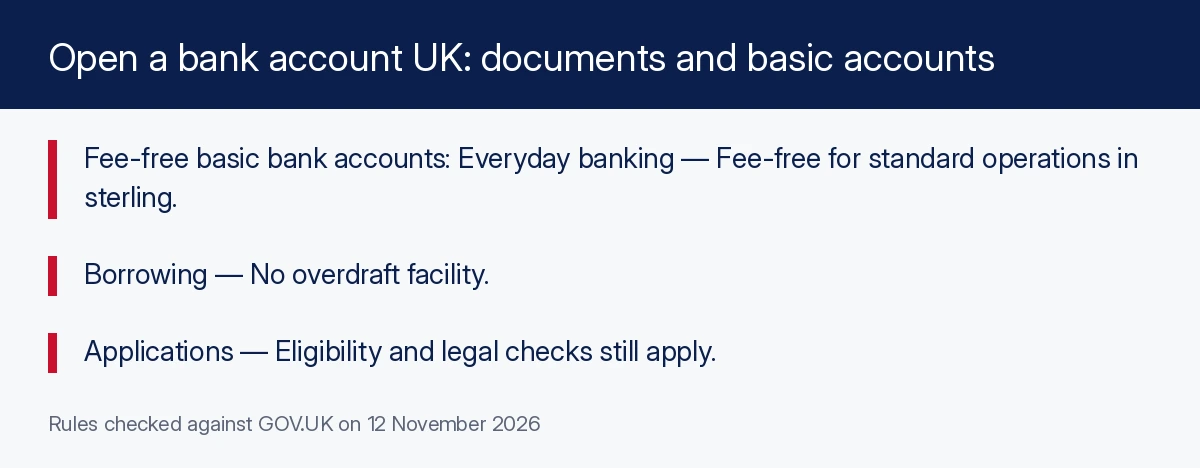
HM Treasury's basic account collection explains that designated providers must offer accounts fee-free for standard operations, including failed payments. The purpose includes avoiding unintended overdrafts. A basic account is designed for everyday transactions rather than borrowing.
The Treasury's detailed explanation says designated providers offer these accounts to legally resident UK customers who do not have an account or are not eligible for a standard current account, subject to the regulations.
A basic account does not have an overdraft facility. Ask how the provider handles payment instructions when there is insufficient money, and which notifications it offers. Fee-free standard operations do not create credit or guarantee that every payment will go through.
The government guest guidance says some providers allow direct basic-account applications, while others offer one after deciding a customer is ineligible for another account. Ask about the route before completing repeated standard-account applications.
This question is a suggested way to ask for help. It does not override the provider's checks or guarantee acceptance.
Apply through the provider's official route
GOV.UK's guidance for Ukrainian guests lists branch, telephone, online and mobile-app applications, depending on the provider. A branch visit may require an appointment. Confirm the available route and required documents before travelling or uploading personal information.
- Read the account's eligibility, fees and document requirements.
- Ask about alternative verification if you lack a usual document.
- Use the provider's official application channel.
- Supply accurate information and respond to follow-up requests.
- Keep the reference and wait for confirmation of the outcome.
If you need help completing a form, ask the provider what support is available. A host or trusted person may help you understand questions, but use your own accurate personal information and make sure you understand the account terms.
If your application is pending, ask the provider what remains outstanding and when to expect an update. Check whether it is waiting for identity documents or has refused the application.
Before giving new payment details to an employer or another organisation, make sure the account is actually open and able to receive the payment. Follow the provider's instructions for finding the correct details rather than copying an application reference.
If a bank refuses your application
A basic account is not guaranteed in every situation. Treasury guidance says designated providers must refuse where opening one would be unlawful, including where it conflicts with financial crime rules. Existing account ownership can also affect eligibility.
The Treasury explanation says a refused basic-account applicant must be informed in writing, without delay and free of charge, of the reason if it may lawfully be given. The provider must also explain the relevant complaint routes and contact details.
- Ask whether the decision concerns a standard or basic account.
- Ask whether information is missing or the application has been refused.
- Request the explanation and complaint instructions that can lawfully be supplied.
- Check whether a basic-account assessment remains available.
- Keep the application details and response if you challenge the decision.
Use the provider's complaint process if appropriate, and follow its information about the Financial Ombudsman Service. This guide does not set an unverified complaint deadline or promise the decision will be changed.
If the issue is documentation, ask specifically which information would resolve it. If the provider cannot accept your application, that does not establish what another provider's current checks will require.
FSCS protection: the current limit and shared licences
FSCS confirms that the standard deposit limit rose to £120,000 on 1 December 2025. It applies per eligible person, per UK-authorised bank, building society or credit union if the institution fails and cannot repay deposits.
The provider must be authorised by the Prudential Regulation Authority. FSCS directs users to the Financial Services Register and offers its own bank and savings protection checker. Use those official routes to check the legal institution behind the account.
Shared banking licences matter. If you have accounts with different brands that share a licence, FSCS treats them together for the protection limit. Opening accounts with different names does not necessarily multiply your cover.
FSCS also says joint accounts are eligible for protection per eligible person. If you hold both a personal and joint account with providers sharing a banking licence, the person's cover applies across those holdings rather than restarting for each account.
This is deposit-failure protection, as described by FSCS. Do not infer that the presence of a payment card or app proves a product has that cover. Ask exactly who holds the funds and check the account's protection information before making a substantial transfer.
Larger balances, extra services and careful comparisons
FSCS has separate rules for certain qualifying temporary high balances. Its current page describes protection up to £1.4 million for six months from first deposit, subject to eligibility. Do not assume any large balance automatically qualifies.
If you expect a large receipt, read the temporary-high-balance guidance linked by FSCS and ask about your situation. Keep the documents showing where the money came from and when it arrived so you can explain the circumstances if necessary.
For ordinary everyday banking, read charges for the services you expect to use. Basic-account fee protection relates to standard operations in sterling. Overseas transactions and other services should be checked against the actual terms rather than assumed free.
Compare how you will use the account as well as any headline fee. Ask about cash access, support, statements and the ability to manage payments. These are questions for the provider; this page does not assert that every account has identical facilities.
Keep separate notes for eligibility, costs and protection. An account might meet your document needs while still being unsuitable for a service you use frequently. Make the decision from the provider's current terms and official protection information.
Your account-opening checklist
Before applying, collect the information you have and identify the gaps. Asking about alternatives early is more useful than guessing which documents a provider will accept. Take particular care where you have recently moved or are relying on another person's address.
- Confirm the account type and whether a basic account is appropriate.
- Check identity requirements and proof-of-address alternatives directly.
- Ask how digital immigration status is verified, if relevant.
- Read standard and additional charges.
- Check the legal provider, FSCS eligibility and any shared licence.
- Keep confirmation that the account is open before arranging incoming payments.
If you are setting up a new home, also organise the paperwork that will support future address checks. Our council tax guide explains how to check the household bill, while the eVisa guide covers accessing digital immigration status.
Before accepting an account, confirm the provider’s current document requirements, charges and protection. Use the official banking and FSCS sources below to check anything unclear.
Build your settling-in checklist
Organise banking alongside your household, health and employment paperwork.
Plan your first weekCommon questions
Can I open an account without proof of address?
Ask the provider about alternatives. GOV.UK’s guidance for supporting Ukrainian guests says proof of address is not legally required, although some banks request it and still need to verify customers.
What documents do all banks accept?
There is no universal acceptance list in this guide. Check the chosen provider’s current identity and address requirements and ask what alternatives it offers.
Does a basic account have an overdraft?
No. Treasury guidance says basic bank accounts do not have an overdraft facility and are fee-free for standard operations in sterling.
Can a basic account application be refused?
Yes. Legal checks apply, and other circumstances such as already holding a current account can affect eligibility. Ask for the explanation and complaint information that can lawfully be provided.
What is the current FSCS deposit limit?
The standard limit is £120,000 per eligible person, per authorised bank, building society or credit union. FSCS says it took effect on 1 December 2025.
Do different bank brands always give separate FSCS cover?
No. Brands sharing a banking licence are treated together for the limit. Use the official protection checker and Financial Services Register links from FSCS.
Does this guide recommend a bank?
No. Compare the provider’s current eligibility, account features, charges and protection against your own needs.
Official sources
- Basic bank accounts collection — HM Treasury · Checked 2026-11-12
- Basic bank accounts: official explanation and refusals — HM Treasury · Checked 2026-11-12
- Supporting guests to open a bank account — GOV.UK · Checked 2026-11-12
- Get a bank account: Homes for Ukraine — GOV.UK · Checked 2026-11-12
- Banks, building societies and credit unions — FSCS · Checked 2026-11-12
SettleUK is an independent guide. It is not a government website and is not affiliated with GOV.UK, DWP, HMRC or the NHS.