Council tax explained: bands, discounts and reductions
How does council tax work and who needs to pay?
Council tax depends on your property band, your council’s charge and any discounts, exemptions or reductions. England, Wales and Scotland use council tax. Northern Ireland uses domestic rates. Check the official band list and your council’s current bill, then apply for any help you may qualify for.
Check your property band and household circumstances separately so you can understand the bill and ask for the right help.
In this guide
- How does council tax work and who needs to pay?
- Council tax bands: what the letters mean
- Check a band and question an error
- Who pays: adults, partners and shared homes
- Council tax single person discount
- Council tax student exemption and mixed households
- Council Tax Reduction for a low income
- Disability help and nation-specific differences
- Moving home, reading a bill and getting help
- Northern Ireland uses domestic rates
- Common questions
- Official sources
- Related guides
How does council tax work and who needs to pay?
Council tax is worked out using your home's valuation band, the charge set by your local council and any discount, exemption or reduction you qualify for. England, Wales and Scotland have council tax. Northern Ireland uses domestic rates, with a different calculation and relief system.
This is council tax explained for someone setting up a home or checking an existing bill. It covers the main decisions and official checking routes, without quoting local charges. You need the council's current bill for the amount payable at a particular address.
SettleUK is an independent guide, not a government site. Your council decides billing and applications for help. The official valuation services deal with property bands. Contact the right organisation for the problem rather than assuming a band challenge also corrects your household details.
If you have just moved, keep your address, move date and tenancy or ownership information ready when contacting the council. Ask it to confirm who is liable and what information it needs to issue the correct bill.
Council tax bands: what the letters mean
In England and Wales, council tax bands reflect historic property values rather than the price you paid today. The official valuation guidance uses values at 1 April 1991 in England and 1 April 2003 in Wales.
England's bands run from A to H. Wales has bands A to I. These letters identify valuation categories; they are not a single national price list. The council sets charges, so a band letter alone does not tell you your annual bill.
| Nation | Where to check | What to do next |
|---|---|---|
| England | GOV.UK Council Tax valuation list | Check the local council's charge |
| Wales | GOV.UK Council Tax valuation list | Check the local council's charge |
| Scotland | Scottish Assessors website | Check your Scottish council's bill |
| Northern Ireland | Land & Property Services valuation search | Check domestic rates instead |
Size, layout, character, location and changes in use can matter to valuation in England and Wales. A new sale price does not directly replace the historic valuation basis. These historic valuation dates do not tell you what a home is worth today.
For a newly built home without a band in England or Wales, GOV.UK says to contact the council. It supplies the information needed for the valuation service to allocate one.
Check a band and question an error
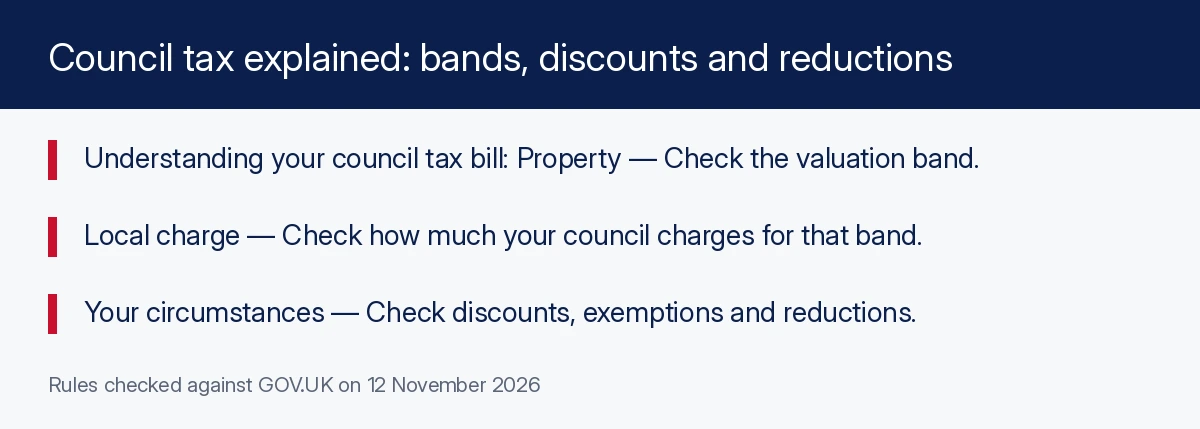
Use Check your Council Tax band on GOV.UK and search the address or postcode for England and Wales. The same official page links to the Scottish Assessors search for Scottish properties.
Make sure you select the correct dwelling, especially where a building contains flats or an annexe. An address error and a disputed valuation are different issues. Note exactly which part looks wrong before contacting the council or valuation service.
GOV.UK says you can challenge a band if you think it is wrong, but you need evidence. Read the official challenge instructions before submitting. A neighbouring property may help you gather evidence, but it does not prove your band is wrong.
- Save the address and band shown in the official list.
- Identify whether your concern is the property description, band or bill.
- Gather the evidence requested by the official challenge process.
- Ask the council about current payment obligations while the issue is considered.
The England and Wales guidance says it is always free to challenge a band with the Valuation Office. You can choose to appoint an agent, but a paid intermediary is not required to use the official route.
Who pays: adults, partners and shared homes
GOV.UK says you will usually have to pay council tax if you are 18 or over. A full bill is based on at least 2 adults living in a home. Spouses and partners living together are jointly responsible for the bill.
Not everyone who lives at an address counts as an adult for this calculation. GOV.UK calls people excluded from the count “disregarded”. Examples include full-time students, some apprentices, student nurses and some live-in carers, subject to the relevant conditions.
Do not divide a bill by the number of bedrooms and assume that establishes legal liability. Ask the council who is responsible, particularly if you rent a room, live in shared accommodation or have an arrangement where someone else handles the household bills.
Scotland's shared-accommodation guidance explains that a council tax HMO has its own definition. For a qualifying property of that kind, the owner is responsible and tenants do not pay council tax directly, even if the rental agreement says otherwise.
The same Scottish guidance warns that council tax HMO rules differ from housing-licensing rules. Do not use the presence or absence of an HMO licence as your only test. Give the council the details of the actual rental arrangement and ask it to confirm liability.
Council tax single person discount
Under GOV.UK's guidance, you get 25% off if you pay council tax and live alone, or everyone else in the home is disregarded. This is why a household with more than one occupant can sometimes still qualify for the single person discount.
For example, an adult living with someone who qualifies as a disregarded full-time student should ask the council to assess a discount. Do not assume the student automatically creates an exemption for the whole property when another counted adult lives there.
You need to apply for a discount or exemption, even where you are disregarded. Contact the council to find out what evidence it wants. Explain the household composition and the date circumstances changed so it can assess the relevant period.
Scotland also offers a single adult discount route where you are the only counted adult. Scottish guidance has its own list of disregarded categories, including certain care leavers. Use the Scottish council's application guidance rather than assuming every English category or condition transfers unchanged.
Council tax student exemption and mixed households
GOV.UK says a household where everyone is a full-time student does not have to pay council tax. If a bill arrives, apply for an exemption. Being enrolled somewhere is not enough on its own: the course must meet the relevant full-time criteria.
For England and Wales, the GOV.UK test describes a course lasting at least 1 year with at least 21 hours of study per week. For someone under 20 studying for a qualification up to A level, it describes at least 3 months and at least 12 hours per week.
Scotland's guidance separately says all-full-time-student households and halls of residence do not pay. Its course definitions differ: check the Scottish guidance and council requirements rather than using the England and Wales course test without checking.
- Ask your education provider for the course information the council requests.
- Tell the council who else lives at the property.
- Check whether you need a property exemption or a disregard for an individual.
- Report when the course or household circumstances change.
Where a non-student lives with students, a bill can still be issued, although a discount may apply. Ask the council to identify the counted adults and explain its decision. A student exemption, a single person discount and an income-based reduction are separate assessments.
Council Tax Reduction for a low income
Council Tax Reduction, sometimes called Council Tax Support, can help if you are on a low income or claim benefits. GOV.UK says eligible bills can be reduced by up to 100%, but the actual award depends on the scheme and circumstances.
You can apply whether you own or rent your home, work or are unemployed. The assessment can consider household income, savings, pensions, your partner's income, children, other adults and residency status. Do not assume that working rules you out or that a benefit award guarantees the full reduction.
Apply to your local council. Ask for the current evidence checklist and explain any existing discounts. Keep a copy of your application and the decision so you can understand which parts of the bill have been reduced.
In Scotland, mygov.scot describes the Scottish Government's Council Tax Reduction Scheme as means-tested and managed locally by councils. It can reduce council tax by up to 100%, depending on household income, savings and other circumstances.
If the amount is unexpected, ask the council how it treated income and other adults. Check whether it has current information before assuming the property band is wrong. A reduction query is normally about the household assessment, while a band query concerns the property valuation.
Disability help and nation-specific differences
Disability-related help is another category to ask about. Scotland's guidance says a home adapted for disability may qualify for a discount based on the band below its actual band. Special arrangements apply where the property is already in the lowest band.
Scotland also describes potential discounts or exemptions where someone has significant cognitive difficulties, using the legal term “severe mental impairment”. An application through the council and a form signed by a doctor are required under that guidance.
This is not an automatic award for every disability or diagnosis. Ask the council about the exact criteria and evidence for the relevant scheme. Explain both the person's circumstances and any adaptations to the home.
For Wales, the GOV.UK band-checking and England-and-Wales valuation guidance provide the official starting point. Ask the Welsh council about its current discounts, student evidence and Council Tax Reduction arrangements rather than assuming another council's application rules apply.
For most Scottish homes, council tax is billed alongside Scottish Water water and waste charges. Check the individual lines on your bill. Do not assume a council tax reduction necessarily means every charge shown on the same document disappears.
If you need a detailed answer about those additional charges, ask the council or Scottish Water for the current position. This guide does not calculate water-charge reductions or quote local amounts.
Moving home, reading a bill and getting help
Check the property address, liable names, billing period, band, discounts and balance when a bill arrives. Compare these with the information you supplied. Keep the bill and any decision notices together so later changes can be traced.
When moving, contact the relevant council about the old and new address. Ask how it will close or update the old account and calculate the new bill. Do not assume a GP address update or a bank address change also updates council tax.
- Ask who is liable at the property and from which date.
- Check the band against the official valuation list.
- Check whether a discount, exemption or reduction has been applied.
- Use the council's instructions for paying and reporting changes.
- Contact it promptly if you cannot afford the bill.
Empty homes and second homes have separate rules. Ask the council about the specific property and current local policy before budgeting. This guide does not assume an empty dwelling receives a discount or that a second home is charged the same as a main home.
If payment is difficult, explain the situation and ask about support and payment arrangements. Keep a record of the response. A question or application is not a substitute for checking what the council currently expects you to pay.
Northern Ireland uses domestic rates
In Northern Ireland, use nidirect's domestic rates guidance. The bill uses a property's rateable capital value multiplied by the combined regional and district domestic rates. It does not use the council tax band calculation described above.
Land & Property Services issues domestic rates bills. Its valuation search provides an estimated full annual calculation, but nidirect warns this excludes carried-over debt and adjustments for reliefs, exemptions or exclusions. Your actual account can therefore differ from the headline estimate.
Help can include Housing Benefit, Rate Rebate or Lone Pensioner Allowance, depending on eligibility. Follow the Northern Ireland help-with-rates links rather than applying an England council tax discount percentage to the rates bill.
For a newcomer, the useful first question is which system applies to the address. Once that is clear, use its valuation service, billing authority and support application process. Keep the systems separate when comparing household budgets across UK nations.
Set up the rest of your household paperwork
Use our settling-in guides alongside your council's own instructions.
Explore settling-in guidesCommon questions
Is the band based on today’s house price?
In England and Wales it uses historic values: 1 April 1991 in England and 1 April 2003 in Wales, rather than today’s sale price.
Where do I check my council tax band?
Use GOV.UK’s band-checking service in England and Wales. It links to the Scottish Assessors website for Scotland.
How much is the single person discount?
GOV.UK says 25% if you pay council tax and live alone, or everyone else in the household is disregarded. Apply to your council and check its decision.
Do all students automatically get an exemption?
No. Full-time status must meet the applicable criteria. An all-full-time-student household can qualify for exemption; mixed households may still have a bill.
Can I apply for Council Tax Reduction while working?
Yes. GOV.UK says working people can apply. Awards depend on the relevant scheme, household income, savings and other circumstances.
Does Northern Ireland have council tax?
Northern Ireland uses domestic rates instead. Check Land & Property Services and nidirect for valuations, bills and help with rates.
Does Scotland include water on the bill?
For most Scottish homes, council tax is billed alongside Scottish Water water and waste charges. Check the separate lines and ask about any help available.
Official sources
- How Council Tax works — GOV.UK · Checked 2026-11-12
- Who has to pay — GOV.UK · Checked 2026-11-12
- Full-time students — GOV.UK · Checked 2026-11-12
- Apply for Council Tax Reduction — GOV.UK · Checked 2026-11-12
- Check your Council Tax band — GOV.UK · Checked 2026-11-12
- How domestic properties are assessed — GOV.UK · Checked 2026-11-12
- How Council Tax works in Scotland — mygov.scot · Checked 2026-11-12
- Scottish discounts, exemptions and reductions — mygov.scot · Checked 2026-11-12
- How rate bills are calculated — nidirect · Checked 2026-11-12
SettleUK is an independent guide. It is not a government website and is not affiliated with GOV.UK, DWP, HMRC or the NHS.