Tax code explained: understand your PAYE code
What does my tax code mean?
Your tax code tells your employer or pension provider how to work out Income Tax deductions. Numbers usually show the tax-free income allocated to that job or pension; letters describe your circumstances. Check the full code and HMRC’s income details before deciding it is wrong.
Understand the numbers and letters on your payslip, then use HMRC’s official service to check the details behind them.
In this guide
- What does my tax code mean?
- Where to find your tax code
- 1257L and the Personal Allowance
- Common tax-code letters explained
- Scottish S and Welsh C prefixes
- W1, M1, X and NONCUM emergency codes
- What a K tax code means
- How to correct a tax code that looks wrong
- Overpaid or underpaid tax
- Keep the right records for your query
- Common questions
- Official sources
- Related guides

What does my tax code mean?
Your tax code tells your employer or pension provider how to work out Income Tax deductions. HMRC tells them which code to use. The numbers usually relate to your tax-free income for that job or pension; the letters describe the rules that apply to you.
This is tax code explained for people reading a UK payslip or pension statement. It covers England, Scotland, Wales and Northern Ireland. Scottish and Welsh prefixes matter, so read the whole code rather than looking only for a familiar number.
SettleUK is an independent guide, not a government site. Use this page to understand the code and prepare your questions. HMRC holds the tax details and decides whether a code needs changing; your employer applies the code HMRC supplies.
A code is an instruction for deducting tax, rather than a statement of your final annual bill. If the income information behind it is incomplete, deductions can be too high or too low. Checking those details is more useful than assuming that everyone should have the same code.
Where to find your tax code
HMRC says you can find your code on a payslip, in the HMRC app, through the online current-year tax service or on a Tax Code Notice letter if you receive one. You get a code for each employment or pension you have.
If you have several jobs or pensions, keep their codes separate. A letter about one source of income does not necessarily describe the code used on another. Start with the payslip or statement that prompted your question and identify its employer or pension provider.
- Write down the complete code, including any prefix or suffix.
- Note which employer or pension provider uses it.
- Check the tax year and pay period on the document.
- Compare it with the relevant entry in HMRC’s service.
The Check your Income Tax service lets you see your code, Personal Allowance and estimated job and pension income. You need to sign in; the service explains how to create sign-in details and whether identity checks are needed.
If Self Assessment is the only way you pay Income Tax, that current-year service cannot provide this check. Follow HMRC’s instructions for your circumstances instead. If you cannot create a personal tax account, the official page directs you to contact HMRC for advice.
1257L and the Personal Allowance
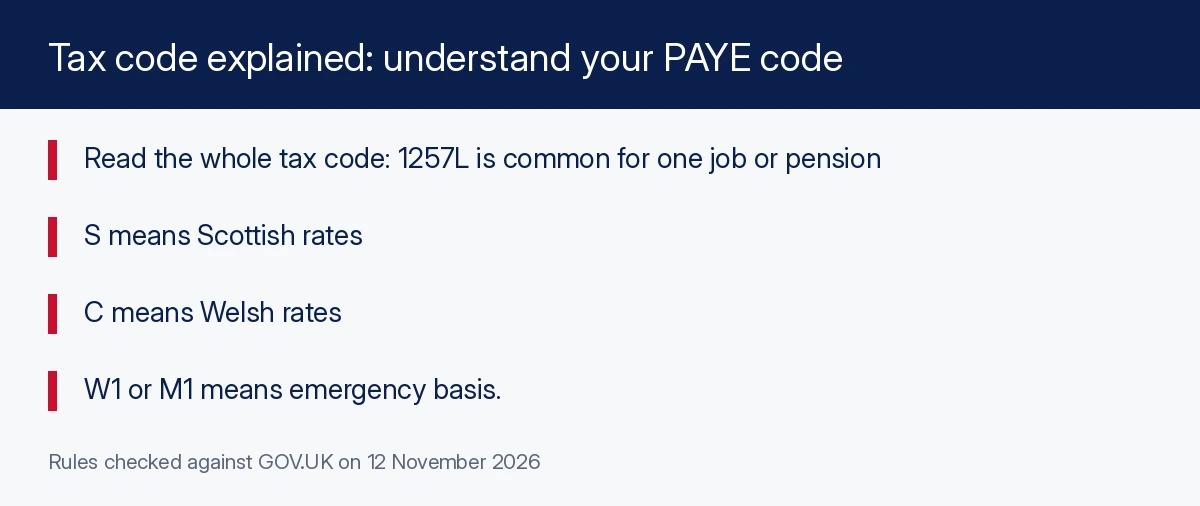
HMRC describes 1257L as the code currently used for most people with one job or pension. The L means entitlement to the standard tax-free Personal Allowance. It does not mean that every worker, newcomer or pension recipient should have that exact code.
For the 2026 to 2027 tax year, running from 6 April 2026 to 5 April 2027, the standard Personal Allowance is £12,570. Your own allowance can differ. Check the figure in your HMRC record rather than treating the standard amount as a personal entitlement in every situation.
For most numbered codes, HMRC starts with your allowance and deducts relevant untaxed income and other adjustments. It then replaces the final digit with a letter. A K code uses a different calculation, explained below.
HMRC’s example starts with £12,570 and deducts a £1,570 employer medical-insurance benefit. That leaves £11,000 tax-free income and produces 1100L. The benefit has changed the code even though the person began with the standard allowance.
Common tax-code letters explained
The HMRC code table explains the letters. Use the entry for your complete code, including any Scottish or Welsh prefix. The same-looking number can accompany different instructions, and the absence of an allowance is not automatically a payroll mistake.
| Code or letter | HMRC meaning |
|---|---|
| L | Entitled to the standard tax-free Personal Allowance |
| BR | All income from this job or pension taxed at the basic rate |
| 0T | Allowance used up, or a new employer lacks the details needed for a code |
| D0 | All income from this job or pension taxed at the higher rate |
| M | Received a transfer of 10% of a partner’s Personal Allowance through Marriage Allowance |
| N | Transferred 10% of Personal Allowance to a partner through Marriage Allowance |
| NT | No tax paid on this income |
| T | Other calculations included in working out Personal Allowance |
BR and D0 are often used where someone has more than one job or pension. That describes the income from the particular source carrying the code. It does not mean all your income from every source is necessarily taxed in the same way.
For 0T, check both possible explanations before drawing a conclusion. HMRC may have allocated the allowance elsewhere, or your new employer may be missing information. Ask about the underlying record rather than requesting an allowance that may already be used against another income.
Scottish S and Welsh C prefixes
An S prefix means the income or pension is taxed using Scottish rates. A C prefix means Welsh rates apply. These are part of the code’s meaning, not optional labels to leave out when asking payroll or HMRC a question.
The prefixes also appear with other letters. HMRC lists SBR and CBR for basic-rate deductions under the respective systems. Its full table includes additional Scottish and Welsh combinations, so use that table when your code is more specific than a simple prefix and number.
One important example is SD0: HMRC describes it as the Scottish intermediate rate. D0 without that prefix means the higher rate. Reading only the ending can therefore lead you to the wrong explanation of the tax being deducted.
If the nation indicated looks unexpected, check your details with HMRC through the current-year service. Give the full code and explain the concern. This guide does not infer your tax position merely from where an employer’s office is based.
W1, M1, X and NONCUM emergency codes
HMRC says an emergency code ends in W1, M1, X or NONCUM. W1 is used for weekly pay, M1 for monthly pay and X where pay dates vary. NONCUM can appear depending on the employer’s payroll software.
On an emergency basis, tax is worked out from that week’s or month’s pay only, rather than total income so far in the tax year. You are taxed as if you received that amount every week or month of the year. This can produce the wrong deduction.
A new job can trigger this if the employer lacks your previous pay and tax details. Give the new employer your P45 if you have it. If the previous employer did not supply one, ask for it; HMRC says this can help resolve the missing information.
HMRC says updating a new starter’s code can take up to 35 days from starting the job. If you started more than 35 days ago and still think it is wrong, follow the official code-update guidance. That timescale is not a promise of a refund on a particular payday.
Emergency treatment is not limited to new jobs. HMRC also describes situations involving newly received company benefits or the State Pension. Read the relevant explanation and check the income details in your account before deciding which correction is needed.
What a K tax code means
A K code means income or deductions not already being taxed exceed your tax-free Personal Allowance. HMRC lists possible reasons including tax owed from an earlier year, State Pension or taxable state benefits, company benefits and savings interest above the relevant allowance.
Your employer or pension provider uses that code to collect tax for the other income or deductions through the employment or pension carrying it. It is therefore different from a normal numbered allowance code. Do not read it as an extra amount of tax-free pay.
HMRC says employers and pension providers cannot take more than half your pre-tax wages or pension when using a K code. If a deduction looks wrong, ask payroll to explain its calculation and check the underlying code details with HMRC.
Keep the explanation of the code alongside the payslip you are checking. A question about whether payroll applied the code correctly and a question about whether HMRC included the right income may need answers from different organisations.
How to correct a tax code that looks wrong
HMRC says incorrect codes usually result from missing or incorrect information. The quickest checking route is its online Income Tax service. Review your employment, pension, estimated taxable income, company benefits and expenses, then update anything wrong or missing.
- Match each job and pension to the correct record.
- Check the estimated taxable income against your circumstances.
- Review company benefits and relevant expenses.
- Update missing or incorrect details through HMRC.
- Keep a note of what you changed and check the next relevant payslips.
If the code needs changing, HMRC says it will tell you and your employer the new code within 15 working days. After you receive it, monthly-paid workers should see it on the next or following payslip; weekly-paid workers should see it on the third payslip.
If it does not appear, speak to your employer to check it received the code. If you cannot use the online service, contact HMRC. For a new job, HMRC says to wait 35 days for the new income details before contacting it about the code.
Overpaid or underpaid tax
An incorrect code can mean paying too much or too little. HMRC needs the income details for the tax year before settling the difference. Changing a code does not, by itself, establish the amount owed or create a guaranteed payment date.
If HMRC has all the details when it updates your code, it works out any overpayment and asks the employer or pension provider to refund the difference through pay. HMRC says this usually happens when the new code is used.
If details are missing, HMRC says a refund cannot be made until it receives them. After the tax year ends, it checks income information and writes if the tax paid was incorrect. Follow the instructions in that official communication for the next step.
For underpaid tax, HMRC may adjust the code to collect what is owed over one or more tax years, where possible. Read its explanation before assuming that lower take-home pay means the employer changed your agreed wage.
Keep the right records for your query
Keep payslips, tax-code notices and relevant job or pension details together. If you ask for help, identify the tax year, income source, code and deduction you are questioning. This makes it easier to distinguish an outdated estimate from a payroll application problem.
A P60 is an annual record of pay and tax. It serves a different purpose from a code used for current deductions. Keep annual records alongside current payslips so you can explain which period the query concerns.
If your concern is the hourly wage rather than tax deductions, use our minimum wage guide. A tax code explains Income Tax treatment; it does not tell you whether the hours and gross pay meet minimum wage rules.
Check your annual tax paperwork
Understand which P60 to expect and what to do if it is missing.
Read the P60 guideCommon questions
What does 1257L mean?
HMRC says 1257L is currently used for most people with one job or pension. L means entitlement to the standard Personal Allowance, £12,570 for 2026 to 2027. Your own code may differ.
Is 1257L an emergency tax code?
Not on its own. HMRC says emergency codes end in W1, M1, X or NONCUM.
What does BR mean?
All income from the job or pension carrying BR is taxed at the basic rate. It is often used where you have more than one job or pension.
What do S and C mean?
S means Scottish Income Tax rates apply to that income or pension. C means Welsh rates apply. Read the complete code in HMRC’s table.
How do I fix a wrong tax code?
Check and update your employment, pension, estimated income, benefits and expenses through HMRC’s current-year Income Tax service. Contact HMRC if you cannot use the online service.
Will changing my code guarantee a refund?
No. HMRC must have your income details and establish whether you overpaid. If a refund is due through payroll, HMRC says it usually happens when the new code is used.
Official sources
- Tax codes overview — HMRC / GOV.UK · Checked 2026-11-12
- What your tax code means — HMRC / GOV.UK · Checked 2026-11-12
- Emergency tax codes — HMRC / GOV.UK · Checked 2026-11-12
- Correct your tax code — HMRC / GOV.UK · Checked 2026-11-12
- Income Tax rates and allowances — HMRC / GOV.UK · Checked 2026-11-12
- Check Income Tax for the current year — HMRC / GOV.UK · Checked 2026-11-12
- Too much or too little tax — HMRC / GOV.UK · Checked 2026-11-12
- K tax codes — HMRC / GOV.UK · Checked 2026-11-12
SettleUK is an independent guide. It is not a government website and is not affiliated with GOV.UK, DWP, HMRC or the NHS.