National minimum wage 2026: rates and pay checks
What is the national minimum wage in 2026?
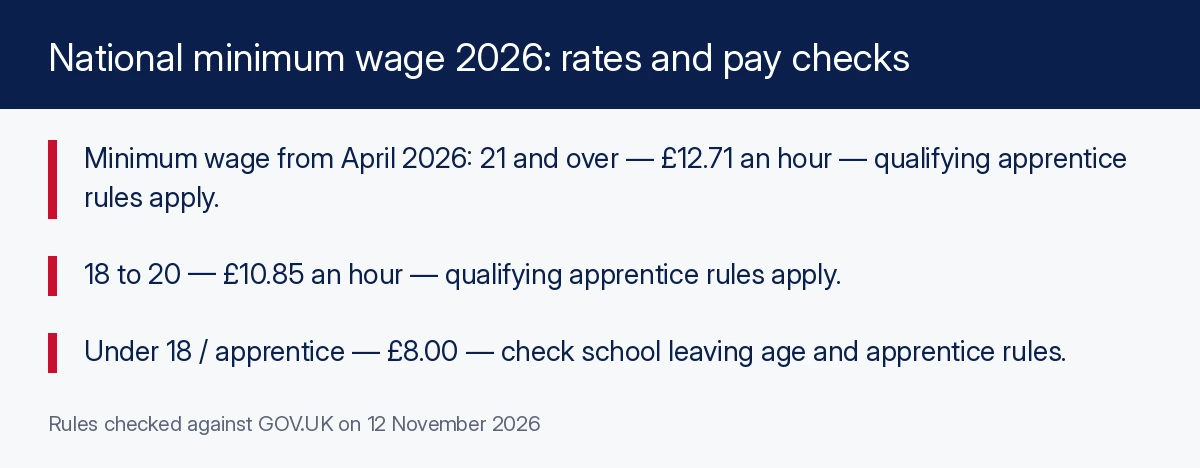
From April 2026, eligible workers aged 21 and over receive at least £12.71 an hour, unless the qualifying apprentice rate applies. Rates are £10.85 for ages 18 to 20, £8.00 for under-18s above school leaving age and £8.00 for qualifying apprentices. GOV.UK also publishes April 2027 rates.
Check your age band, apprenticeship stage, hours and deductions before deciding whether your pay meets the legal minimum.
In this guide
- What is the national minimum wage in 2026?
- April 2026 rates by age and apprenticeship status
- When the apprentice rate applies
- Who is entitled and who needs a different check?
- Count the right working time
- Check pay, deductions, uniforms and tips
- Use the official calculator and keep evidence
- Raise an underpayment with the employer
- Complain to HMRC if the problem is unresolved
- Published minimum wage 2027 rates and your next checks
- Common questions
- Official sources
- Related guides

What is the national minimum wage in 2026?
From April 2026, the National Living Wage is £12.71 an hour for eligible workers aged 21 and over. National Minimum Wage rates are £10.85 for ages 18 to 20 and £8.00 for under-18s above school leaving age. The qualifying apprentice rate is £8.00.
This national minimum wage 2026 guide covers England, Scotland, Wales and Northern Ireland. The statutory hourly rate depends on age and apprenticeship status. It is a minimum, rather than a promise about your take-home pay or the rate offered in every job.
SettleUK is an independent guide, not a government site. Rates and rules below were checked against GOV.UK on 12 November 2026. The official rates page also publishes April 2027 figures, which are shown separately so they are not confused with current rates.
For a personal check, gather your payslips, hours and relevant deductions. A headline hourly rate can look correct while the calculation is wrong because working time or job-related costs have been missed.
April 2026 rates by age and apprenticeship status
The official rates page says minimum wage rates change on 1 April each year. Use the table for the relevant period and check whether the special apprentice conditions apply before choosing an age-based row.
| Worker category | Hourly rate from April 2026 | Check |
|---|---|---|
| Age 21 and over | £12.71 | National Living Wage, unless the qualifying apprentice rate applies |
| Age 18 to 20 | £10.85 | National Minimum Wage, unless the qualifying apprentice rate applies |
| Under 18 | £8.00 | Must be at least school leaving age |
| Qualifying apprentice | £8.00 | Under 19, or 19 and over in the first apprenticeship year |
The National Living Wage in this table is the statutory minimum for the older age group. A contract offering more remains a separate contractual matter. Use the hours and pay period that apply to your job when checking your pay.
Do not use a younger age band simply because a worker is on probation, newly arrived or doing casual work. GOV.UK includes trainees, workers on probation and foreign workers among those entitled to the correct minimum where they qualify.
If the pay period crosses an age or rate change, ask payroll how it applied the current official rules. Avoid comparing a single payday with a rate-change date without checking the period the pay covers.
When the apprentice rate applies
Apprentices qualify for the apprentice rate if they are under 19, or are aged 19 or over and in the first year of their apprenticeship. Age alone does not settle which rate applies: you also need to know the apprenticeship stage.
Once an apprentice is aged 19 or over and has completed the first apprenticeship year, the minimum wage for their age applies. Both conditions matter. A worker who has progressed beyond the first year should ask payroll to check their category.
GOV.UK gives an example of an apprentice aged 21 in the first year receiving the £8.00 apprentice minimum under April 2026 rates. Its example for an apprentice aged 21 who has completed that year uses £12.71.
- Check the apprenticeship start date and current year.
- Check your age for the period in question.
- Match both details to the official apprentice conditions.
- Ask payroll to explain the rate used if it differs.
Keep the apprenticeship agreement and pay records available. If you are described as a trainee rather than an apprentice, do not assume that automatically authorises the apprentice rate. Ask for clarification of the arrangement and use the official eligibility guidance.
Who is entitled and who needs a different check?
GOV.UK's eligibility guidance says people classed as workers must be at least school leaving age to receive the National Minimum Wage. The National Living Wage age threshold is 21, subject to the apprenticeship rules.
Eligible categories include part-time and casual workers, agency workers, apprentices, some pieceworkers, trainees, workers on probation and foreign workers. A small employer must still pay the correct minimum. An agreement to accept less than the legal minimum is not binding.
There are exceptions. GOV.UK lists genuinely self-employed people running their own business, some volunteers, certain work placements, company directors and other specific categories. The label used for a role does not by itself answer every eligibility question.
- Check your actual working arrangement against the official worker guidance.
- If it is an internship or placement, read the specific exception rather than assuming all placements are unpaid.
- If the employer says you are self-employed, ask how that status was determined.
- Seek advice where the status or exception is unclear.
This guide does not decide employment status from a job title. Use the official guidance and get advice about the facts of the arrangement if you and the employer disagree.
Count the right working time
The different types of work guide says minimum wage applies even where eligible workers are not paid by the hour. There are separate methods for hourly work, salaried hours, output work and unmeasured work.
Time that can count includes required working time, certain standby time near the workplace, waiting for work tasks, training and travel between work assignments. Ordinary travel between home and work is excluded under the guidance, as are rest breaks actually taken.
For example, the official guide explains that a care worker moving between appointments without a break must count both the appointments and the travel between them. Returning home for a break creates a different situation, which the guidance addresses separately.
Keep a clear record of starts, finishes, breaks, training and work-related travel. If your payslip only shows scheduled contact hours, ask whether other time has been considered. Do not assume every minute away from home counts, or that only customer-facing time counts.
Sleep-in arrangements and other complex working patterns have specific rules. Use the live guidance or seek advice rather than applying a simple hours calculation to every overnight shift.
Check pay, deductions, uniforms and tips
GOV.UK's employer guidance explains which payments count in minimum wage calculations. It excludes tips, service charges and cover charges. These cannot be used to bring otherwise insufficient pay up to the legal minimum.
Unreimbursed purchases needed for the job, such as tools, uniform and safety equipment, also matter. Payments for the employer's own use or benefit are excluded from the qualifying calculation. Ask payroll to explain how required costs have been treated.
Income Tax and National Insurance contributions are included when working out minimum wage pay. This means a take-home amount below the hourly minimum does not by itself prove underpayment: you need the correct pre-deduction calculation and treatment of other costs.
The official guidance includes a uniform-rental example where the advertised hourly rate is above the minimum, but the required unreimbursed uniform cost brings the effective amount below it. Check required job costs as well as the hourly rate in your contract.
If several deductions appear, ask for each one's purpose and how payroll treated it for minimum wage. Our tax code guide explains a different issue: how PAYE tax is deducted.
Use the official calculator and keep evidence
The worker minimum wage calculator helps check whether you receive the correct minimum and whether your employer owes past payments from the previous year. Use the official instructions for the period you are checking.
For hourly work, GOV.UK says average hourly pay must meet the minimum over the period the pay packet covers. Pay reference periods are usually linked to how often you are paid and cannot exceed 31 days.
- Identify the pay period on the payslip.
- Check the applicable age or apprentice rate for that period.
- Gather the hours and work-related costs relevant to the calculation.
- Use the calculator and keep the result alongside your records.
- Ask payroll about any unexplained difference.
Record what you entered rather than keeping only a final result. If a wrong assumption about hours or costs is corrected, you can repeat the check consistently. For annual salaries or output work, use the relevant official calculation method.
A P60 is an annual pay-and-tax summary and is useful for broader records. It does not replace the payslips, hours and expense information needed to investigate a particular minimum wage period.
Raise an underpayment with the employer
The official dispute guidance says workers who think they receive less than the correct minimum should speak to the employer first. Explain the period and calculation so payroll can identify the issue.
If that does not resolve it, the guidance says you can ask in writing to see payment records. You can take someone with you and make copies. The employer must pay arrears it owes.
A useful written enquiry sets out your age or apprenticeship stage, the relevant pay period, the hours you believe count and the costs you think were handled incorrectly. Ask the employer to explain its calculation and any correction.
Keep copies of payslips, rotas, messages about required training or travel, and receipts for necessary job costs. These records help explain the concern. Do not change original records to make the totals match your estimate.
If you are uncomfortable raising the issue or the answer is unclear, use the advice and enforcement links in GOV.UK's dispute guide. This page does not set a tribunal deadline or promise the outcome of a complaint.
Complain to HMRC if the problem is unresolved
GOV.UK says workers can complain to HM Revenue and Customs about their employer or employment agency. You can also complain on someone else's behalf. Follow the complaint link from the official worker-disputes page to use the current route.
If HMRC finds underpayment, the guidance says it issues a notice for arrears and a fine. If an employer still refuses to pay, HMRC can take it to court on the worker's behalf. The current page says HMRC enforces minimum wage on behalf of the Fair Work Agency.
The guidance also describes tribunal options, including where someone has been dismissed because of a minimum wage dispute. Employment procedures and advice routes can depend on the jurisdiction. Check the appropriate route rather than assuming one process covers every employment claim throughout the UK.
- Keep the disputed periods and supporting records organised.
- Use the official complaint form rather than an unofficial reporting service.
- Explain what you have already asked the employer and its response.
- Seek advice promptly about any separate employment claim.
The minimum wage complaint concerns pay entitlement. A tax-code correction, bank payment delay or disagreement over a higher contractual rate may need additional action through a different route.
Published minimum wage 2027 rates and your next checks
As checked on 12 November 2026, GOV.UK's rates page publishes an April 2027 row. Use these for pay periods covered by the new rates, not to check earlier earnings.
| Category | Published hourly rate from April 2027 |
|---|---|
| 21 and over | £13.21 |
| 18 to 20 | £11.27 |
| Under 18 | £8.31 |
| Qualifying apprentice | £8.31 |
Keep the future table separate from a check on pay earned under April 2026 rates. The apprentice eligibility conditions and school-leaving-age requirement still need checking; a table heading does not remove them.
Before relying on a future budget, revisit GOV.UK for the current rate and ask payroll which pay period first reflects any applicable change. Keep your own birthday and apprenticeship progression in mind as separate reasons to review the rate.
Understand your employment paperwork
Keep annual tax summaries alongside payslips and hours records.
Read the P60 guideCommon questions
What is the National Living Wage from April 2026?
£12.71 an hour for eligible workers aged 21 and over, subject to the apprentice-rate rules.
What is the rate for ages 18 to 20?
The April 2026 National Minimum Wage is £10.85 an hour, unless the qualifying apprentice rate applies.
When does an older apprentice get their age rate?
Apprentices aged 19 or over who have completed the first year of their apprenticeship are entitled to the minimum wage for their age.
Do tips count towards minimum wage?
No. GOV.UK excludes tips, service charges and cover charges from minimum wage calculations.
Does travel between jobs count?
Travel between work assignments can count. Ordinary commuting between home and work does not. Check the official working-time guidance for your pattern.
How do I report underpayment?
Use the complaint link on GOV.UK’s worker-disputes page to complain to HMRC about an employer or employment agency. Keep the relevant pay and hours records.
Are April 2027 rates published?
Yes. The GOV.UK page checked for this guide publishes £13.21 for ages 21 and over, £11.27 for ages 18 to 20 and £8.31 for under-18s and qualifying apprentices from April 2027.
Official sources
- National Minimum Wage and National Living Wage rates — GOV.UK · Checked 2026-11-12
- Minimum wage calculator for workers — GOV.UK · Checked 2026-11-12
- Who gets the minimum wage — GOV.UK · Checked 2026-11-12
- Minimum wage for different types of work — GOV.UK · Checked 2026-11-12
- Employers and minimum wage calculations — GOV.UK · Checked 2026-11-12
- Paid by the hour — GOV.UK · Checked 2026-11-12
- Worker disputes over minimum wage — GOV.UK · Checked 2026-11-12
SettleUK is an independent guide. It is not a government website and is not affiliated with GOV.UK, DWP, HMRC or the NHS.