Right to rent check: tenant guide for England
What is a right to rent check, and where does it apply?
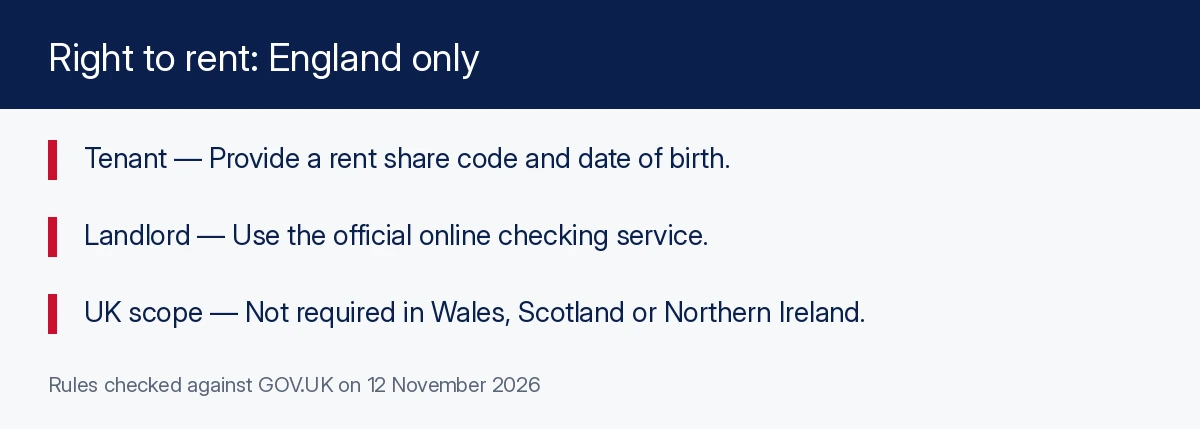
A right to rent check is an England-only check of an adult tenant’s eligibility to rent. Depending on your circumstances, provide a rent share code and date of birth or accepted documents. The landlord completes the check before the tenancy starts.
Prepare the right evidence, understand what a landlord checks and keep initial checks separate from follow-up checks and code expiry.
In this guide
- What is a right to rent check, and where does it apply?
- Who must be checked before moving in?
- Which accommodation is outside these checks?
- How do tenants get a right to rent share code?
- What if you are British, Irish or use original documents?
- What does the landlord check and keep?
- When must the initial check happen?
- When are follow-up checks needed?
- What if documents are unavailable or the code fails?
- Common questions
- Official sources
- Related guides

What is a right to rent check, and where does it apply?
A right to rent check establishes whether an adult can legally rent residential accommodation in England. A landlord checks the relevant evidence before a new tenancy. Depending on your nationality and status, you may use a share code or accepted documents.
This guide is about England only. GOV.UK says you do not need to prove your right to rent in Wales, Scotland or Northern Ireland. Do not apply England’s immigration checking rules to a home elsewhere in the UK. SettleUK is an independent guide, not a government site.
The process is separate from affordability, references and the tenancy agreement. This page explains the immigration evidence check, not every step involved in renting a property. Use the official guidance for your evidence and ask the landlord to distinguish any other information they are requesting.
Who must be checked before moving in?
The official landlord guidance says landlords must check all tenants aged 18 and over before the start of a new tenancy. This includes people not named on the agreement, situations without a tenancy agreement and agreements that are not in writing.
The guidance also covers lodgers. Landlords must check all new tenants rather than only people they think are not British citizens. It is against the law to select people for checking on that basis, and landlords must not discriminate because of where somebody is from.
If you are moving in with other adults, agree who is collecting the evidence and which route each person will use. Do not assume one person’s share code covers a partner or another adult in the household. The requirement concerns the adults who will occupy the home.
As a practical preparation step, tell the landlord which adults intend to live at the address and ask when the evidence is needed. That discussion can prevent an otherwise straightforward move from stalling because an adult occupant was left out of the original paperwork.
Which accommodation is outside these checks?
GOV.UK lists types of accommodation where these tenant checks are not needed, including social housing, care homes, hospices, hospitals, hostels, refuges, mobile homes and student accommodation. It also lists accommodation provided by a local authority or as part of a job, and leases of seven years or longer.
Use the linked landlord guidance and code of practice to check the exact category. Do not assume that any privately rented room occupied by a student is automatically within the listed student-accommodation exemption. The accommodation arrangement matters, not just the occupation or course of the person moving in.
If the landlord says a check is unnecessary, ask which accommodation category applies and check the official wording. Equally, if the property is in Scotland, Wales or Northern Ireland, the England-only right to rent requirement does not apply merely because an agent also operates in England.
This guide does not assess a particular agreement or accommodation exemption. Where the category is uncertain, check on GOV.UK’s landlord guidance before treating an ordinary private tenancy as excluded. Keep the question about the accommodation separate from the question about your immigration evidence.
How do tenants get a right to rent share code?
Open GOV.UK’s right to rent share-code service and follow the sign-in instructions. The page asks for your date of birth and details from a BRP, passport or national identity card as applicable. Select the renting purpose rather than the work purpose.
The page lists a UKVI account or an eligible BRP reference as ways to use the service. Many eVisa holders already have the account they need. Our eVisa guide explains account access and how to deal with an incorrect or inaccessible record.
Give the share code and your date of birth to the landlord or agent. They use the separate landlord checking service to view the result. Do not give them your UKVI password or ask them to sign in as you to inspect your personal account.
GOV.UK’s eVisa guidance says a share code lasts for 90 days and can be used repeatedly before it expires. If your code has expired, get another. Code expiry and the end of immigration permission are different dates; the landlord must read the check result.
- Use the official right to rent route.
- Follow the prompts using your linked identity details.
- Choose the sharing purpose for renting.
- Give the code and your date of birth to the checker.
- If it does not work, check expiry, the purpose and the details entered.
What if you are British, Irish or use original documents?
The tenant overview says British or Irish citizens can use a British passport, an Irish passport or passport card, or a certificate of registration or naturalisation as a British citizen. The listed passports and Irish passport card can be current or expired.
Other document combinations may be available if you do not have the listed evidence. Follow the other-documents route linked from GOV.UK; do not assume that any letter with your address is enough. Ask the landlord which accepted route they are checking.
If you are not British or Irish, eligible original immigration documents may be an alternative to a code. GOV.UK says you can choose an accepted option and the landlord cannot reject your application because you used an eligible document instead of a share code.
Landlords cannot accept BRP or BRC cards as physical evidence for this check; the landlord guidance says to ask for a share code instead. Using a document reference to access a digital service is a different action from presenting the card as accepted physical evidence.
The specific share-code page also lists British or Commonwealth citizens with a digital certificate of entitlement proving right of abode. If that applies, use those instructions. Check the digital-certificate instructions if you hold one.
What does the landlord check and keep?
The landlord opens the official tenant share-code checking service and enters your date of birth and code. The result is used to check whether you can rent and how long for. A code handed over by itself is not the complete check.
For original documents, the landlord checks that they are genuine, belong to you and are consistent, with you present. The guidance includes photographs, dates of birth and supporting evidence where names differ. For people who are not British or Irish, permission to stay must not have ended.
| Check route | What you provide | What the landlord does |
|---|---|---|
| Online | Rent share code and date of birth | Views the official result and records the check |
| Original documents | Evidence accepted for your circumstances | Checks originals and consistency with you present |
| Home Office check | Relevant reference and circumstances | Uses the checking route where required |
| Follow-up | Current evidence when requested | Rechecks time-limited rights under the official rule |
For an online check, the landlord prints or saves the profile page and records the check date. GOV.UK says this information must be kept for the time you rent from them and for one year afterwards, following data protection law.
You can keep your own note of what you provided and when, but that does not replace the landlord’s record. If the agent says evidence is missing, ask whether they need another accepted document, a working code or information for a Home Office check.
When must the initial check happen?
The check is required before the start of the new tenancy. If the tenant has permission to stay only for a limited time, the landlord guidance says the check must be done in the 28 days before the tenancy starts. Do not confuse this with share-code validity.
A code can still be within its 90-day validity period while the landlord needs to make the actual check within the applicable pre-tenancy window. Generating a code early does not itself establish that the landlord has completed a correctly timed check.
Confirm the tenancy start date with the agent and ask when they will run the check. Tell them if the start date changes so they can check the timing again.
If you are also starting employment, keep the housing and work requests apart. Our right to work share-code guide covers the employment route. Sending whichever code is most recently saved in your phone is not a reliable way to answer a specific request.
When are follow-up checks needed?
The official follow-up guidance says a further check is required if there is a time limit on permission to stay. It says to do the check just before whichever is later: the end of permission to stay or 12 months after the previous check.
That “later of” wording matters. The next check may be later than a year away or later than the end of the tenant’s permission. GOV.UK says no follow-up is required where there is no time limit on permission to stay.
If a landlord finds after a follow-up check that a tenant can no longer legally rent in England, the guidance says the landlord must tell the Home Office. This guide does not turn that reporting rule into advice about ending a tenancy or removing someone from a home.
For personal organisation, keep any official evidence of changes to your permission accessible and respond to a properly explained follow-up request. If the record appears wrong or a decision is pending, direct the landlord to the official checking guidance instead of assuming an expired document settles the issue.
Ask the landlord what date they have recorded for the next check and which part of the official rule they used. This can help resolve a misunderstanding without trying to calculate immigration consequences from the date printed on an old card.
What if documents are unavailable or the code fails?
The landlord guidance says to use the Home Office landlord checking service if the tenant does not have the right documents or a valid share code. Examples include documents held by the Home Office, an outstanding case or appeal, or permission to rent communicated by the Home Office.
The landlord needs the tenant’s Home Office reference number for that service. The how-to-check page says an answer is provided within two working days. Use the current GOV.UK instructions if the situation needs escalation rather than treating a technical failure as proof that someone cannot rent.
If you cannot access an eVisa or think the status shown is wrong, use the official account help or error-reporting route. Tell the landlord the nature of the problem. A screenshot of an error can help describe it, but it does not replace the required evidence check.
Keep your wider move organised with the first-week checklist, council tax guide and bank account guide. These tasks are useful to plan together, while each has its own evidence and official rules.
For questions about a deposit, ending a tenancy or eviction, use the relevant official renting guidance. Those rules need to be checked separately from immigration evidence.
Common questions
Is a right to rent check required across the UK?
No. The requirement described here applies to England. GOV.UK says you do not need to prove right to rent in Wales, Scotland or Northern Ireland.
Does everyone on the tenancy need checking?
The landlord guidance requires checks on all tenants aged 18 and over, including adults not named on the agreement. It also covers lodgers and arrangements without a written agreement.
Can my landlord insist on a share code?
If you can prove right to rent with an accepted original document, GOV.UK says the landlord cannot insist you use the online service instead.
Can I use a BRP as physical proof?
No. The landlord checking guidance says BRP and BRC cards cannot be accepted as physical evidence. Use the appropriate share-code route or other accepted evidence.
How long does a share code last?
GOV.UK’s eVisa guidance says 90 days. The landlord still needs to make the actual check at the correct time; code validity does not replace the pre-tenancy timing rule.
When is a follow-up check due?
For time-limited permission, GOV.UK says just before the later of permission ending or 12 months after the previous check. No follow-up is required where permission has no time limit.
Can only people thought to be foreign be checked?
No. Landlords must check all new tenants covered by the rules. GOV.UK says it is unlawful to check only people thought not to be British and prohibits discrimination based on where someone is from.
Official sources
- Prove your right to rent in England — GOV.UK · Checked 2026-11-12
- Get a right to rent share code — GOV.UK · Checked 2026-11-12
- Who landlords must check — GOV.UK · Checked 2026-11-12
- How landlords do a check — GOV.UK · Checked 2026-11-12
- Follow-up right to rent checks — GOV.UK · Checked 2026-11-12
- Landlord: view a tenant’s right to rent — GOV.UK · Checked 2026-11-12
- eVisa share-code validity — GOV.UK · Checked 2026-11-12
SettleUK is an independent guide. It is not a government website and is not affiliated with GOV.UK, DWP, HMRC or the NHS.