Disability Living Allowance payment dates
When is Disability Living Allowance paid?
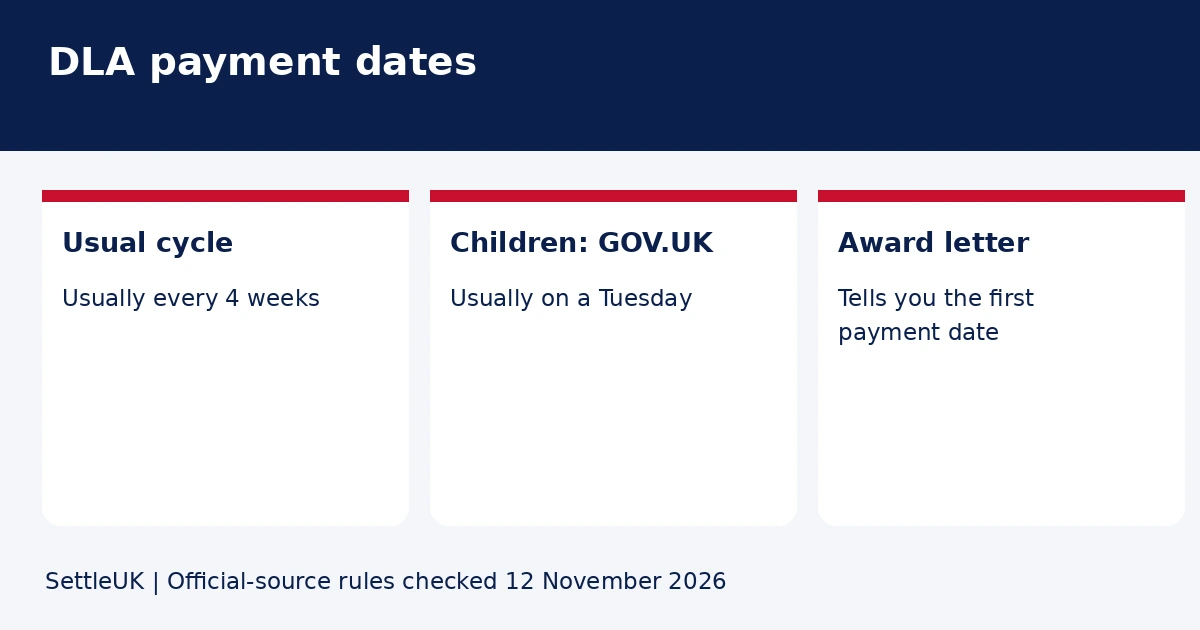
Disability Living Allowance is usually paid every four weeks. GOV.UK says children’s DLA in England and Wales is usually paid on a Tuesday. Payments due on a weekend or bank holiday usually arrive on the working day before. Check your award information for your own date.
Understand Disability Living Allowance payment dates for children and existing adult awards in England and Wales, with separate guidance for Northern Ireland and Scotland.
In this guide
- When is Disability Living Allowance paid?
- Four-week payments and weekly rates are different
- How to check your next DLA payment
- How bank holidays affect DLA payment dates
- Christmas 2026 and New Year planning
- New claims: start dates and first-payment letters
- Who to contact if DLA has not arrived
- Changes that need checking beyond the calendar
- When a child turns 16 or an adult award changes
- Scotland and cross-border moves
- Common questions
- Official sources
- Related guides
When is Disability Living Allowance paid?
Disability Living Allowance is usually paid every four weeks. For DLA for children in England and Wales, GOV.UK is more specific: it says payment is usually every four weeks on a Tuesday. Check your own award information before deciding that a particular Tuesday is your payday.
This guide covers children's DLA and existing adult DLA awards in England and Wales, with a separate Northern Ireland explanation. Scotland has different benefits and transfer arrangements. The name on your latest award correspondence matters when identifying the correct payment guidance.
GOV.UK's general benefit payment guidance says a payment due on a weekend or bank holiday is usually paid on the working day before. The children's DLA page says bank-holiday payments are usually made before the holiday, with normal payments continuing afterwards.
Start with the official children's payment guidance if you manage a child's award. Existing adult recipients should also use their own award correspondence and the appropriate official contact route.
Four-week payments and weekly rates are different
DLA guidance expresses care and mobility rates as weekly amounts. The usual deposit cycle is four weeks. A weekly figure in an award description does not mean that the account should receive a payment every week, and a calendar month is not the same thing as four weeks.
The children's benefit has care and mobility components, and a child may qualify for one or both. Read the award as a whole when checking an expected deposit. Do not assume that seeing two component names means there should be two separate paydays.
| What you are looking at | What it means | Where to check |
|---|---|---|
| Weekly rate | The published rate description | Your award decision |
| Payment frequency | Usually every four weeks | Official payment guidance |
| Children's usual weekday | GOV.UK says usually Tuesday | Your own confirmed arrangements |
| First deposit | A separate date after a decision | The first-payment letter |
For budgeting, record the actual expected date beside each bill. Keep DLA separate from Child Benefit and Carer's Allowance, even where the same household receives several benefits. Use the timing rules for each benefit individually.
If an amount differs from what you expected, ask for an explanation rather than changing your calendar to make it fit. The issue may concern award information and not simply the date shown in your bank account.
How to check your next DLA payment
For a new children's DLA award, the decision letter tells you when you will receive the first payment. GOV.UK distinguishes that letter from the earlier acknowledgement confirming the application. Keep both, but use the decision information when checking the first deposit.
For an ongoing award, use the latest payment correspondence alongside your bank records. Note the date and reference of the last payment you can identify. This gives the paying office something precise to investigate if you cannot establish the next expected date.
- Confirm whether the award is DLA for a child or an existing adult award.
- Find the latest decision or payment letter and check the benefit name.
- Look for a deposit already received before a weekend or bank holiday.
- Check that you are looking at the account used for the benefit.
- Contact the appropriate service if the date remains unclear.
These are practical checks rather than a replacement for official payment information. Avoid copying a friend's payment date: even the published Tuesday wording does not identify which four-week cycle belongs to your child.
How bank holidays affect DLA payment dates
GOV.UK says children's DLA due on a bank holiday will usually be paid before the holiday. Its general benefit guidance specifies the working day before when the due date is a weekend or bank holiday. Ask the paying office if you are unsure how this affects your award.
The children's page also says that payments continue as normal after the holiday adjustment. An early deposit should therefore prompt you to check your existing schedule, rather than deciding that every later payment has permanently moved to the earlier weekday.
Use the official holiday list for the relevant nation. England and Wales, Scotland and Northern Ireland have separate entries in the GOV.UK JSON. A holiday date in one list does not establish how another nation's benefit agency will handle a particular award.
If a deposit arrives sooner than expected, check the reference and correspondence before treating it as additional entitlement. A timing change by itself does not explain an increased award. Ask the paying office about any amount or payment purpose you do not understand.
Our bank holiday guide can help you organise several benefits, while the official DLA pages remain the source for DLA's published rules.
Christmas 2026 and New Year planning
The GOV.UK bank-holiday feed lists Christmas Day on 25 December 2026, the Boxing Day bank holiday on 28 December 2026 and New Year's Day on 1 January 2027 in England and Wales and Northern Ireland. These verified dates can help you check your diary.
| Holiday | England and Wales / Northern Ireland | What it confirms |
|---|---|---|
| Christmas Day | 25 December 2026 | A bank holiday, not a universal DLA payday |
| Boxing Day bank holiday | 28 December 2026 | A date to compare with your schedule |
| New Year's Day | 1 January 2027 | A possible holiday conflict to check |
A holiday list is not a personal DLA payment timetable. Your award information is the starting point for checking your own due date. Check GOV.UK payment guidance and ask the paying office about any uncertainty.
Check GOV.UK for festive updates and keep any later payment letter with your records. If your usual due date is not clear, ask the paying office before making plans around an early payment.
If you manage several household payments, use our Christmas benefit guide to organise them. Enter each confirmed date separately so a change affecting another benefit does not become an assumed change to DLA.
New claims: start dates and first-payment letters
For children's DLA in England and Wales, GOV.UK says the benefit can be paid from the start of the claim and cannot be backdated. The claim start date and the date money first reaches an account are different things to check.
The official guidance says a claim starts when the form is received, or on the date you call the enquiry line if you return the claim pack within six weeks. Keep a record of the call and the paperwork so you can discuss the relevant dates accurately.
GOV.UK says an application-confirmation letter arrives within three weeks after applying. Once a decision is made, another letter tells you when the first payment will arrive. The acknowledgement is not a promise that the award has been approved or that payment will follow immediately.
When asking about progress, explain whether you are waiting for the acknowledgement, the award decision or a payment already described in a letter. These are separate questions, and identifying the stage makes the conversation clearer.
Use the Northern Ireland claim instructions if that is where the child lives. Nidirect provides its own claim route through the Disability and Carers Service. Do not send an application using an England and Wales address simply because the benefit has the same name.
Who to contact if DLA has not arrived
First compare your records with the expected date and check for an earlier holiday payment. If you still need help, use GOV.UK's Disability Service Centre page to select the right service. Different DLA recipients have different contact arrangements.
| England and Wales contact category | Published telephone | Published hours |
|---|---|---|
| DLA: born after 8 April 1948 | 0800 121 4600 | Monday to Friday, 9am to 5pm |
| DLA: born on or before 8 April 1948 | 0800 731 0122 | Monday to Friday, 8am to 6pm |
| Already claimed PIP and asking about DLA | 0800 121 4433 | Monday to Friday, 9am to 5pm |
The contact page specifically says to use the PIP number if you have made a PIP claim and want to discuss DLA. Check the official page for accessible contact options, alternative formats and any updates before calling. The ordinary hours above are not a festive opening-hours promise.
- Have your award letter and relevant claim reference available.
- Note the expected date and the last payment you can identify.
- Explain any account change or later decision letter.
- Ask what has happened to the payment and what you should do next.
In Northern Ireland, contact the Disability and Carers Service through nidirect. Ask whether the payment has been sent and when you should follow up if it is still missing.
Changes that need checking beyond the calendar
A changed or missing payment may require an award check. For children's DLA, GOV.UK says a change can affect the amount received. Report changes through the DLA helpline instead of assuming every difference is caused by a weekend or bank holiday.
The reporting list includes changes to personal details, the help needed or the child's condition, hospital and care-home stays, residential school, and plans to go abroad for more than four weeks. Read the complete official list for the circumstances you need to report.
If a child is in a care home, details of funding and later changes in the stay can matter. The official page sets out reporting requirements. This guide does not calculate an individual suspension date from a brief description of a hospital or care-home stay.
In Northern Ireland, nidirect directs changes for children and adults to the Disability and Carers Service. Its guidance gives local examples, including changes to personal details, care needs and hospital or care-home stays. Follow the appropriate national instructions for the actual award.
If you receive a new decision and disagree with it, check the official reconsideration instructions. A request to explain a late payment and a challenge to an award decision are different matters to describe to the service.
When a child turns 16 or an adult award changes
For the England and Wales children's route, GOV.UK says the child will need to apply for Personal Independence Payment when they turn 16. They receive an invitation letter. Follow the deadline in that letter rather than guessing that payments transfer automatically on a birthday.
GOV.UK says DLA payments stop unless the child applies for PIP by the stated date. If they apply by that date, DLA continues until the claim is assessed. Keep the invitation and a record of action taken alongside the payment paperwork.
The official guidance also says to contact DLA to change payment details so DLA can be paid into the young person's own account. If they cannot manage their benefits, the page explains the possibility of becoming an appointee. Check that route rather than assuming informal help is sufficient.
For existing adult recipients in England and Wales, GOV.UK says a DLA claim might end. If yours is affected, a letter will explain when and how to apply for PIP. Follow your own letter; do not assume all adult awards end together.
Nidirect has separate Northern Ireland guidance about children turning 16 and existing adult awards. Keep using that route if you live there. Our PIP payment guide explains the next benefit's payment information, but your official correspondence controls the steps for your claim.
Scotland and cross-border moves
Children living in Scotland apply for Child Disability Payment instead of DLA for children. GOV.UK says a move to Scotland while receiving children's DLA must be reported to the DLA helpline. Apply for Child Disability Payment as soon as possible after moving.
The children's change-reporting page says DLA continues for up to 13 weeks after a move to Scotland. Treat that as a reason to act promptly, not a promise that no paperwork is needed. Confirm the claim and payment arrangements with the relevant agencies.
For a child moving from Scotland to England or Wales, GOV.UK says Social Security Scotland will explain when Child Disability Payment stops. Apply for children's DLA as soon as the child moves, because otherwise payments could be affected.
For adults, the current GOV.UK DLA overview says all existing Scottish DLA claims have moved to Scottish Adult Disability Living Allowance. That benefit is distinct from Adult Disability Payment. Read the name on the award before choosing guidance or asking about a missing deposit.
Keep the correct benefit in view
Use the payment hub to find the relevant guide, then confirm personal dates with the agency named on your award.
Browse payment guidesCommon questions
How often is DLA paid?
DLA is usually paid every four weeks. For children’s DLA in England and Wales, GOV.UK says payment is usually on a Tuesday. Check your own award for the relevant payment cycle.
Is DLA paid on the same date each month?
The published frequency is four weeks, rather than a fixed calendar-month date. Use your own payment correspondence and check any holiday conflict before planning bills.
What happens if DLA is due on a bank holiday?
GOV.UK says children’s DLA is usually paid before the holiday, then payments continue as normal. The general benefit rule says the working day before for payments due on a weekend or bank holiday.
When will my child’s first DLA payment arrive?
GOV.UK says that once the decision is made, a letter will tell you when the first payment will arrive. An application acknowledgement is a different letter.
Who handles DLA payment problems in Northern Ireland?
Nidirect directs DLA questions to the Disability and Carers Service. Use its official contact route and have your award information and payment record ready.
Will DLA automatically become PIP at 16?
Follow the invitation letter. GOV.UK says DLA stops unless the child applies for PIP by the date given. If they apply by that date, DLA continues until the claim is assessed.
Does Scotland still use the same DLA arrangements?
Scotland uses Child Disability Payment for children. GOV.UK says existing Scottish adult DLA claims have moved to Scottish Adult Disability Living Allowance. Check the benefit name on your award; this is distinct from Adult Disability Payment.
Official sources
- How and when your benefits are paid — GOV.UK / DWP · Checked 2026-11-12
- DLA for children: rates and payment timing — GOV.UK / DWP · Checked 2026-11-12
- DLA for children: how to claim — GOV.UK / DWP · Checked 2026-11-12
- DLA for children: changes you need to report — GOV.UK / DWP · Checked 2026-11-12
- DLA for children: when your child turns 16 — GOV.UK / DWP · Checked 2026-11-12
- Contact the Disability Service Centre — GOV.UK / DWP · Checked 2026-11-12
- Disability Living Allowance for adults — GOV.UK / DWP · Checked 2026-11-12
- Disability Living Allowance for children in Northern Ireland — nidirect · Checked 2026-11-12
- Disability Living Allowance for adults in Northern Ireland — nidirect · Checked 2026-11-12
- Official UK bank holidays JSON — GOV.UK · Checked 2026-11-12
SettleUK is an independent guide. It is not a government website and is not affiliated with GOV.UK, DWP, HMRC or the NHS.