Council tax single person discount explained
Who gets council tax single person discount?
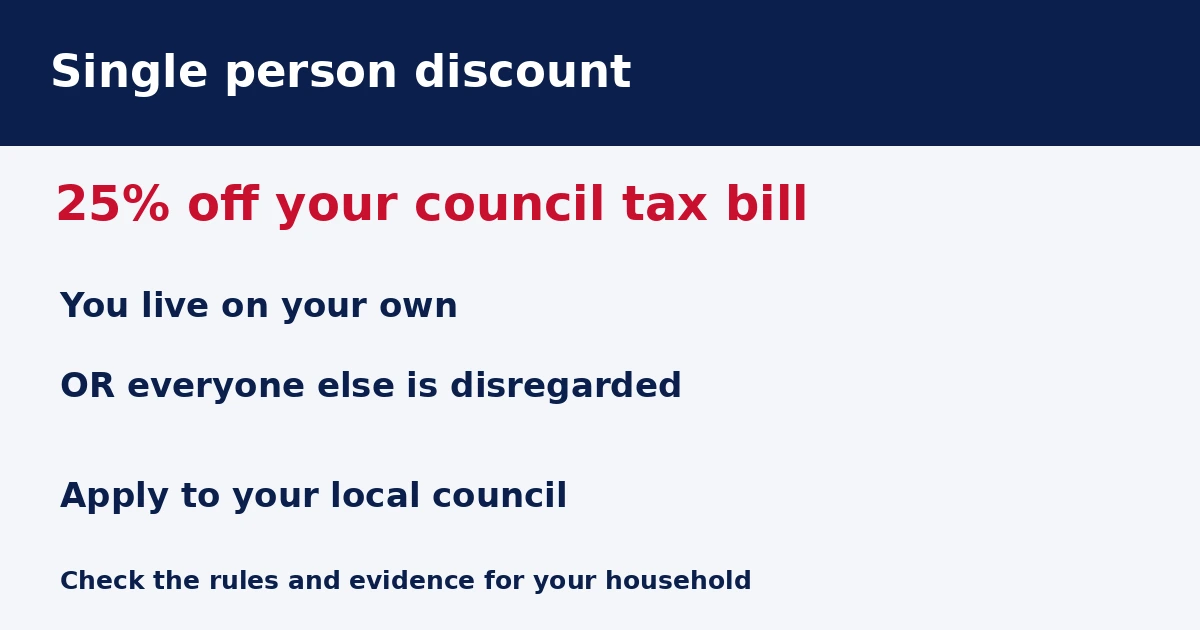
You can get 25% off if you pay council tax and live alone, or if everyone else in your home is disregarded. Apply to your council. This guide covers England, Scotland and Wales; check the applicable national rules and your council’s evidence requirements.
Check who counts as an adult, which discount route fits your household and what to ask your council. SettleUK is an independent guide, not a government site.
In this guide
- Who gets council tax single person discount?
- How the 25% discount works
- Who counts as an adult for council tax?
- Children, students, carers and disability
- National differences and the right official source
- How to apply and prepare evidence
- Moving, household changes and start dates
- Single person discount versus low-income support
- Checking the bill and questioning a decision
- A practical checklist before you contact the council
- Common questions
- Official sources
- Related guides
Who gets council tax single person discount?
The council tax single person discount is 25% off the bill when you pay council tax and live alone, or when everyone else in the home is disregarded. The important question is how many adults count for council tax, rather than simply how many people share the address.
This guide covers council tax in England, Scotland and Wales. Use your council’s rules for the detailed assessment, particularly where another resident may be disregarded. Northern Ireland uses a different rates scheme; the council tax discount discussed here is not a rates discount.
Start with the GOV.UK rules on counted adults. If your circumstances are more complicated than an adult living alone, explain the household to the council rather than choosing a discount category from its name.
How the 25% discount works
A full council tax bill is based on at least two adults living in a home. GOV.UK says you get 25% off if you pay council tax and live on your own, or if everyone else in the property is disregarded. You need to apply for a discount or exemption.
The percentage does not mean every eligible person gets the same cash saving. Council tax depends on the property’s band and the local charge. Read your council’s revised bill to see the discount and the amount you must pay.
| Household situation | What to investigate | Important qualification |
|---|---|---|
| One adult living alone | 25% discount | Apply to the council |
| One counted adult with other residents | 25% discount | Everyone else must be disregarded |
| At least two counted adults | Full-bill starting point | Other help may still be relevant |
| Everyone is disregarded | Discount or exemption assessment | Do not assume single person rules apply |
Keep the council’s decision and updated payment schedule together. If the discount does not appear as expected, ask the council to explain the assessment before assuming your own calculation is the amount due.
Who counts as an adult for council tax?
GOV.UK says you usually have to pay council tax if you are 18 or over. However, some people are disregarded when the council works out how many people live in the property. That is why an address with more than one resident may still qualify for the discount.
Examples listed by GOV.UK include people under 18, full-time college or university students, student nurses, certain apprentices and some live-in carers. Other categories have specific conditions. Ask about the exact category and evidence instead of assuming that anyone studying, training or caring is automatically disregarded.
Do not confuse not being counted with a decision about who must pay the bill. GOV.UK says spouses and partners who live together are jointly responsible for paying. If you are unsure who is liable, ask the council to decide that question as well as the discount question.
For an uncertain household, write down each resident and the category you want checked. Include any student, caring or other circumstances you want the council to check. Keep that list beside you when completing the application.
Children, students, carers and disability
Children and students
GOV.UK lists under-18s as disregarded, along with full-time college and university students. An adult living with children should therefore ask about the counted-adult test rather than dismissing the discount because they do not literally live alone.
If someone is studying, check the relevant nation’s conditions and ask which evidence the council needs. The Scottish Government’s mygov.scot guidance has its own student definitions. Use the conditions for the country where the home is located.
Live-in carers
GOV.UK lists a live-in carer for someone who is not their partner, spouse or child under 18 among disregarded people. Describe both the care arrangement and the relationship when you contact the council. Do not assume that every household receiving care qualifies for this disregard.
Severe mental impairment
GOV.UK describes separate discount conditions for severe mental impairment, including medical certification and eligibility for certain benefits. Ask the council which evidence it requires. This is different from assuming that any disability or diagnosis automatically means a resident is disregarded.
Our Council Tax Reduction guide also explains the distinction between low-income support and disability-related property help. Be clear about which route you want the council to consider.
National differences and the right official source
Use the council responsible for your address. The GOV.UK discount finder is a practical starting point. Check the council’s current instructions rather than copying an application checklist from a different nation.
England and Wales
The GOV.UK counted-adult guidance explains the 25% rule and the need to apply. This guide does not give one evidence list, processing time or retrospective award period for every English and Welsh council. Those details should be checked with the authority handling your bill.
Scotland
Mygov.scot describes a single adult discount when you are the only adult counted in the home. Its disregarded-resident examples include care leavers under 26 and people on certain immigration resettlement schemes, alongside students, carers and other categories.
Those Scottish examples are a reason to consult the national guidance rather than treating a short UK-wide list as complete. Ask the council to check the precise conditions for the resident in question, including any relevant dates and supporting evidence.
For Northern Ireland, use the separate scheme linked from GOV.UK’s support page. Do not use the 25% council tax rule to estimate a rates bill.
How to apply and prepare evidence
You need to apply even if someone in the home is disregarded. Use the official council route and read the form carefully: an application based on living alone may ask different questions from one based on a resident’s student or carer status.
- Find the council responsible for your bill.
- Choose the discount application appropriate to your household.
- Explain who lives at the address and the relevant circumstances.
- Provide the evidence the council requests.
- Save the submission confirmation and any correspondence.
- Check the decision and revised bill.
| Question to prepare | Useful information to locate | What to confirm locally |
|---|---|---|
| Which property is involved? | Bill and account details | The correct account and address |
| Who lives there? | Household details | Who the council counts |
| What changed? | Relevant move or status dates | Which date and evidence it can accept |
| Why is a person disregarded? | Information about the category | Required supporting documents |
This table suggests preparation; it is not a mandatory national evidence list. If you cannot provide a requested document, explain the problem and ask about alternatives. Never treat a saved online draft as proof that the council has received an application.
Moving, household changes and start dates
If someone moves in or out, ask the council how the change affects the discount and what date it should use. Do not decide that a household change is irrelevant simply because you still consider yourself the main bill payer.
If you have been eligible for an earlier period, ask the council about a retrospective application and the evidence it needs. This guide does not promise a universal backdating period. Explain the period you want checked and ask for the authority’s current rules.
For someone temporarily away, ask the council how it decides where that person lives for council tax purposes. We do not give a universal absence rule here. Describe the actual circumstances rather than assuming that every night away removes a resident from the household.
GOV.UK says you must contact your council if you receive a discount by mistake. If you do not, you could face a fine, and the council may ask you to repay the discount. Keep a record of when you reported a relevant change.
Single person discount versus low-income support
Single person discount concerns the adults counted in the home. Council Tax Reduction concerns low income and household circumstances. GOV.UK says you could qualify for reduction if you are on a low income or claim benefits, including when working or owning your home.
If both issues may be relevant, ask the council to check both routes. Do not assume that applying for one automatically answers every question about the other. Ask it to explain how any awards are reflected in the revised bill.
Disability-related band reduction is another separate route. GOV.UK describes qualifying property requirements, such as an additional room needed for a disabled person or space for using a wheelchair indoors. It is not the same as changing the property’s valuation band because you believe the original valuation was wrong.
Our council tax bands guide explains that valuation question. When contacting the council, distinguish an incorrect household count, a missing income-based award and an incorrect property band. Each concern needs a clear explanation.
Checking the bill and questioning a decision
Your council tax bill shows the annual amount, how it has been worked out and the payment dates. Check whether the discount decision appears in that calculation. If you cannot see how the figure was reached, ask for a breakdown.
Write down the point you disagree with: the counted adults, the accepted evidence, the period or the calculation. Ask the council for the review or appeal route applying to your nation and decision. Do not rely on a deadline from another jurisdiction.
GOV.UK’s bill appeal guidance says to contact the council if it has not reduced a bill when you believe a discount or exemption applies. Use your own decision notice for the next steps and confirm any deadline rather than letting correspondence sit unanswered.
If payment is difficult, contact the council immediately. The official payment guidance says councils can help with arrangements and can take action to recover debts. Ask what you should pay while a discount enquiry is being considered.
A practical checklist before you contact the council
Bring together the bill, a simple household list and the dates relevant to your enquiry. These records make it easier to explain what you are asking the council to decide. They do not replace the council’s evidence requirements.
- Check whether you are asking about living alone or a disregarded resident.
- Use the guidance for England, Scotland or Wales as appropriate.
- Ask which evidence supports the particular disregard.
- Check the period covered by the application and decision.
- Report a discount you believe has been awarded by mistake.
- Ask separately about low-income support if the bill remains difficult to afford.
If you are new to the system, our settling-in council tax guide explains the broader starting point. The council’s official service remains the place to obtain a decision on your household and a confirmed amount to pay.
Look at all the help relevant to your bill
Explore household discounts, low-income support and property band checks.
Visit the council tax hubCommon questions
How much is council tax single person discount?
GOV.UK says you get 25% off if you pay council tax and live alone, or if everyone else in the home is disregarded. Apply to your council and check the revised bill.
Can I qualify if I live with children?
GOV.UK lists under-18s as disregarded. If you are the only counted adult, ask your council about the discount. The number of residents alone does not decide entitlement.
Can I get the discount if I live with a student?
Possibly. GOV.UK lists full-time college and university students as disregarded. The council must check the applicable conditions and evidence. Use the relevant national rules rather than assuming every course qualifies.
Do I need to apply?
Yes. GOV.UK says you need to apply for a council tax discount or exemption even if you are disregarded. Use your council’s official route and provide the evidence it requests.
Is single person discount means-tested?
The 25% rule described here is based on counted adults. Low-income Council Tax Reduction is a separate route assessed using household circumstances and income. Ask your council about both if relevant.
What if I receive the discount by mistake?
Contact your council. GOV.UK says you must report a discount awarded by mistake; otherwise you could get a fine. The council may also ask you to repay the discount.
Can the council backdate my discount?
Ask your council about the period it can consider and what evidence it needs. This guide does not promise a universal retrospective award period. Explain the relevant dates and household circumstances.
Official sources
- Who has to pay — GOV.UK · Checked 2026-11-12
- Apply for a Council Tax discount — GOV.UK · Checked 2026-11-12
- Council Tax discounts, exemptions and reductions — Scottish Government / mygov.scot · Checked 2026-11-12
- Paying your bill — GOV.UK · Checked 2026-11-12
- Apply for Council Tax Reduction — GOV.UK · Checked 2026-11-12
- Discounts for disabled people — GOV.UK · Checked 2026-11-12
- Appeal a Council Tax bill — GOV.UK · Checked 2026-11-12
- Rates support: change of circumstances and evidence — nidirect · Checked 2026-11-12
SettleUK is an independent guide. It is not a government website and is not affiliated with GOV.UK, DWP, HMRC or the NHS.