Council tax bands: understanding and checking your band
How do council tax bands work?
Council tax bands group homes using a historical valuation basis. Your bill also depends on the local council’s charge and any discounts, exemptions or reductions. Check England and Wales bands through GOV.UK, and Scottish bands through Scottish Assessors. Northern Ireland uses rates instead.
Check the correct national band table, find your official property entry and understand how the band relates to the amount you pay. SettleUK is an independent guide, not a government site.
In this guide
- How do council tax bands work?
- How to check your home’s band
- Council tax bands in England
- Council tax bands in Wales
- Scotland: use Scottish Assessors
- Why the band and annual bill are different
- What can affect the assessment?
- How to question or challenge a band
- Disability reductions, affordability and avoiding confusion
- Your band-checking checklist
- Common questions
- Official sources
- Related guides
How do council tax bands work?
Council tax bands group homes by their assessed value at a historical valuation date. Your bill also depends on your council’s charge and any discounts, exemptions or reductions. A band is not a current house valuation, and the same letter does not give every household the same annual bill.
This guide covers England, Wales and Scotland. England and Wales use the Valuation Office route; Scotland uses Scottish Assessors. Northern Ireland uses rates instead, so do not use these council tax tables to calculate a Northern Ireland bill.
Start with the official band lookup and your council’s current charge for that band. If you believe the valuation is wrong, follow the relevant challenge route. If the charge is correct but unaffordable, investigate support rather than assuming the property must be in the wrong band.
How to check your home’s band
For England and Wales, use Check your Council Tax band on GOV.UK. Search by address or postcode. Make sure the result matches the actual dwelling you occupy, particularly where a building contains flats or an annexe.
For Scotland, GOV.UK directs users to the Scottish Assessors link on the official band-checking page. The Scottish Government also identifies that service as the place to find your band. Use the assessor route for Scottish valuation questions rather than sending them to the England and Wales service.
- Identify the country in which the property is located.
- Open the correct official band lookup.
- Match the address and dwelling description carefully.
- Compare the result with your council tax bill.
- Find your council’s current charge for the listed band.
Keep a copy or note of the entry you checked. If the address or dwelling looks wrong, describe the mismatch when seeking advice. A converted building can raise a different question from a straightforward disagreement over the band letter.
Council tax bands in England
English bands use the price a property would have sold for on the open market on 1 April 1991. The Valuation Office’s official assessment guidance lists eight bands, A to H. Use the historical date when reading the table; today’s sale price is not the figure these boundaries describe.
| Band | Property value at 1 April 1991 |
|---|---|
| A | Up to £40,000 |
| B | £40,001 to £52,000 |
| C | £52,001 to £68,000 |
| D | £68,001 to £88,000 |
| E | £88,001 to £120,000 |
| F | £120,001 to £160,000 |
| G | £160,001 to £320,000 |
| H | More than £320,000 |
These amounts are quoted from the official assessment guidance. They are not the amount charged each year. To find an annual bill, go to the council’s charge information and then check whether household relief applies.
The Valuation Office says it does not use property price indexes for valuations. Avoid trying to prove a band simply by taking a present-day estate-agent figure and applying a general inflation calculator. The official assessment considers the property and the correct valuation basis.
Council tax bands in Wales
Welsh bands use the price a property would have sold for on 1 April 2003. There are nine bands, A to I, in the official assessment table. Welsh band boundaries therefore differ from England’s, and the English 1991 table should not be used for a Welsh home.
| Band | Property value at 1 April 2003 |
|---|---|
| A | Up to £44,000 |
| B | £44,001 to £65,000 |
| C | £65,001 to £91,000 |
| D | £91,001 to £123,000 |
| E | £123,001 to £162,000 |
| F | £162,001 to £223,000 |
| G | £223,001 to £324,000 |
| H | £324,001 to £424,000 |
| I | More than £424,000 |
The Valuation Office handles Welsh band assessments and challenges through the official routes linked here. Your council handles the charge and collection. Ask the organisation responsible for the issue: a valuation question and a missing discount need different enquiries.
Before budgeting for a later year, check the official band lookup and your council’s charges for that year. The historical value boundaries shown here are separate from the annual amount your council sets.
Scotland: use Scottish Assessors
The Scottish Government says Scottish bands run from A to H. Your amount depends on the band, the charge set by your council and any discounts or exemptions for which you or the property qualify.
Scottish councils set the Band D charge, with charges for other bands fixed in proportion under the rules described by the Scottish Government. This does not mean that the cash charge for a particular band is identical across councils.
For a Scottish challenge, GOV.UK says to contact an assessor based in your local Valuation Joint Board or council. Do not use the England and Wales challenge service for a Scottish property. Begin with the Scottish Assessors lookup and the relevant local assessor.
If you are comparing homes across the border, compare the actual council bills and household circumstances. A shared band letter by itself is not enough to establish that the properties face the same charge or were valued on the same basis.
Why the band and annual bill are different
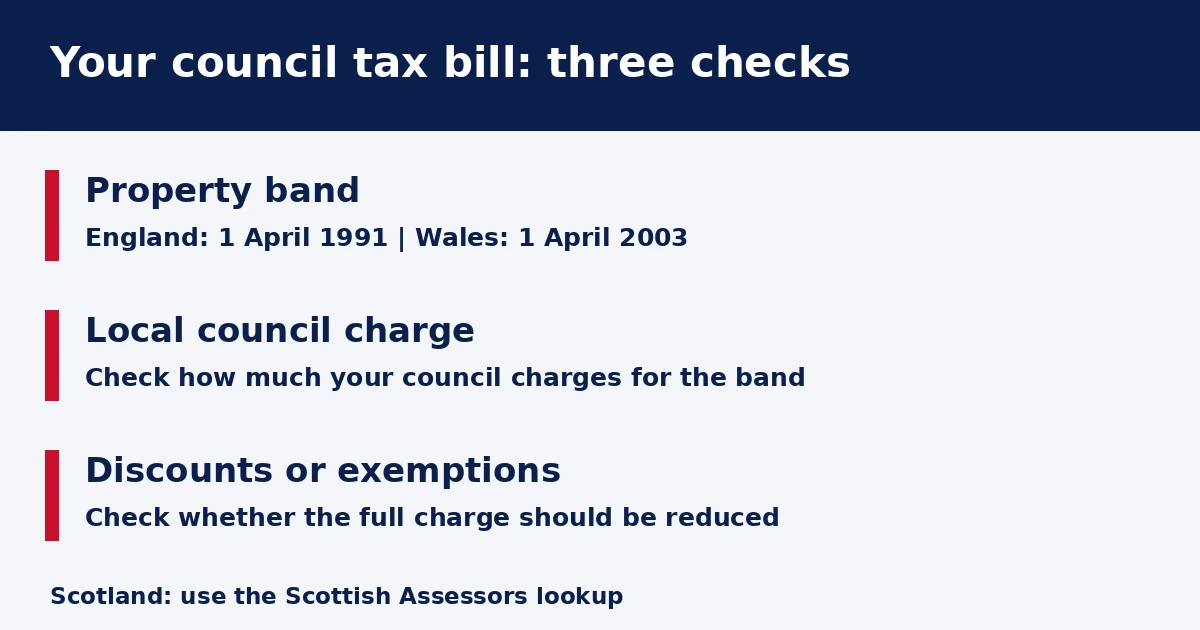
GOV.UK says you need three things to work out council tax: the valuation band, how much the council charges for it, and whether a discount or exemption applies. It also identifies Council Tax Reduction as possible help for people on low incomes or benefits.
| Part of the question | Where to check | What it tells you |
|---|---|---|
| Property’s band | Valuation Office or Scottish Assessors | The valuation category |
| Annual charge | Your council | The local charge for that band |
| Household discount | Your council | Whether the full charge is reduced |
| Low-income support | Your council’s reduction scheme | Whether income-based help applies |
Your bill should state the annual amount, the calculation and the payment dates. Compare like with like: an annual charge is different from a monthly instalment, and a bill after discounts is different from the council’s full charge for the band.
Use our single person discount guide if you may be the only counted adult. For low-income help, see Council Tax Reduction. Neither question is answered simply by confirming that the property’s band is correct.
What can affect the assessment?
The Valuation Office lists size, layout, character, location, change in use and the relevant historical value among assessment factors. The band is not determined by a single feature, such as bedroom count, viewed in isolation.
Newly built properties and buildings converted to domestic use need assessment. If you move into a property without a band, the official guidance says to contact your council. It will provide the Valuation Office with the information needed to allocate one.
An increase in a property’s size may lead to a higher band when it is next sold. The official guidance also explains that some changes can affect a band without a sale, including a self-contained annexe. Do not assume every renovation has the same consequence.
Separate living accommodation can require its own band. The assessment guidance says physical features matter when deciding whether an additional area of accommodation exists, rather than simply how the household uses it. Ask the Valuation Office about a specific annexe or conversion.
For a Scottish home, take the property question to the local assessor. The detailed Valuation Office examples in this section concern its England and Wales guidance and should not be treated as a complete statement of Scottish assessment rules.
How to question or challenge a band
GOV.UK distinguishes a legal right to challenge, called making a proposal, from asking for a band review when you think the band is wrong without that legal right. Use the official guidance to establish the appropriate route for your circumstances.
For England and Wales, the official online challenge service covers both routes. You may need evidence. Read the instructions before submitting so that the reason for the challenge is clear and the supporting material addresses the valuation issue.
- Confirm the exact property entry you want reviewed.
- Explain what you believe is wrong with the assessment.
- Read the evidence instructions for your challenge route.
- Keep copies of the submission and any correspondence.
- Follow the response and any next-step instructions carefully.
Do not assume that a neighbouring home’s band automatically proves yours is wrong. The official assessment considers several property factors. If making a comparison, explain why it is relevant and check the evidence requirements rather than relying on the band letter alone.
We do not quote a universal challenge deadline or promise a lower band. Check the live proposal or review guidance and any notice you have received. Scottish challenges go to the assessor, with the applicable Scottish process.
Disability reductions, affordability and avoiding confusion
Disabled Band Reduction is a distinct council-administered route. GOV.UK says a qualifying household can have its bill reduced to the next lowest band’s rate. That is different from asking the valuation authority to correct an alleged mistake in the property’s band.
The scheme has property-related conditions, including relevant additional rooms or indoor wheelchair space. Check the national guidance and your council’s requirements. This guide does not apply the England and Wales lowest-band percentage to Scotland.
If the correct bill is difficult to pay, contact your council immediately. GOV.UK says councils can help with payment arrangements. Ask separately about low-income reduction and any household discount rather than waiting for a valuation enquiry to resolve an affordability problem.
A useful first message states the issue precisely: “I want to check the band”, “the discount seems missing” or “I cannot afford the instalments”. Add the relevant property and account details through the council’s or valuation authority’s official contact route.
Your band-checking checklist
Check the property entry first, then the council’s charge and your household circumstances. Keeping those enquiries separate makes it easier to find the responsible organisation and understand the answer. Save the documents so you can compare the official entry, decision and bill.
- Use the England and Wales lookup or Scottish Assessors as appropriate.
- Read historical value tables using the correct date and nation.
- Find the annual charge on your council’s official information.
- Check household discounts and low-income support.
- Use the official challenge route if you believe the band is wrong.
- Continue paying during a challenge and ask for help if payment is difficult.
For a new home, our settling-in council tax guide helps with the wider bill questions. Confirm current charges directly with the council before budgeting around a property you are considering.
Understand the whole bill
See the guides to bands, household discounts and income-based support together.
Open the council tax hubCommon questions
What are council tax bands based on?
In England, bands use the price a property would have sold for on 1 April 1991. In Wales, the date is 1 April 2003. For Scotland, use Scottish Assessors and the applicable Scottish valuation guidance.
How many council tax bands are there?
Official guidance lists A to H in England and Scotland, and A to I in Wales. The same letter does not establish an identical annual charge across different councils.
How do I check my council tax band?
Use GOV.UK’s address or postcode lookup for England and Wales. For Scotland, use Scottish Assessors. Match the correct dwelling, especially in a building containing flats or an annexe.
Does my current house price determine my band?
England and Wales bands use historical valuation dates, not today’s sale price. The Valuation Office considers factors including size, layout, character and location. A present-day price alone does not establish the correct band.
Who handles a band challenge?
For England and Wales, submit the challenge to the Valuation Office using the official route. In Scotland, challenges go to an assessor based in the local Valuation Joint Board or council.
Can I stop paying while my challenge is reviewed?
No. GOV.UK says you must continue paying council tax while the challenge is being reviewed. Contact your council immediately if you are having difficulty paying.
Is disabled band reduction a band challenge?
It is a different route. A qualifying household may have the bill reduced to the next lowest band’s rate under the disability scheme. Ask the council about eligibility rather than assuming the property’s valuation band is wrong.
Official sources
- Check your Council Tax band — GOV.UK · Checked 2026-11-12
- How domestic properties are assessed for Council Tax bands — HM Revenue & Customs / Valuation Office · Checked 2026-11-12
- Challenge your Council Tax band — GOV.UK · Checked 2026-11-12
- How to challenge — GOV.UK · Checked 2026-11-12
- How Council Tax works — GOV.UK · Checked 2026-11-12
- Council Tax policy — Scottish Government · Checked 2026-11-12
- Paying your bill — GOV.UK · Checked 2026-11-12
- Discounts for disabled people — GOV.UK · Checked 2026-11-12
- Rates support: changes and evidence — nidirect · Checked 2026-11-12
SettleUK is an independent guide. It is not a government website and is not affiliated with GOV.UK, DWP, HMRC or the NHS.