Council tax reduction: eligibility and local applications
Can I get council tax reduction?
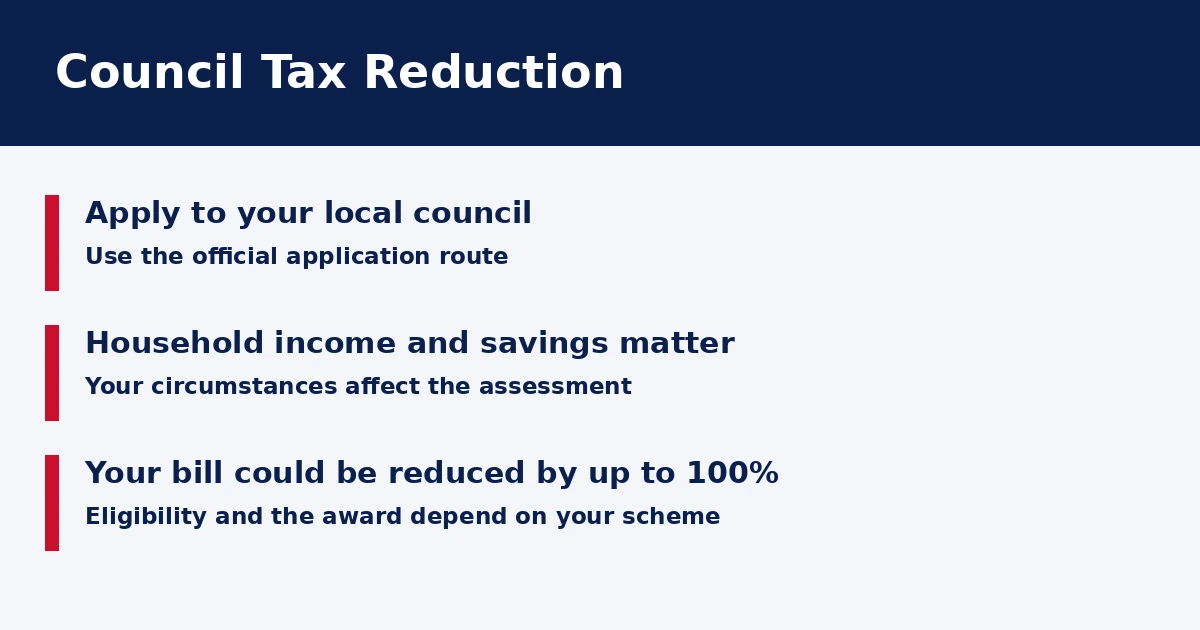
You could qualify if you have a low income or claim benefits. Apply to your local council; the award depends on your household and the scheme where you live. England, Scotland and Wales have council tax support routes. Northern Ireland has a separate rates system.
Understand what your council needs to assess low-income support, which other discounts to check and where national rules differ. SettleUK is an independent guide, not a government site.
In this guide
- Can I get council tax reduction?
- What Council Tax Reduction does to your bill
- England, Scotland and Wales: choose the correct route
- How income and your household affect eligibility
- Evidence to prepare before applying
- How to make a local application
- Start dates, backdating and the decision
- Other discounts and disability-related help
- Changes, incorrect discounts and difficulty paying
- Your next steps and questions to take to the council
- Common questions
- Official sources
- Related guides

Can I get council tax reduction?
You could qualify for council tax reduction if you have a low income or claim benefits. Apply to the council responsible for your bill. The award depends on your household and the scheme applying where you live; being employed or owning your home does not automatically rule you out.
This guide covers the application route in England, Scotland and Wales. Northern Ireland has a separate rates system: use the different scheme linked from GOV.UK’s application page. Do not use a council tax application to seek help with a Northern Ireland rates bill.
The most useful starting point is your own bill and your council’s official application page. This guide explains how to organise the questions and evidence, rather than offering a national eligibility calculator that might apply the wrong local rules.
What Council Tax Reduction does to your bill
GOV.UK also calls this help Council Tax Support. It is a discount on your bill if you qualify. The official application guidance says the bill could be reduced by up to 100%; that maximum is not a promise that every eligible applicant will have nothing to pay.
Your personal result depends on where you live, your circumstances and your household income. Before budgeting around an award, ask the council for its calculation. Use the revised amount it confirms rather than treating an online estimate or another household’s award as your entitlement.
Check each part of your bill: the property band, the council’s charge, relevant discounts or exemptions, and low-income support. These are related questions, but they do not all have the same application route.
| Question about your bill | Route to investigate | What to ask |
|---|---|---|
| Is my household income low enough? | Council Tax Reduction | Which scheme and calculation apply? |
| Am I the only counted adult? | Household discount | Should an adult be disregarded? |
| Does the home meet disability conditions? | Disabled Band Reduction | Does the property qualify? |
| Is the property valuation wrong? | Band challenge | Which valuation authority should review it? |
Our single person discount guide and council tax bands guide explain the other routes. Tell the council what you are asking it to check so that an income application is not mistaken for a band complaint.
England, Scotland and Wales: choose the correct route
Start with the postcode finder on GOV.UK, which directs you to the appropriate council. Read the scheme attached to that authority rather than borrowing a capital limit, backdating rule or minimum contribution from a council elsewhere.
England
GOV.UK says what you receive depends on where you live because councils run their schemes. Ask the council which rules apply to your circumstances, including your age and household. Check the rules for your household before deciding whether to apply.
Scotland
The Scottish Government’s Council Tax Reduction Scheme provides means-tested help and is managed locally by councils. Mygov.scot says it can reduce the bill by up to 100%. Councils assess household income, savings and other circumstances, including children, disability and certain state benefits.
Wales
Use your Welsh council’s official application route and ask for its current Council Tax Reduction rules. This guide does not set out Welsh income limits, savings limits or backdating periods. Check those on the council’s website before deciding that you are ineligible or expecting an award.
Moving across a national border is a reason to check the destination council’s rules afresh. Keep the old and new addresses separate in your notes, and ask each council about the bill for its own area.
How income and your household affect eligibility
The official eligibility summary lists household income, savings, pensions and your partner’s income as relevant. It also identifies benefits, residency status, children living with you and other adults in the home. An application needs a household picture, not just your latest wage.
You can apply whether you rent or own, work or are unemployed. Do not assume that having a job closes the route, or that receiving a benefit guarantees the largest possible reduction. Ask the council to apply its scheme to the information you provide.
If your earnings vary, ask how the council wants them reported and which period it needs to assess. Avoid selecting only the lowest payslip yourself. A useful enquiry explains the change and asks what evidence will let the council calculate the claim correctly.
- List who lives at the address and how each person is connected to you.
- Separate wages, pensions and benefits in your notes.
- Record savings and ask which accounts or investments must be declared.
- Explain any recent household or residency change when asking for guidance.
These are preparation suggestions, not a universal evidence standard. Your council’s form and evidence request take priority. If a question does not fit your situation, ask for clarification rather than leaving an unexplained blank or supplying a guessed figure.
Evidence to prepare before applying
Build a small application file around the factors the official source says matter. The checklist below suggests documents to locate and questions to ask. It does not mean every council requires every item, or that a particular document will be accepted everywhere.
| Information to organise | Possible document to locate | Question for the council |
|---|---|---|
| Address and bill | Your current council tax bill | Which account should the application use? |
| Employment income | Payslips or earnings records | Which earnings period is needed? |
| Benefits and pensions | Award notices or statements | Which payments must be included? |
| Savings | Account statements | Which balances and dates are required? |
| Household circumstances | Notes on occupants and changes | What supporting evidence is acceptable? |
If you have difficulty getting evidence, contact the council through the route on its official page. Explain what is missing and ask about an acceptable alternative. Do not assume that a document problem means you cannot make an enquiry or that an unfinished online form is a submitted claim.
Keep copies of what you send and any confirmation. This is practical record-keeping advice: it gives you something concrete to refer to if you need to ask whether the council has received a document or needs further information.
How to make a local application
Use Apply for Council Tax Reduction and enter your postcode. Follow the council link, check the address and read its instructions. An official council page is the place to confirm the application method, evidence requirements and support available if you cannot use its online process.
- Locate the council responsible for the property’s bill.
- Read its Council Tax Reduction or Council Tax Support instructions.
- Prepare the household and income information it requests.
- Complete the application using the official route.
- Save the submission confirmation and follow any evidence instructions.
- Read the decision and compare it with your bill.
If you receive Universal Credit, ask your council directly whether it needs a separate application or additional information. This guide does not promise an automatic council tax award following a benefit claim. Confirm the local process before treating another application as sufficient.
For a new address, check that you are using the correct property and account details. Our settling-in council tax guide can help you organise the wider bill questions while you investigate support.
Start dates, backdating and the decision
Ask the council what date it will assess your claim from and whether you can request an earlier start. No universal backdating period is quoted here. If you want an earlier period considered, explain the dates and circumstances and ask what evidence its scheme requires.
When a decision arrives, check the address, household details, assessment period and income information against your own records. If something looks wrong, identify the specific item when you contact the council. A focused query is easier to follow than saying only that the award feels too small.
GOV.UK says your bill shows the annual amount, how it was worked out and payment dates. Keep the decision alongside the bill so you can compare the award with the amount the council is asking you to pay.
If you cannot understand the calculation, request an explanation of the figures and rules used. Ask about the council’s review route and any deadline shown on the decision. The correct next step can depend on the nation and the type of decision being challenged.
Other discounts and disability-related help
Low-income support is not the only reason a bill may be reduced. GOV.UK says you can get 25% off if you pay council tax and live alone, or if everyone else in the home is disregarded. You need to apply for the relevant discount or exemption.
Disability-related help raises a different question: whether the home and household meet the conditions. GOV.UK describes a Disabled Band Reduction Scheme for qualifying properties, including required additional rooms or indoor wheelchair space. Do not treat receipt of a disability benefit alone as proof that the property qualifies.
In Scotland, mygov.scot also describes a reduction for a home adapted for disability. It says eligible households pay the band below, with a specific rule for homes already in Band A. Check the Scottish guidance rather than applying another nation’s lowest-band example.
Ask the council to check each potentially relevant route. Describe the income issue, the occupants and any disability-related property needs separately. This avoids expecting an application for one kind of help to answer a different question about the bill.
Changes, incorrect discounts and difficulty paying
GOV.UK says you must contact your council if you receive a council tax discount by mistake; a fine or repayment may follow if you do not. If you think your support no longer reflects your household, ask the council how to report the change and what date it needs.
Keep a short change log: what changed, when it happened and when you told the council. Ask whether it needs updated evidence. This is a useful way to keep your correspondence consistent, especially if income and household composition change around the same time.
If the bill is unaffordable, contact the council immediately. GOV.UK says councils can help with payment arrangements, including spreading payments over a longer period. Asking for instalment help is a separate practical conversation from establishing entitlement to a reduction.
Your next steps and questions to take to the council
Start with the official postcode finder, then work from the council’s current instructions. You do not need to solve every rule yourself before asking for help. Give a clear account of your household and ask the council to identify the scheme and evidence requirements that apply.
- Which Council Tax Reduction rules apply to my household?
- What income, savings and household evidence do you need?
- What start date can you consider, and is backdating possible?
- Should I also apply for a household or disability-related discount?
- What should I pay while waiting, and how do I question the decision?
Use official sources for the final entitlement decision. Ask your council which savings limits apply, how long an assessment may take and what happens next. Keep its reply with your application confirmation so you can follow up if needed.
Check the rest of your bill
See how valuation, household discounts and support fit together before you contact the council.
Explore council tax guidesCommon questions
Can I get council tax reduction?
You could qualify if you are on a low income or claim benefits. Your council assesses your circumstances, household income and other relevant factors under the scheme applying where you live.
Can I apply if I work or own my home?
Yes. GOV.UK says you can apply whether you own or rent your home, and whether you are unemployed or working. Entitlement still depends on the applicable scheme and your household circumstances.
Can council tax reduction cover the whole bill?
GOV.UK says your bill could be reduced by up to 100%. That is a possible maximum, not a guarantee for every applicant. Ask your council for your assessment and confirmed bill.
Is this the same as single person discount?
No. Council Tax Reduction concerns low income and household circumstances. A single person discount concerns how many adults are counted in the home. Ask the council to check the relevant routes.
What evidence should I provide?
Follow your council’s instructions. GOV.UK identifies household income, savings, pensions, partner’s income, children, other adults and residency status as relevant factors. Ask which documents and assessment periods your council requires.
Does this apply in Northern Ireland?
Northern Ireland has a separate rates system. Use the Northern Ireland scheme linked from GOV.UK’s Council Tax Reduction application page rather than applying council tax rules to a rates bill.
Can I get my application backdated?
Ask your council which start-date and backdating rules apply to your circumstances. This guide does not quote a universal backdating period. Explain the earlier period you want considered and ask what evidence is needed.
Official sources
- Apply for Council Tax Reduction — GOV.UK · Checked 2026-11-12
- How Council Tax works — GOV.UK · Checked 2026-11-12
- Who has to pay — GOV.UK · Checked 2026-11-12
- Discounts for disabled people — GOV.UK · Checked 2026-11-12
- Council Tax discounts, exemptions and reductions — Scottish Government / mygov.scot · Checked 2026-11-12
- Council Tax policy — Scottish Government · Checked 2026-11-12
- Paying your bill — GOV.UK · Checked 2026-11-12
- Change of circumstances and suitable evidence for rates support — nidirect · Checked 2026-11-12
SettleUK is an independent guide. It is not a government website and is not affiliated with GOV.UK, DWP, HMRC or the NHS.