Haringey bulky waste collection: booking and rules
How do I book Haringey bulky waste collection?
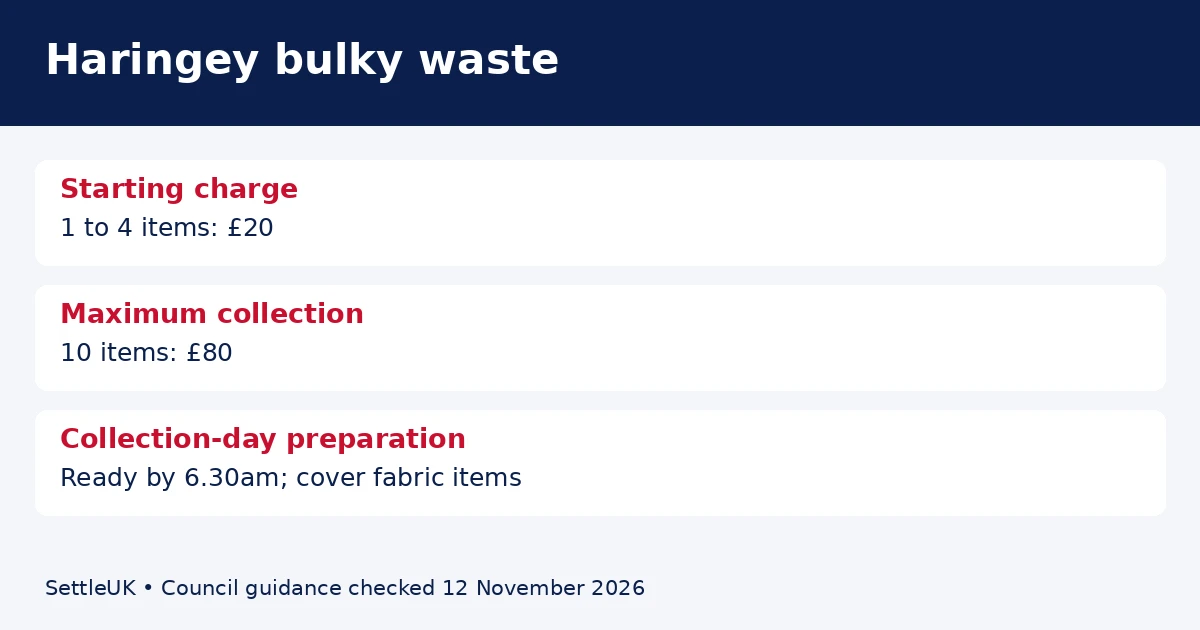
Book using the Veolia online service linked from Haringey Council’s bulky item collections page. Prices start at £20 for one to four items, with a maximum of ten items costing £80. Check accepted materials, separate upholstered-item arrangements and the requirement to have items ready by 6.30am.
Plan your collection using official Haringey Council guidance checked on 12 November 2026. This guide covers Haringey, London, England.
In this guide
- How do I book Haringey bulky waste collection?
- What does Haringey bulky collection cost?
- Which furniture and appliances are accepted?
- How must carpets and rugs be prepared?
- Why might a sofa be collected separately?
- What cannot go in a bulky collection?
- Where and when should I put items out?
- What if I need to change a booking or report a problem?
- Where can I check reuse and recycling alternatives?
- What should I check before hiring a private collector?
- Common questions
- Official sources
- Related guides
How do I book Haringey bulky waste collection?
Haringey bulky waste collection is booked through the online Veolia service linked from the council’s bulky item collections page. The published charge is £20 for one to four items, rising with the item count to £80 for ten items. Ten is the stated maximum.
This guide covers Haringey, London, England. SettleUK is an independent guide, not a government site, and does not take bookings or payments. Council sources were checked on 12 November 2026. Use the official service for your actual item list, collection date and payment.
Start on Haringey’s bulky item collections page and use its “Start now” link. Before opening the form, list each object, note whether it contains upholstery and decide whether you can get it to street level. These details help you check the published rules against your load.
The council gives the Veolia waste team’s telephone number as 020 8885 7700, Monday to Friday, 8.30am to 5.30pm. Use that contact if an item, access arrangement or booking instruction is unclear. Do not assume that completing a form resolves a question about an excluded item.
What does Haringey bulky collection cost?
| Number of items | Published cost |
|---|---|
| 1 to 4 | £20 |
| 5 | £30 |
| 6 | £40 |
| 7 | £50 |
| 8 | £60 |
| 9 | £70 |
| 10 — maximum | £80 |
The starting band covers one to four items. Beyond that band, the published table gives a separate price for each total up to ten. Check your list before payment: a single extra object can move the request into a different price row.
Use the final council-linked booking information to check how your objects are counted. This guide does not invent rules for dismantled furniture, paired items or complete furniture sets where the public council page does not explain them. Ask before booking if the count is ambiguous.
Do not assume that the maximum of ten permits an oversized pile with several unlisted extras. Put the exact intended objects on the booking. If your clear-out exceeds the limit, contact the official service about an appropriate arrangement instead of relying on the crew to add more on the day.
The public council page does not establish a concession or refund policy for every circumstance. If either affects your decision, check with Veolia before paying. A fee table tells you the advertised collection cost; it does not by itself explain cancellation rights or additional service arrangements.
Which furniture and appliances are accepted?
Haringey lists beds and bed frames, bedside cabinets, bookcases, chairs, mattresses, sofas and sofa beds, tables and wardrobes. It also lists computers and monitors, cookers, dishwashers, freezers, fridges, ovens, printers, tumble driers, televisions and washing machines.
Doors are listed with an important restriction: fire doors and metal doors are not accepted. A broad category in a booking list can still contain exclusions. Describe your door accurately rather than choosing the nearest available label for an object the council specifically excludes.
One-off garden waste collections also appear on the accepted list. That does not override the separate exclusion of tree trunks and thick branches. Check the material itself, especially where a garden clear-out includes soil, rubble or renovation waste as well as plant material.
Keep an appliance description precise when asking for advice. The accepted list verifies that fridges and freezers appear in the service, but does not provide a universal model-size rule or preparation instruction for every appliance. This guide does not borrow another borough’s fridge rules.
For an object not clearly covered, contact the waste team before booking. Explain what it is made from, its condition and where it will be placed. Those are practical details to help the service answer your question; they do not establish acceptance on their own.
How must carpets and rugs be prepared?
Carpets and rugs are accepted only inside a tied bag that must be less than 80 litres. The exclusions list separately says carpets and rugs not inside a tied bag cannot be collected. This is a specific local rule, not a general suggestion to tie a roll of carpet.
Check this requirement before removing floor coverings and leaving them ready outside. If you cannot fit your material within the stated bag condition, ask the council for the correct route. Do not assume that a neatly rolled carpet meets a tied-bag requirement.
The wording “less than 80 litres” is stricter than “up to 80 litres”. Follow the council’s wording when preparing the bag and ask the waste team if the packaging or quantity is uncertain. This guide does not claim how many carpet bags count as one booked item.
If your flooring project also produces renovation debris, keep the booking question separate for those materials. House renovation waste, masonry, tiles, rubble and soil appear on the exclusions list. The fact that a prepared carpet is accepted does not make the rest of the work’s waste acceptable.
Why might a sofa be collected separately?
Haringey says bulky waste containing persistent organic pollutants, or POPs, must be collected separately. Its explanation is that these chemicals accumulate in the environment and can harm human health. The council says it now uses different vehicles and teams for affected items.
The examples include upholstered furniture such as sofas, armchairs and dining chairs; cushioned items such as stools, cushions and bean bags; and child safety items such as pushchairs and car seats. Check the full description when your booking mixes these with other objects.
These items can still be collected, but the council says they may be taken at different times or a day later. A mixed load therefore does not necessarily disappear in one visit. Keep the booking details available if part of the load is removed first.
Do not conclude immediately that a remaining upholstered item has been forgotten when other items have gone. Check the separate-collection information and any booking message, then contact Veolia if the position remains unclear. This guide does not turn “a day later” into a formal missed-collection reporting deadline.
What cannot go in a bulky collection?
| Category | Published exclusions |
|---|---|
| Hazardous materials | Asbestos, hazardous waste or chemicals, car batteries, gas bottles and cylinders |
| Building and renovation waste | Bricks, stonework, cement, paint, plasterboard, house renovation waste, masonry and tiles |
| Other heavy or specialist items | Pianos, rubble and soil, tree trunks and thick branches, tyres |
| Unprepared flooring | Carpets and rugs not inside a tied bag |
Use the exclusion list before paying. Do not hide smaller excluded objects inside furniture or add building debris alongside an accepted appliance. The service’s list of household items is not a general clearance permission for hazardous or construction waste.
Haringey’s hazardous and clinical waste guidance says hazardous and clinical waste cannot go into bins or recycling and require a special collection. It directs hazardous-waste bookings to the City of London Corporation. Use that council guidance to identify the appropriate specialist route.
The hazardous page discusses broad material categories, while the bulky list specifically includes fridges and monitors. If the condition or type of your appliance raises a hazardous-waste question, ask the waste team which route applies. Do not attempt to resolve it by dismantling an appliance yourself.
For any excluded item, ask about the correct disposal route before transporting it or hiring a clearance company. A recycling centre may have its own acceptance conditions; exclusion from bulky collection does not automatically prove acceptance at a particular centre.
Where and when should I put items out?
Items must be ready by 6.30am, easy to access and visible from the road. Haringey says to place them outside the front boundary of your property at street level. Items must not be placed up or down stairs. Follow the specific arrangement in your official booking if anything is unclear.
Fabric items, such as sofas or mattresses, must be covered. Plan suitable protection before the collection day rather than waiting until the furniture is already exposed. The public page gives the covering instruction but does not establish a universal remedy or refund rule for wet items.
If you live on a housing estate or in a block of flats, items should be at street level and outside any gated area. Do not leave them in communal areas: the council identifies a fire risk. Housing estate collections can use a nearby collection point.
Ask the waste team to confirm the correct point if your building has several entrances, gates or shared storage areas. Do not guess which nearby space is authorised. Keep the answer with the booking confirmation so you can prepare the location consistently.
The public bulky page does not verify an indoor assisted-removal service. If stairs, mobility or heavy furniture make presentation difficult, discuss that before booking. Do not assume the crew can collect an object from inside merely because the object appears on the accepted list.
What if I need to change a booking or report a problem?
Keep the booking reference, address, booked item list and confirmation together. If circumstances change, contact Veolia through the council-linked service or waste team. This guide does not quote a cancellation notice period or promise a refund because those terms were not verified on the fetched public council page.
For a collection problem, describe which items remain, whether other objects were taken and where the remaining items are. Check first whether a separate upholstered-item collection is expected. That distinction can help the service understand whether you are reporting a missed visit or asking about another team.
The rubbish and recycling section has a missed-bin route, but a missed household bin is not automatically the same process as a booked bulky collection. Use your bulky booking information and the official waste team to confirm the correct reporting route for the visit.
This guide does not publish Christmas or bank-holiday collection changes for 2026/27. Check your live booking and council notices for any special arrangements. Neither the normal presentation time nor a recycling-centre opening schedule verifies a festive bulky collection date.
Where can I check reuse and recycling alternatives?
Use Haringey’s reuse, recycling, donations and collections directory to look for alternatives. It includes filters for furniture and electrical equipment, local collection options and repair services. Check the individual entry and receiving organisation’s conditions before promising an item to someone.
The directory lists Western Road reuse and recycling centre in Wood Green and Edmonton EcoPark in Lee Park Way. These listings identify possible facilities; they do not mean every load or vehicle has unrestricted entry. Review the particular centre’s current information before setting off.
The council’s Western Road centre page gives the address as Western Road, London, N22 6XJ. Access is from Coburg Road, turning left off Western Road; the council says you cannot turn right into the site. Check your route before approaching with a bulky load.
That page links to the North London Waste Authority for site details and van or trailer bookings. Use those links to check vehicle requirements and acceptance. This guide does not infer a van allowance, DIY-waste limit or eligibility rule from another north London borough’s page.
If an object could be reused, describe its condition honestly and confirm acceptance before arranging movement. A reuse listing is a place to investigate, not a guarantee that a collector will take a damaged sofa or that a repair service handles your particular appliance.
What should I check before hiring a private collector?
Haringey’s rubbish removal company guidance says to check the person or business on the Environment Agency register of waste carriers, brokers and dealers before booking. Registration should be checked for the actual collector rather than assumed from an advert or a low quote.
Even where the company is registered, the council says to ask where the waste is going, note the vehicle licence number, keep paperwork and get a receipt. Keep these details with the agreed description of the job so you can identify the arrangement later.
Ask specifically what the quoted service covers: which items, which location and who is responsible for moving them. These are practical questions for comparing services, not additional council collection rules. Do not use a private quote as evidence that the council will accept the same load.
For more planning help, use our fly-tipping guide and tip opening times guide alongside the official local pages. Confirm the actual booking or site conditions before payment, travel or moving a heavy item.
Common questions
How much is Haringey bulky waste collection?
The council lists £20 for one to four items, £30 for five, £40 for six, £50 for seven, £60 for eight, £70 for nine and £80 for ten. Ten is the maximum.
How do I book?
Start on Haringey Council’s bulky item collections page and follow the online Veolia booking link. The council also lists the Veolia waste team on 020 8885 7700.
When must items be ready?
By 6.30am. Items must be easy to access, visible from the road and at street level outside the front property boundary. Fabric items must be covered.
Will sofas be collected with other items?
Items affected by the POPs arrangements use different teams and vehicles. Haringey says they may be collected at different times or a day later.
Can I book carpets and rugs?
The council accepts them inside a tied bag that is less than 80 litres. Carpets and rugs not inside a tied bag are excluded. Check counting or packaging questions with the waste team.
Can I leave items in a communal hallway?
No. Haringey says not to leave items in communal areas because of fire risk. For estates and flats, use street level outside gated areas, or the applicable nearby estate collection point.
Can I include renovation waste?
The council excludes construction and house renovation waste, masonry, tiles, rubble and soil. Check the correct alternative disposal route before booking or travelling.
Official sources
- Bulky item collections — Haringey Council · Checked 2026-11-12
- Reuse, recycling, donations and collections directory — Haringey Council · Checked 2026-11-12
- Western Road reuse and recycling centre — Haringey Council · Checked 2026-11-12
- Rubbish removal companies — Haringey Council · Checked 2026-11-12
- Hazardous and clinical waste — Haringey Council · Checked 2026-11-12
SettleUK is an independent guide. It is not a government website and is not affiliated with GOV.UK, DWP, HMRC or the NHS.