Fridge disposal: safe collection and recycling
How do I arrange safe fridge disposal?
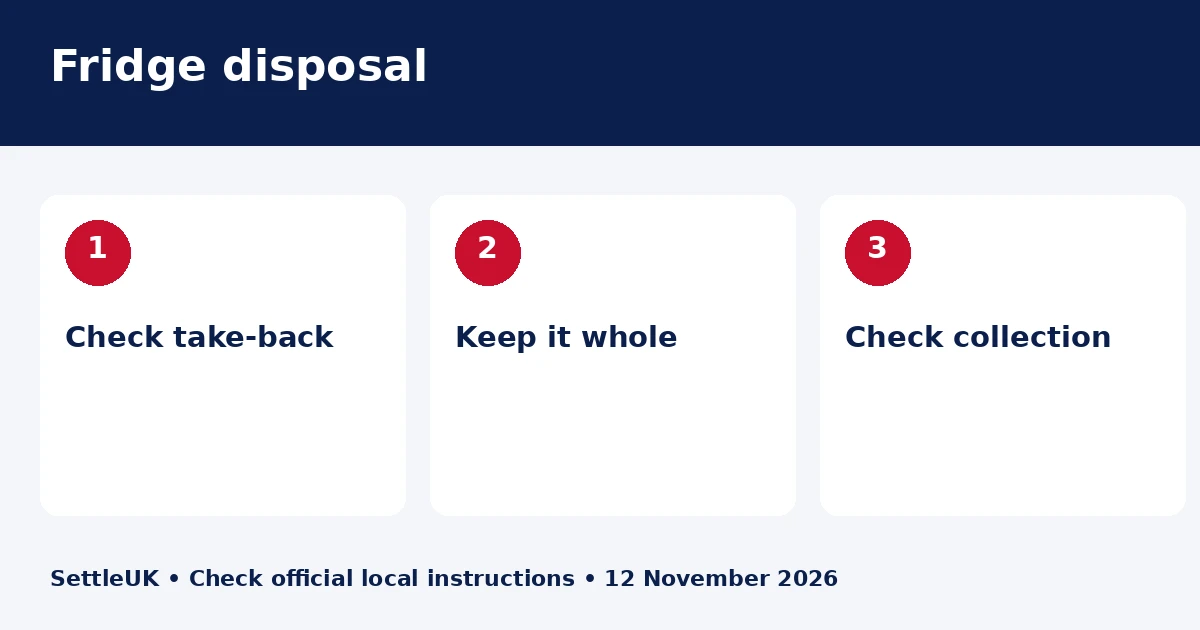
Check retailer take-back if replacing a fridge, or ask your council about collection and recycling centres. Keep the appliance whole. Verify a private collector through the relevant official register and confirm preparation, access and any charge before collection.
Arrange household fridge disposal with clear checks for retailer take-back, council services, recycling centres and authorised collectors across the UK.
In this guide
- How do I arrange safe fridge disposal?
- Compare the available disposal routes
- Ask the retailer about electrical take-back
- Check reuse only if the fridge is suitable
- Book a council fridge collection
- Check a recycling centre before travelling
- Why should the appliance remain whole?
- Verify a private collector in the right nation
- Confirm preparation, access and the full quote
- Deal with failed collections and dumped appliances
- Common questions
- Official sources
- Related guides
How do I arrange safe fridge disposal?
Check the seller's electrical take-back arrangements if you are replacing a fridge. Otherwise, ask your council about collection or an accepting recycling centre. Keep the appliance whole and use an authorised service. If you hire a private collector, check the relevant official register before handing over the fridge.
This guide covers household fridge disposal in England, Scotland, Wales and Northern Ireland. Collection services and regulator routes differ, so confirm the terms for your address. SettleUK is an independent guide, not a government site.
Start with GOV.UK's household-waste guidance. It lists council collection, recycling centres and retailer electrical take-back among disposal options. None of these routes establishes a universal collection price or promises that someone will remove an appliance from inside your home.
Compare the available disposal routes
The right route depends on whether the appliance is reusable, whether you are buying a replacement and whether you can use an accepting recycling centre. Confirm acceptance before paying for transport. Check the exact appliance type and any faults when asking about acceptance.
| Option | Best first question | Details to confirm |
|---|---|---|
| Retailer take-back | What service comes with my purchase? | Drop-off, collection, charges and preparation |
| Reuse organisation | Can you accept this actual appliance? | Condition, collection and access |
| Council collection | Does your service take this fridge? | Booking, item description and presentation |
| Recycling centre | Does this site accept household fridges? | Vehicle, booking and access conditions |
| Private collector | Can I verify your authorisation? | Business identity, destination and full quote |
If you also have a mattress, furniture or packaging to remove, list these separately. An electrical-appliance arrangement is not confirmation that other household waste is included. Our mattress disposal guide helps with the separate checks for bedding.
Do not choose solely on the earliest advertised appointment. Compare what is actually included, whether the service can reach the appliance and whether you have time to follow its preparation instructions.
Ask the retailer about electrical take-back
GOV.UK's electrical-retailer guidance says sellers must provide a way for customers to dispose of old household electrical equipment when selling a new version of the same item. It describes free take-back arrangements and the Distributor Take Back Scheme.
The same guidance requires retailers to tell customers which service they provide, including collect on delivery. Online retailers must publish that information on their websites. Read the seller's actual disposal information before ordering if removal of your old appliance is important to the purchase.
Free take-back does not necessarily include home collection, disconnection or carrying the fridge from your kitchen. Ask the retailer to distinguish its take-back route from any delivery-day removal service and to confirm the price of any optional service.
- Is the old appliance accepted with this purchase?
- Where does handover happen: store, another location or your property?
- Must removal be booked separately from delivery?
- What access and preparation does the service require?
- What happens if the old fridge is not ready when the vehicle arrives?
Keep the answer with your order confirmation. If the delivery company and retailer give different instructions, ask the retailer to resolve the difference before delivery day. Do not assume the driver can change the booked service on arrival.
Check reuse only if the fridge is suitable
GOV.UK lists giving away or selling reusable items as an option. For a fridge, ask the intended recipient or reuse organisation about the actual appliance, including its working condition. A general statement that an organisation accepts electrical items is not an acceptance decision for your fridge.
As a local example, Leeds City Council's donation guidance says electrical items should be free from rust, reasonably clean, have intact seals and ideally be in full working order. Its page lists different organisations with different acceptance policies.
Describe faults honestly. Ask whether the organisation needs photographs, a model description or other information before agreeing collection. If it declines the item, use a disposal route instead of assuming another charity must accept it.
Confirm who is responsible for moving the appliance and where it needs to be for collection. If the handover cannot be completed under the agreed conditions, contact the recipient before moving it to a shared area or leaving it outside.
In England, GOV.UK also says to check a charity collecting items on the waste-carrier register, selecting lower tier. For a private waste collection business, select upper tier. If you live elsewhere in the UK, use your nation's official regulator route.
Book a council fridge collection
For England and Wales, use the GOV.UK bulky-collection postcode finder. It says most councils collect large items such as fridges for a fee. The finder is labelled England and Wales only; in Scotland and Northern Ireland, begin with your council's own website.
Look for the accepted-item list and collection conditions, not just the payment button. Confirm the exact appliance type, where the crew collects from and what the booking covers. There is no national council fridge-collection fee in this guide.
Explain any stairs, narrow access, shared entrance or lack of an outside storage area before booking. Ask the council what options apply to your situation. Do not assume a standard collection includes moving an appliance from its installed position.
Record the collection reference and the required presentation point. Leeds, for example, tells residents to leave items in the exact location given during booking and follow the collection rules. Your own council's confirmation should be the final instruction for your address.
If the booking cannot be completed, ask about another council route or an accepting recycling centre. A failed online booking does not authorise leaving the appliance next to household bins or outside a recycling facility.
Check a recycling centre before travelling
GOV.UK directs householders to council websites to find local recycling centres. Check the named site's appliance acceptance and visiting conditions. “Recycling centre” does not by itself establish that a facility accepts every type of household electrical item.
Leeds says household items including fridges can be taken to its household waste recycling centres for free. This is a Leeds-specific example. Confirm your own site's policy rather than treating that statement as a UK-wide promise.
Ask about booking, residence evidence, vehicle restrictions and any instructions for bringing a fridge. If using a borrowed or hired vehicle, describe it accurately. Confirm the access conditions before arranging the vehicle, rather than discovering a restriction at the gate.
Use our tip opening times guide to check the site's official details. Opening hours are only part of the decision: acceptance and access need checking as well. Ask the facility for its instructions about moving and unloading the appliance.
When the site is closed or cannot accept your fridge, keep it for an agreed lawful route. Do not unload outside the entrance. Contact the responsible authority to find out what alternative arrangement it offers.
Why should the appliance remain whole?
The Environment Agency publishes specialist standards for permitted facilities handling waste temperature-exchange equipment. Its storage and handling guidance requires protection of cooling circuits, compressors, appliance casing and foam insulation. It also says equipment that has not been degassed must be handled whole.
These standards are for permitted facilities in England. For household disposal, leave specialist treatment to the receiving service. Do not cut cooling pipes, remove the compressor or break up the insulation to make the appliance easier to transport.
If the fridge is already damaged, tell the collection service or recycling centre before moving it. Describe visible damage and ask how it should be handled. The Environment Agency's guidance expressly addresses damaged equipment posing a risk of refrigerant gas or oil release.
Ask the service how the fridge should be prepared and moved. For appliance-specific instructions, including any restart delay if it will be reused, consult the manufacturer.
Verify a private collector in the right nation
In England, GOV.UK says to check a private waste business on the waste-carrier register and select upper tier. Use the official link from its household-waste guide. Compare the registered identity with the business you are paying, and ask for clarification if the names differ.
Wales has the Natural Resources Wales public register. Scotland uses SEPA's waste transporters and brokers search. Northern Ireland's official route is DAERA's registered-carriers page. Use the appropriate system rather than assuming English search filters apply everywhere.
SEPA's page explains what to check when an expiry date is in the past, including looking for a renewal application in the Details section. Read the complete record and the regulator's explanation. If you are unsure about a business's authorisation, ask the regulator before handing over waste.
Leeds advises asking where the waste is going, paying by card or bank transfer and obtaining a receipt or waste transfer note. Keep the business details, agreed item description and receipt together. Do not accept a social-media advertisement as proof of authorisation.
Confirm preparation, access and the full quote
Ask the provider how emptying, cleaning, defrosting and disconnection should be handled for its service. Get the instructions before the appointment so you can decide whether you can meet them. Use the instructions for your booking rather than another council's preparation times.
Describe the appliance's location clearly. Mention a fitted installation, stairs, doors or shared access when requesting the quote. Ask who handles each stage of removal and whether the service can undertake the work you need.
Get a complete price for the agreed service if there is a charge. Ask whether carrying, access difficulties or additional items change it. Confirm any revision before the appliance is loaded, and keep a record of what you agreed.
- Appliance type and condition described.
- Acceptance and collection location confirmed.
- Preparation instructions received.
- Collector checked where required.
- Price and handover record agreed.
If you cannot meet an instruction, contact the service before the appointment. A short conversation about access or preparation is more useful than leaving the fridge somewhere the booked crew has not agreed to collect from.
Deal with failed collections and dumped appliances
For a failed collection, use the contact route on your booking confirmation. Give the reference, appliance description and presentation location. Ask whether to keep it in place or move it while the service investigates; follow the instructions for that booking.
If the fridge belongs to someone else and has been dumped, use the official fly-tipping reporting route. Do not dismantle it to identify the owner. Our report fly tipping guide explains how to provide useful location information without handling the waste.
Before handover, check that the service matches your agreement. Keep the appliance whole, follow the preparation instructions and save the confirmation and receipt.
Find the right route for other bulky items
Plan each item separately so your collection or recycling-centre visit covers the actual load.
Browse bulky waste guidesCommon questions
Is fridge disposal free?
Check the route and service. Electrical-retailer guidance describes free take-back arrangements, but that does not establish free home collection. Leeds lists free household fridge drop-off at its recycling centres; other councils’ terms need checking.
Must a retailer collect my old fridge from home?
Do not assume home collection is included. GOV.UK describes electrical take-back responsibilities and requires retailers to explain their service. Ask the seller whether collection is offered, what it costs and what preparation is required.
Can I take a fridge to a recycling centre?
Check that the specific site accepts household fridges and that you meet its booking, vehicle and access requirements. Leeds lists fridge acceptance at its household waste recycling centres, but this is a local example.
Can I dismantle a fridge for scrap?
Keep it whole and leave treatment to an appropriate service. Environment Agency facility guidance requires protection of cooling circuits, compressors, casing and insulation. Tell the receiving service about damage rather than cutting pipes or removing components yourself.
How do I check the collector?
Use the official regulator route for your nation: Environment Agency in England, Natural Resources Wales, SEPA in Scotland or DAERA in Northern Ireland. Compare the business identity and keep the receipt and agreed collection details.
How long should I defrost it before collection?
Ask the collection service for its preparation instructions and check the manufacturer’s guidance for your appliance. Confirm when it needs to be empty, defrosted and ready, so you can prepare before the appointment.
Official sources
- Dispose of household waste — GOV.UK · Checked 2026-11-12
- Electrical waste: retailer responsibilities — GOV.UK · Checked 2026-11-12
- Large waste item collection — GOV.UK · Checked 2026-11-12
- Get rid of unwanted items — Leeds City Council · Checked 2026-11-12
- Waste temperature-exchange equipment standards — Environment Agency · Checked 2026-11-12
- Waste storage and handling appropriate measures — Environment Agency · Checked 2026-11-12
- Waste carriers public register — Natural Resources Wales · Checked 2026-11-12
- Find waste transporters and brokers — SEPA · Checked 2026-11-12
- Registered waste carriers / transporters — DAERA · Checked 2026-11-12
SettleUK is an independent guide. It is not a government website and is not affiliated with GOV.UK, DWP, HMRC or the NHS.