Report fly tipping: evidence and official routes
How do I report fly tipping in the UK?
Report small-scale fly-tipping to the council covering the location. Record where it is and what you can see without touching the waste. Large-scale dumping, hazardous waste and pollution may need the relevant environmental regulator. Use the route for England, Scotland, Wales or Northern Ireland.
Find the official route for dumped waste, record useful evidence safely and understand the difference between reporting an offence and arranging clearance.
In this guide
- How do I report fly tipping in the UK?
- Check what you are reporting
- Collect useful evidence without handling waste
- Report fly-tipping and waste crime in England
- Use council and SEPA routes in Scotland
- Report fly-tipping and environmental incidents in Wales
- Use council and NIEA routes in Northern Ireland
- What if the waste is on private land?
- Write a clear report and keep the record
- Prevent your own waste becoming someone else's problem
- Common questions
- Official sources
- Related guides
How do I report fly tipping in the UK?
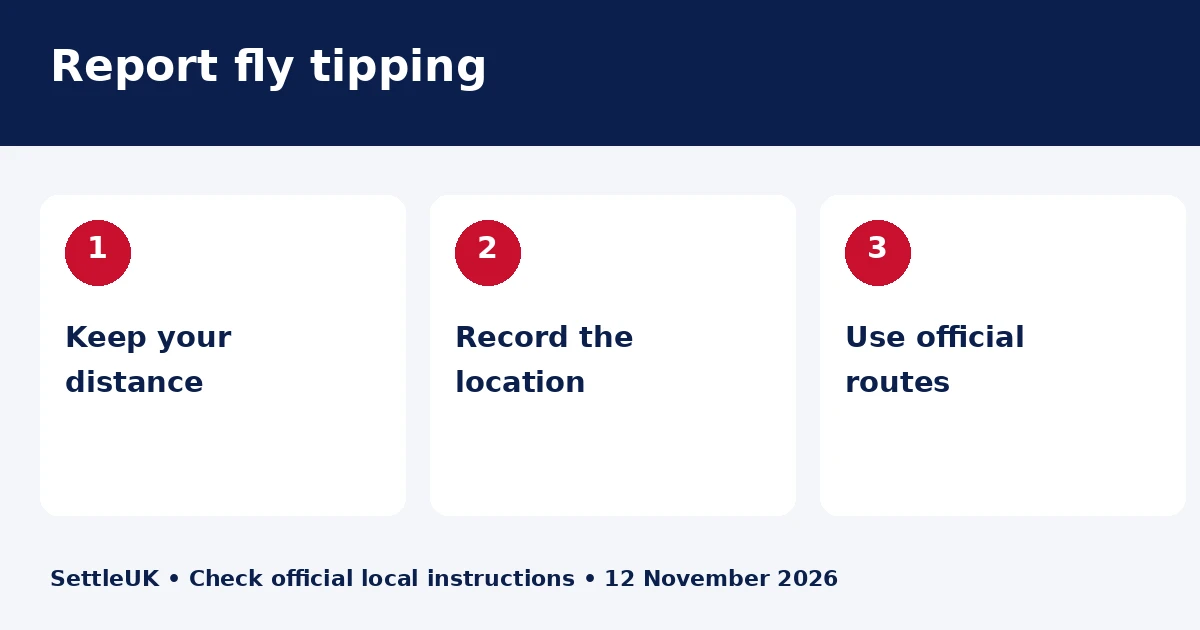
Report small-scale fly-tipping to the local council for the place where the waste is dumped. Record the exact location and describe what you can see without touching it. Large-scale dumping, hazardous waste and pollution may need a national environmental regulator; use the nation-specific routes below.
This guide covers England, Scotland, Wales and Northern Ireland. SettleUK is an independent guide, not a government site. Reports must go to the responsible council or regulator, not to SettleUK.
GOV.UK's fly-tipping guidance distinguishes small-scale dumping from larger waste crime. It directs reports of fly-tipping in England, Scotland and Wales to the local council's environmental health team. Northern Ireland has separate official guidance, which also directs ordinary fly-tipping reports to councils.
Check what you are reporting
GOV.UK describes fly-tipping as illegal dumping of household, commercial or industrial waste on a small scale. Its examples include rubbish bags, furniture and garden waste. A report should describe the actual scene rather than guessing the offence or identifying an offender without evidence.
Explain whether you found dumped waste or saw someone depositing it. These are different observations. If you found it, give the time you first noticed it rather than inventing a dumping time. If you saw the act, record what happened as accurately as you can.
| What you see | What to say | What to avoid |
|---|---|---|
| Dumped furniture or bags | Location, visible items and approximate extent | Opening bags to identify contents |
| Someone depositing waste | Time, observed action and vehicle details if safely visible | Confrontation or following a vehicle |
| Possible hazardous material | Visible appearance and why you are concerned | Touching or testing the material |
| Waste near water | Watercourse and exact position | Entering the water or moving waste |
Do not assume every item beside a bin is definitely fly-tipped. Explain its position and any apparent collection context. The authority can assess the report. You do not need to establish guilt before sending accurate observations.
Collect useful evidence without handling waste
nidirect's fly-tipping guidance says not to touch dumped waste because it may contain hazardous substances, syringes, broken glass or asbestos. It also says not to disturb a site because evidence could help identify those responsible.
The same page advises recording the exact location, date and time, whether waste is in or near water, and a photograph for the council. These are useful reporting prompts across the UK, although you should follow the receiving authority's own form and instructions.
- Note a road name and a nearby landmark or entrance.
- Describe which side of the road, path or boundary the waste occupies.
- Say when you noticed it and whether dumping is still happening.
- Describe visible items and the approximate extent without searching through them.
- Take photographs only from a position you can reach safely.
If you witnessed dumping, nidirect advises noting the people involved and vehicle make, colour and registration. Record only what you actually observed. Do not approach someone, block a vehicle or follow it to obtain missing details.
A useful photograph shows the location as well as the waste. Do not move objects to improve the image or search for names on paperwork. Send the evidence privately through the authority's reporting route rather than turning a suspicion into a public accusation.
Report fly-tipping and waste crime in England
For small-scale fly-tipping in England, contact the local council's environmental health team using the official route linked by GOV.UK. Use the council covering the dumping location, which may differ from the council where you live.
GOV.UK directs large-scale illegal dumping to the Environment Agency. Its guide also covers other waste crimes, including illegal waste sites and unlawful burning. Describe the actual activity when asking which team should handle it rather than relying on your own legal classification.
For pollution as well as dumped waste, check GOV.UK's environmental-problem guidance. It gives separate routes for water pollution and other incidents, and includes Environment Agency-regulated waste sites and land pollution among matters for the agency.
If you see discarded syringes, GOV.UK also directs that issue to councils. Mention them in your report without touching them. A report about removal and a report about pollution can require different information, so state both concerns clearly.
Use council and SEPA routes in Scotland
GOV.UK directs small-scale fly-tipping reports in Scotland to local councils. Start on the council's official website for the incident location and search for its fly-tipping reporting service. Follow its form rather than using an English council's reporting page.
mygov.scot's environmental-incident guidance identifies matters for the Scottish Environment Protection Agency, or SEPA. These include illegal dumping of hazardous waste or large amounts of industrial waste, pollution to water or land, and incidents at regulated waste sites.
Use SEPA's official environmental-event reporting page for its current submission route. Its page warns that the reporting mailbox is not monitored continuously and that the system is unsuitable for contacting emergency services about an immediate threat to life, health or property.
Do not assume a form submission guarantees an immediate visit. Keep the details you submitted and follow any instructions on the acknowledgement. If the scene changes, describe the new information to the responsible authority without going closer to investigate.
Report fly-tipping and environmental incidents in Wales
Natural Resources Wales says fly-tipping of household rubbish or small amounts of commercial waste should be reported to the local authority. Use the council covering the location for those reports.
For an environmental incident, NRW asks what you saw, where and when it happened, whether it is still happening, and for any photographs or videos. The location is essential. Give clear observations and explain any connection to water, land or wildlife without guessing the substance involved.
NRW says it prioritises the most serious incidents according to risks to the environment, people and wildlife. It also says not every report needs a site visit and it does not provide individual feedback on every report, although all reports are assessed.
If your main concern is removal, ask the council separately about clearance. Keep a copy of your report so you can refer to it if you need to provide further information.
Use council and NIEA routes in Northern Ireland
nidirect says to report people fly-tipping to the local council. Its waste-crime guidance distinguishes council matters from reports for the Northern Ireland Environment Agency's Environmental Crime Unit, known as ECU.
ECU investigates serious and persistent environmental crime. The official page gives its criteria for significant waste volumes and hazardous waste. Check those current criteria rather than using an England-specific large-dumping description to decide which Northern Ireland service to contact.
nidirect expressly says smaller volumes of non-hazardous fly-tipped waste and domestic burning events should not be reported to ECU's email address. It says those reports will not be answered there and directs people to the local council for advice.
For a specialist report, use the NIEA contact route linked from nidirect and explain the location, waste and observed activity. The page says ECU makes further contact only where necessary and that most emails do not receive updates. Keep your original report for reference.
What if the waste is on private land?
Report the suspected dumping, but distinguish investigation from arranging clearance. For England, GOV.UK says that if someone has illegally dumped waste on your land, you need to decide how to deal with it and pay for proper disposal. Do not assume a report includes a free removal service.
For land in Scotland, Wales or Northern Ireland, ask the relevant council or regulator who is responsible for clearance and what you need to do.
If you are a tenant or the land is shared, notify the owner or person managing the site. Explain exactly where the waste is and provide your report reference if you have one. Ask who will arrange any necessary clearance before hiring a service on someone else's behalf.
If clearance is arranged, use a lawful waste service. GOV.UK's household-waste guidance says waste must only be handed to someone legally allowed to take it. nidirect similarly advises asking where waste will go and what records will show it was managed legally.
Do not move dumped waste to a road, public bin area or another property. Ask the responsible authority or clearance service how to deal with it, especially where you suspect hazardous material.
Write a clear report and keep the record
Put the most useful facts at the beginning. Start with the exact location and a short description of the waste. Make clear which details you personally saw and which are uncertain.
If you saw the dumping, add the observed time, vehicle details and action. If you only found waste later, say that. Avoid presenting an address found nearby or a business name on packaging as proof of who dumped it.
Keep a copy of the report, photographs and any reference supplied. If new information becomes available, use the authority's follow-up instructions and refer to the original report. Do not assume every system provides a reference or permits anonymous submission.
Read the form's privacy information if you are concerned about your details. Check what the authority says about using your information and contacting you. If you need an update, follow its published process.
Prevent your own waste becoming someone else's problem
Book a lawful route before moving unwanted items out. nidirect warns against leaving rubbish outside closed recycling centres, charity shops or on communal bin-area floors. A hoped-for collection or donation is not the same as an agreed handover.
If you hire a household waste collector, check the relevant official authorisation route and keep the business details and handover record. Ask where the waste will go. Being offered a normal-looking price does not remove the need to check the provider.
For practical disposal planning, use our mattress guide, fridge guide and recycling-centre checks. Each helps you confirm acceptance before collection or travel.
Arrange disposal before putting items outside
Choose a confirmed collection, reuse or recycling-centre route for your actual items.
Browse bulky waste guidesCommon questions
Who do I report fly tipping to?
For ordinary small-scale fly-tipping, contact the council covering the dumping location. Larger waste crime, hazardous dumping or pollution may need a regulator. Use the nation-specific official guidance for England, Scotland, Wales or Northern Ireland.
Should I touch dumped waste to find evidence?
No. nidirect advises against touching waste because it may contain hazards and against disturbing a site because it may contain evidence. Record visible details and photographs from a safe place instead.
What information should I include?
Give the exact location, visible items, when you noticed them and whether dumping is continuing. Explain whether waste is near water. Include photographs if safe. If you witnessed dumping, record observed vehicle details without approaching or following anyone.
Will reporting get waste on my land removed for free?
Ask separately about clearance. For England, GOV.UK says people with illegally dumped waste on their land need to arrange and pay for proper disposal. For land elsewhere in the UK, check your responsibilities with the relevant council or regulator.
Can I report anonymously?
Read the receiving authority’s form and privacy information. This guide does not promise anonymity for every council or regulator. Use the official service’s instructions if you are concerned about sharing your details.
Will I get an update?
That depends on the service. NRW says it does not give individual feedback on every incident. Northern Ireland’s waste-crime guidance says most ECU emails do not receive updates. Keep your report and follow the receiving authority’s instructions.
Official sources
- Reporting fly-tipping and waste crime — GOV.UK · Checked 2026-11-12
- Report an environmental problem — GOV.UK · Checked 2026-11-12
- Report an environmental incident — Natural Resources Wales · Checked 2026-11-12
- Report an environmental incident — mygov.scot · Checked 2026-11-12
- Report an environmental event — SEPA · Checked 2026-11-12
- Fly-tipping — nidirect · Checked 2026-11-12
- Report waste crime — nidirect / NIEA · Checked 2026-11-12
- Dispose of household waste — GOV.UK · Checked 2026-11-12
SettleUK is an independent guide. It is not a government website and is not affiliated with GOV.UK, DWP, HMRC or the NHS.